Bible in Art · A photographic exhibition
The Art of
the Universe
God’s handiwork, woven throughout the universe.
Journey through 100 extraordinary NASA and ESA images from the Hubble and James Webb space telescopes. Discover stellar nurseries, luminous nebulae, and distant galaxies—each a new invitation to wonder.
Explore all 100 images ↓“The heavens declare the glory of God; and the firmament sheweth his handywork.”Psalm 19:1 · King James Version
Look closely. Let wonder lead.
Every image, caption, and reflection appears below. Select an image to view it larger, or choose “Listen to the didactic” to hear its description and reflection.
These are telescope observations, presented in color to reveal structures and wavelengths—including infrared light our eyes cannot see. Scientific captions draw on NASA and ESA/Hubble image records. The faith reflections are written for Bible in Art.
 View larger ↗
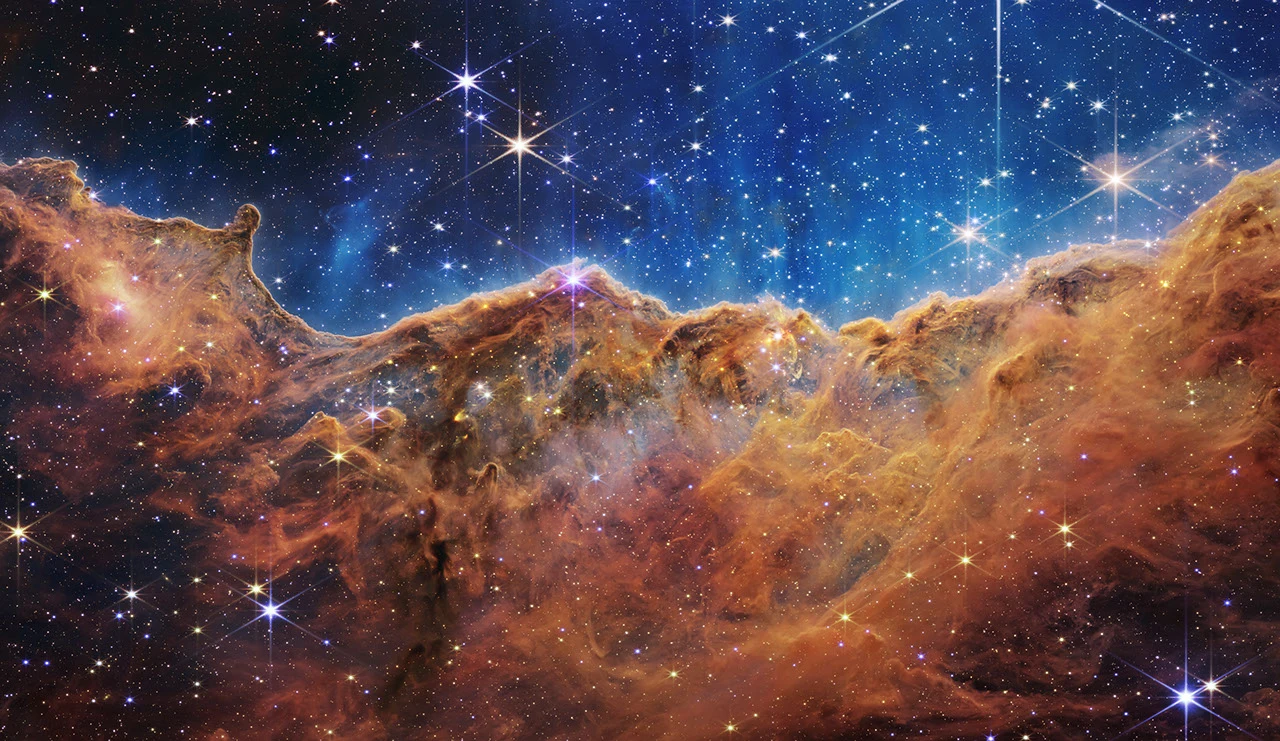
01 / 100 · Where stars are born
Cosmic Cliffs
James Webb · NIRCam
The golden ridges are the edge of a star-forming region called NGC 3324 in the Carina Nebula. Webb’s infrared vision reveals young stars behind the dust, while radiation and winds from nearby hot stars carve the cloud’s dramatic boundary.
A reflection on God’s handiwork
Across this luminous landscape, we are invited to see God’s handiwork in the unfolding beauty of creation—vast, intricate, and filled with possibility.
Image credit: NASA, ESA, CSA, STScI
Image story & original downloads ↗Back to gallery navigation ↑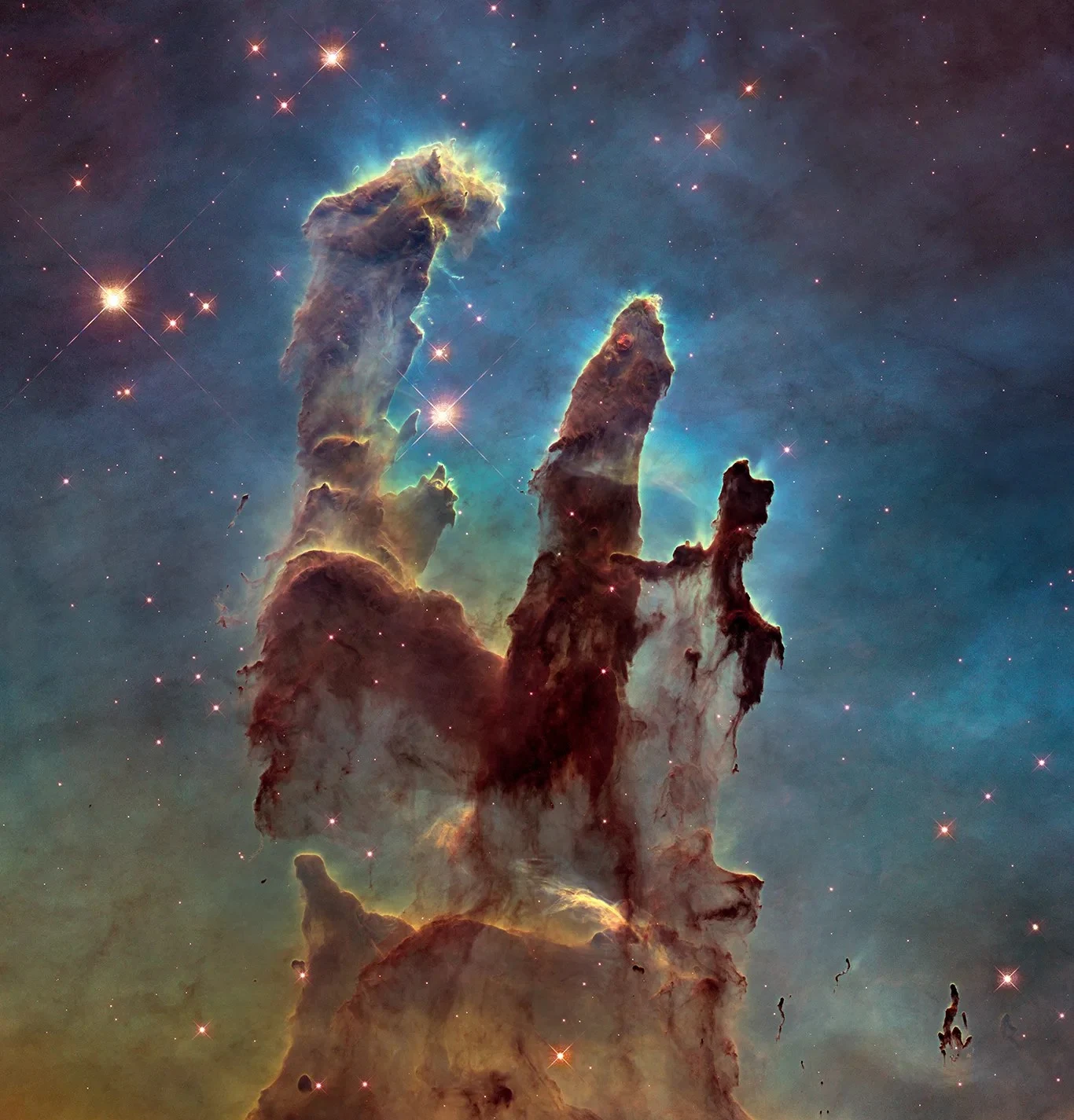 View larger ↗
02 / 100 · Where stars are born
Pillars of Creation — Hubble
Hubble · visible light
These towering columns of gas and dust belong to the Eagle Nebula, a region where stars are forming. Hubble reveals their sculpted surfaces as radiation from nearby young stars illuminates and erodes the clouds. Compare these pillars with Webb’s infrared view below.
A reflection on God’s handiwork
Like cathedral columns lifted into the heavens, these forms invite reverence for the Creator whose handiwork reaches far beyond our familiar world.
Image credit: NASA, ESA and the Hubble Heritage Team (STScI/AURA)
Image story & original downloads ↗Back to gallery navigation ↑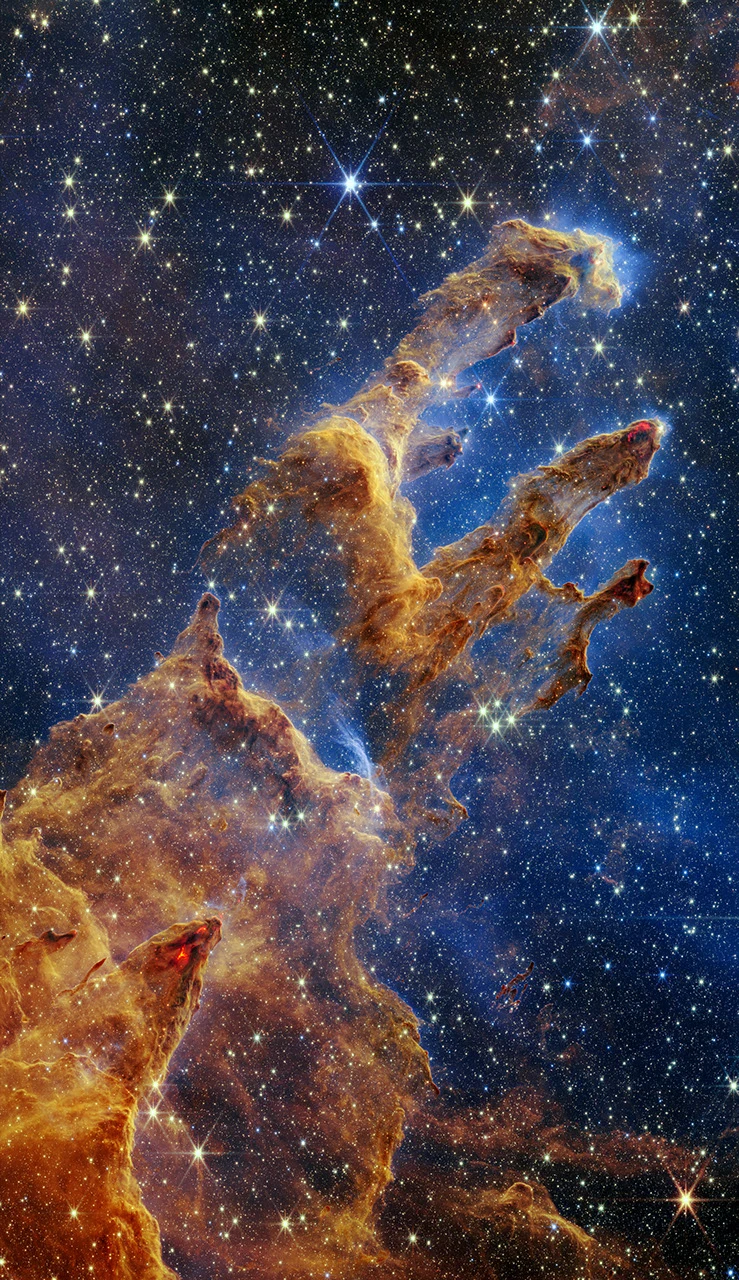 View larger ↗
03 / 100 · Where stars are born
Pillars of Creation — Webb
James Webb · NIRCam
Webb sees the same celebrated pillars in near-infrared light. Many stars that are concealed in visible-light views become apparent, and the clouds appear more translucent. Red features near some pillar tips trace energetic activity associated with young stars.
A reflection on God’s handiwork
A new way of seeing reveals beauty that was already there. This view invites reflection on the wonders of God’s creation that remain beyond our unaided sight.
Image credit: NASA, ESA, CSA, STScI; image processing: Joseph DePasquale, Anton Koekemoer, Alyssa Pagan (STScI)
Image story & original downloads ↗Back to gallery navigation ↑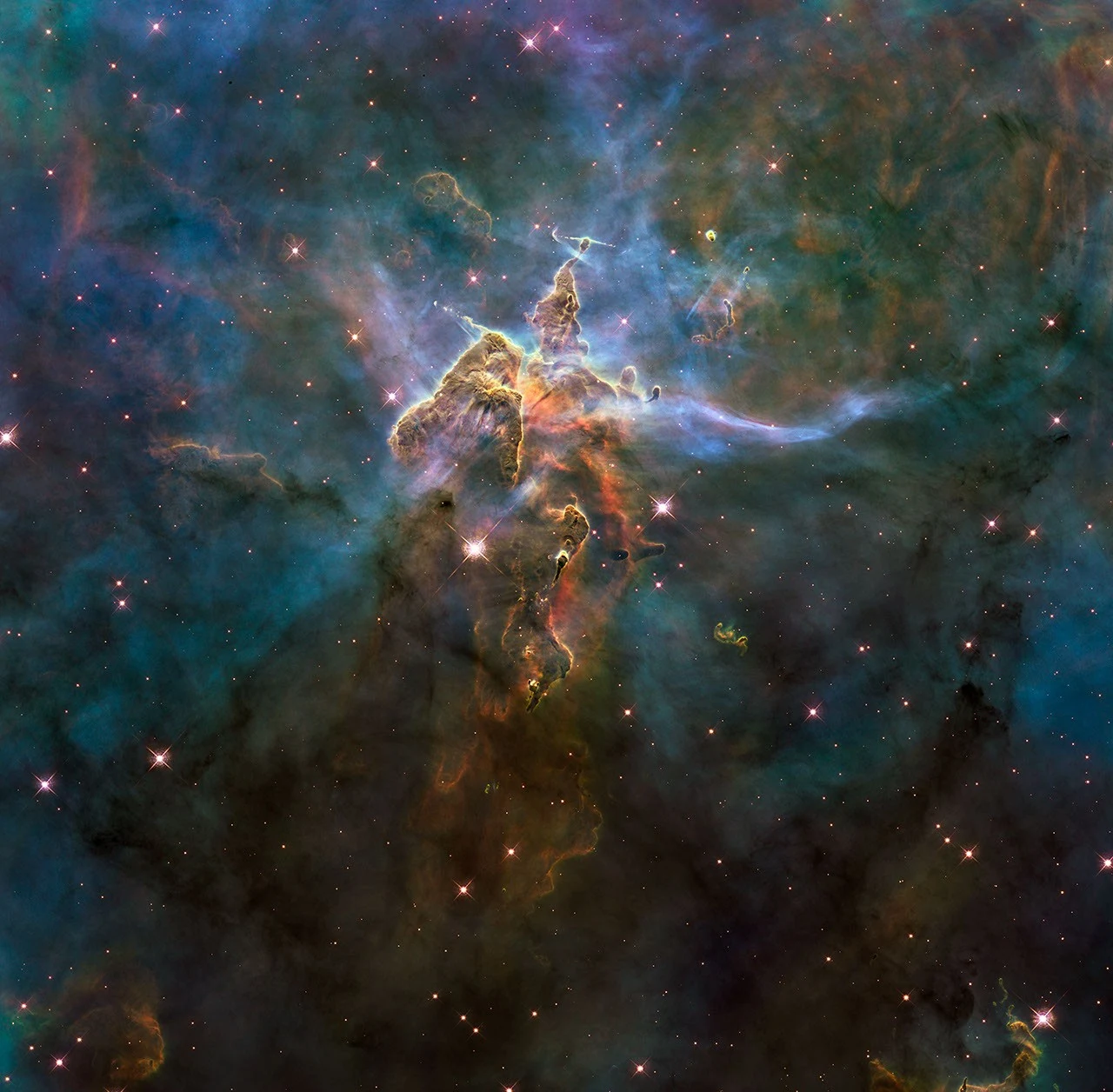 View larger ↗
04 / 100 · Where stars are born
Mystic Mountain
Hubble · WFC3
In the Carina Nebula, a dramatic pillar of gas and dust rises roughly three light-years. Light and winds from nearby stars sculpt its exterior, while stars forming inside send out jets. Its mountain-like shape is a cloud in space, not a solid peak.
A reflection on God’s handiwork
Its soaring form encourages us to pause in wonder. Even in distant clouds, we find patterns and beauty that speak to the heart of God’s abundant creativity.
Image credit: NASA, ESA, Hubble 20th Anniversary Team, Mario Livio (STScI)
Image story & original downloads ↗Back to gallery navigation ↑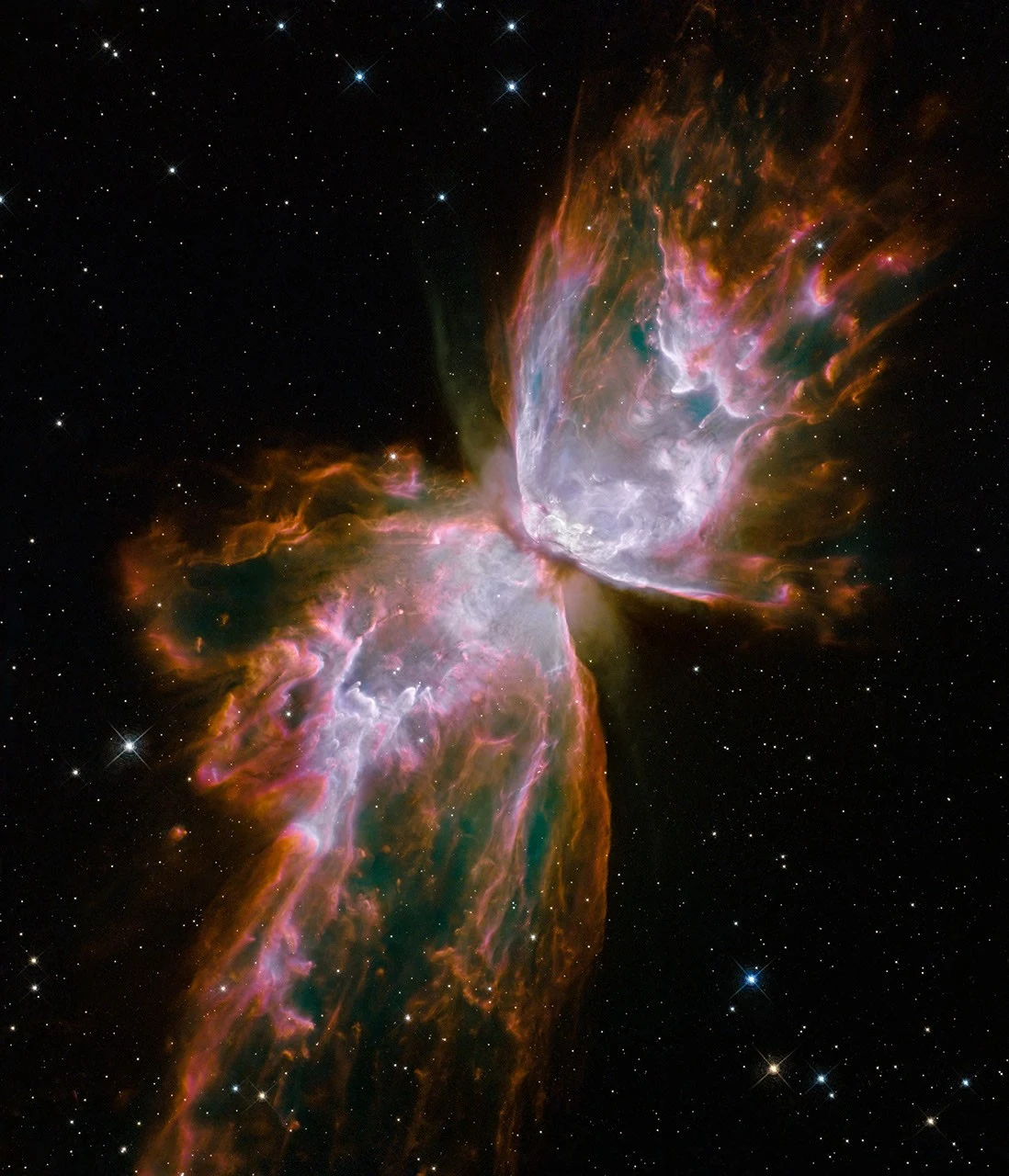 View larger ↗
05 / 100 · The changing lives of stars
The Butterfly Nebula
Hubble · WFC3
NGC 6302 looks like a butterfly, but its wings are expanding gas released by an aging star. A dusty central region hides the intensely hot stellar remnant. Hubble’s observations show structure in the outflow and light emitted by different elements.
A reflection on God’s handiwork
Beauty emerges even through change. The delicate appearance of these powerful outflows invites contemplation of God’s handiwork across the changing seasons of creation.
Image credit: NASA, ESA, and the Hubble SM4 ERO Team
Image story & original downloads ↗Back to gallery navigation ↑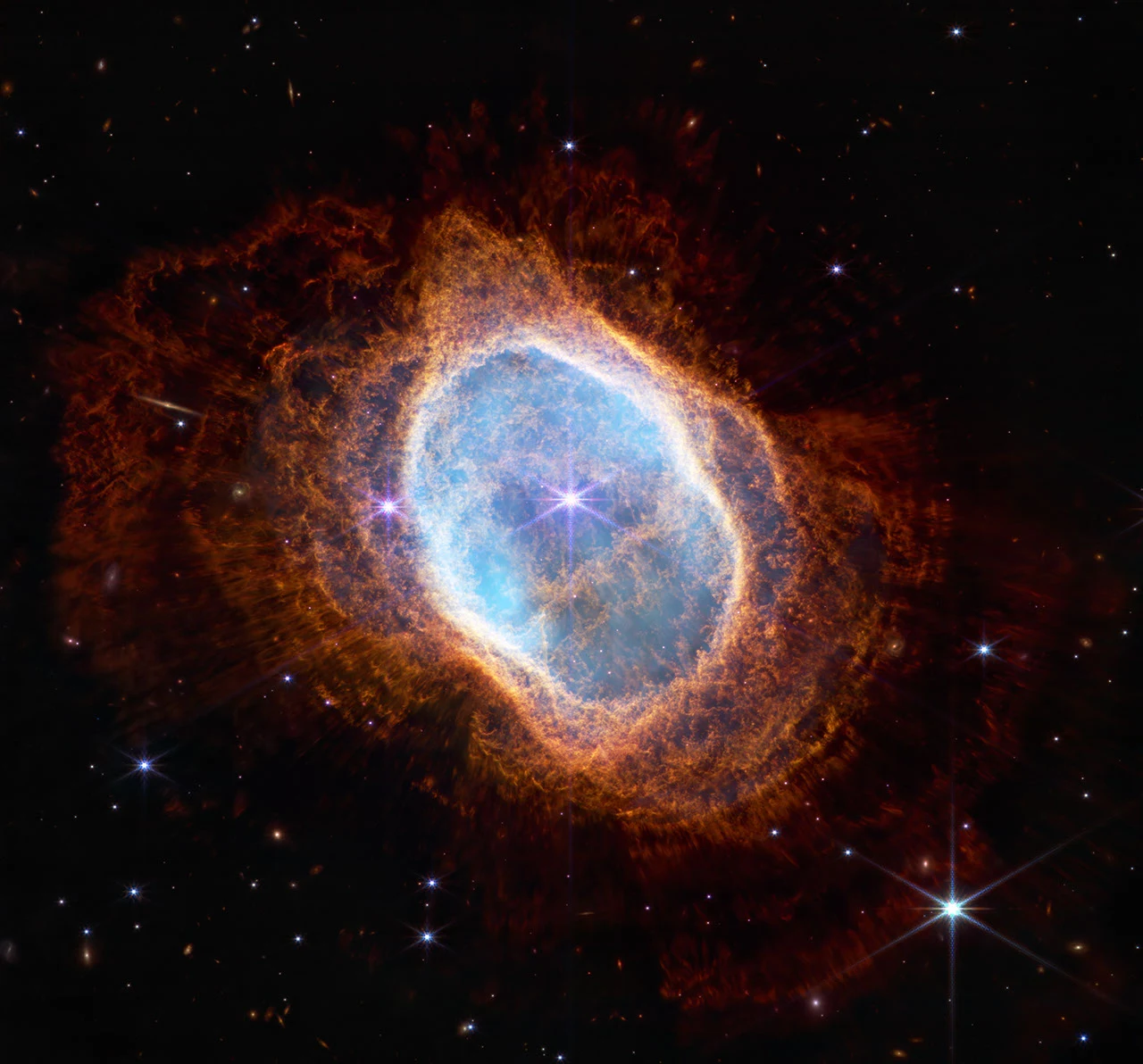 View larger ↗
06 / 100 · The changing lives of stars
The Southern Ring Nebula
James Webb · NIRCam
This near-infrared view of NGC 3132 shows shells of gas and dust shed by a dying star. The glowing interior and rippled outer layers preserve clues to the star’s history and the influence of its stellar companions. Distant galaxies are visible beyond the nebula.
A reflection on God’s handiwork
The rings resemble a jewel suspended in darkness. They invite gratitude for a universe whose beauty extends through beginnings, transformations, and endings.
Image credit: NASA, ESA, CSA, STScI
Image story & original downloads ↗Back to gallery navigation ↑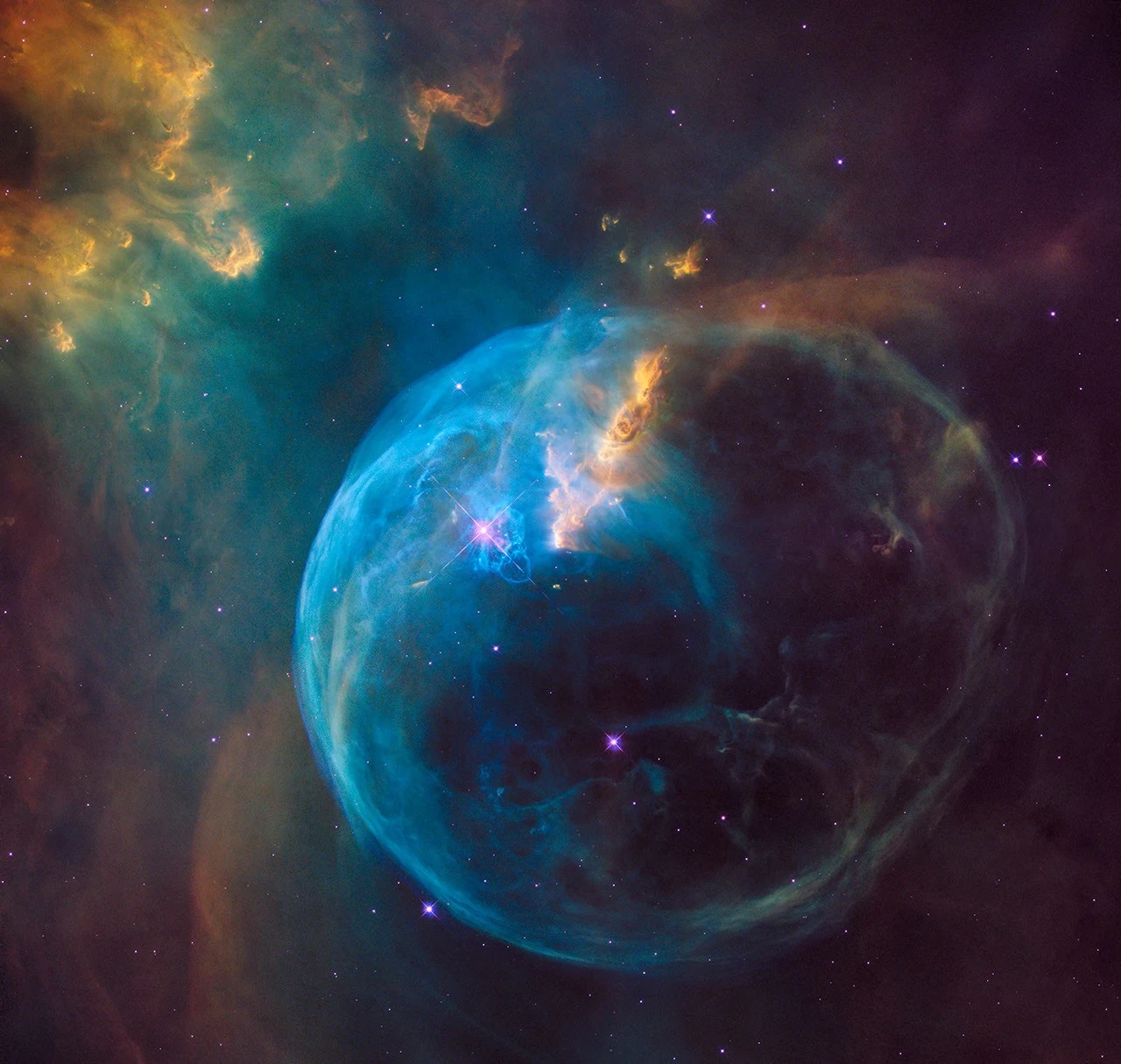 View larger ↗
07 / 100 · The changing lives of stars
The Bubble Nebula
Hubble · WFC3
A hot, massive star drives a strong stellar wind into surrounding material, forming the shell of NGC 7635. The bubble is about seven light-years across. Its rounded form meets a more uneven landscape of glowing gas and dense clouds.
A reflection on God’s handiwork
A seemingly delicate sphere holds a story of immense power. Its form invites reflection on the scale and variety of God’s handiwork throughout the heavens.
Image credit: NASA, ESA, and the Hubble Heritage Team (STScI/AURA)
Image story & original downloads ↗Back to gallery navigation ↑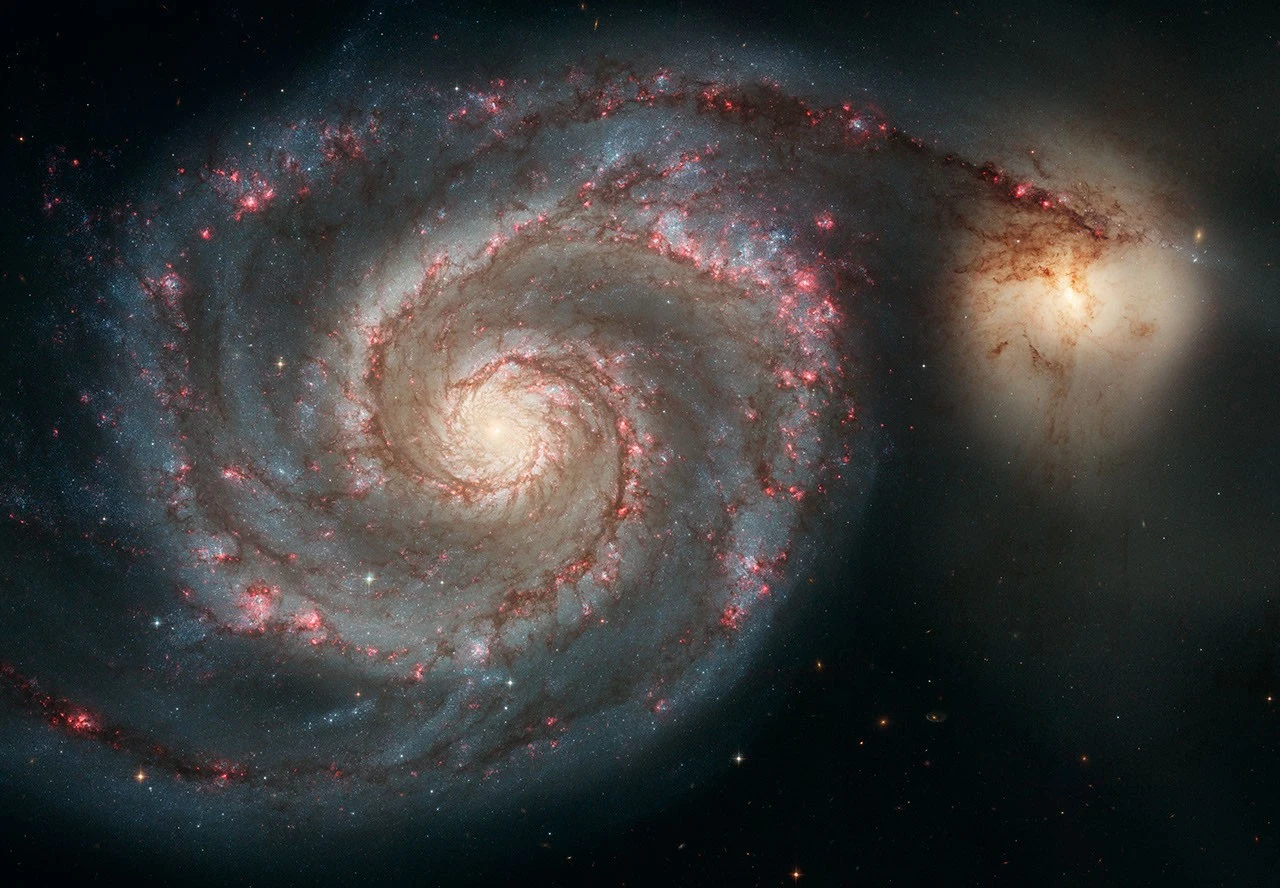 View larger ↗
08 / 100 · Galaxies beyond our own
The Whirlpool Galaxy
Hubble · ACS
The face-on spiral galaxy M51 displays sweeping arms, dark dust lanes, and pink regions of star formation. Its bright companion appears nearby. This Hubble view lets us compare the younger stars along the arms with the warmer-toned central region.
A reflection on God’s handiwork
Its graceful spiral draws the eye outward, inviting us to contemplate the beauty of God’s handiwork on a scale far larger than our own galaxy’s neighborhood.
Image credit: NASA, ESA, S. Beckwith (STScI), and The Hubble Heritage Team (STScI/AURA)
Image story & original downloads ↗Back to gallery navigation ↑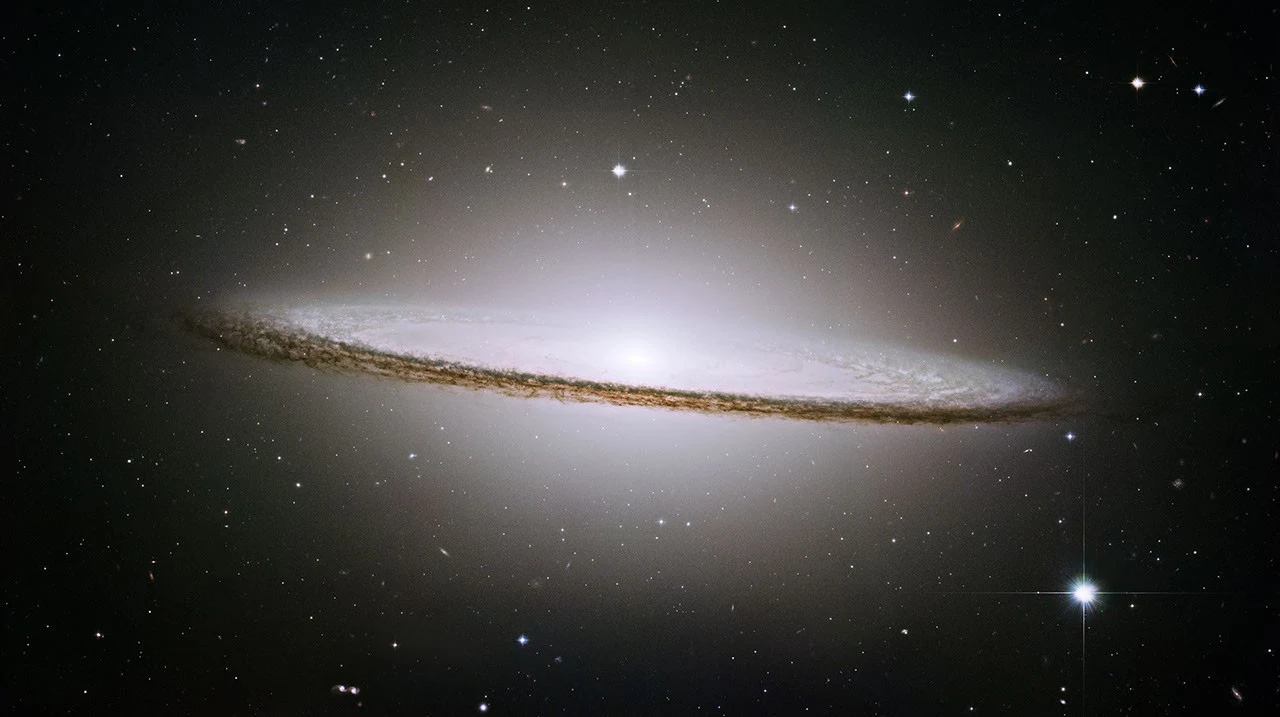 View larger ↗
09 / 100 · Galaxies beyond our own
The Sombrero Galaxy — Hubble
Hubble · ACS
Seen nearly edge-on, the Sombrero Galaxy, M104, has a bright central bulge and a dark band of dust. Its tilted disk creates the familiar hat-like silhouette. Hubble’s view emphasizes the contrast between glowing starlight and the dust crossing in front of it.
A reflection on God’s handiwork
Light and shadow give this distant galaxy its striking form. We are invited to discover beauty in contrast, and to marvel at creation’s extraordinary variety.
Image credit: NASA and The Hubble Heritage Team (STScI/AURA)
Image story & original downloads ↗Back to gallery navigation ↑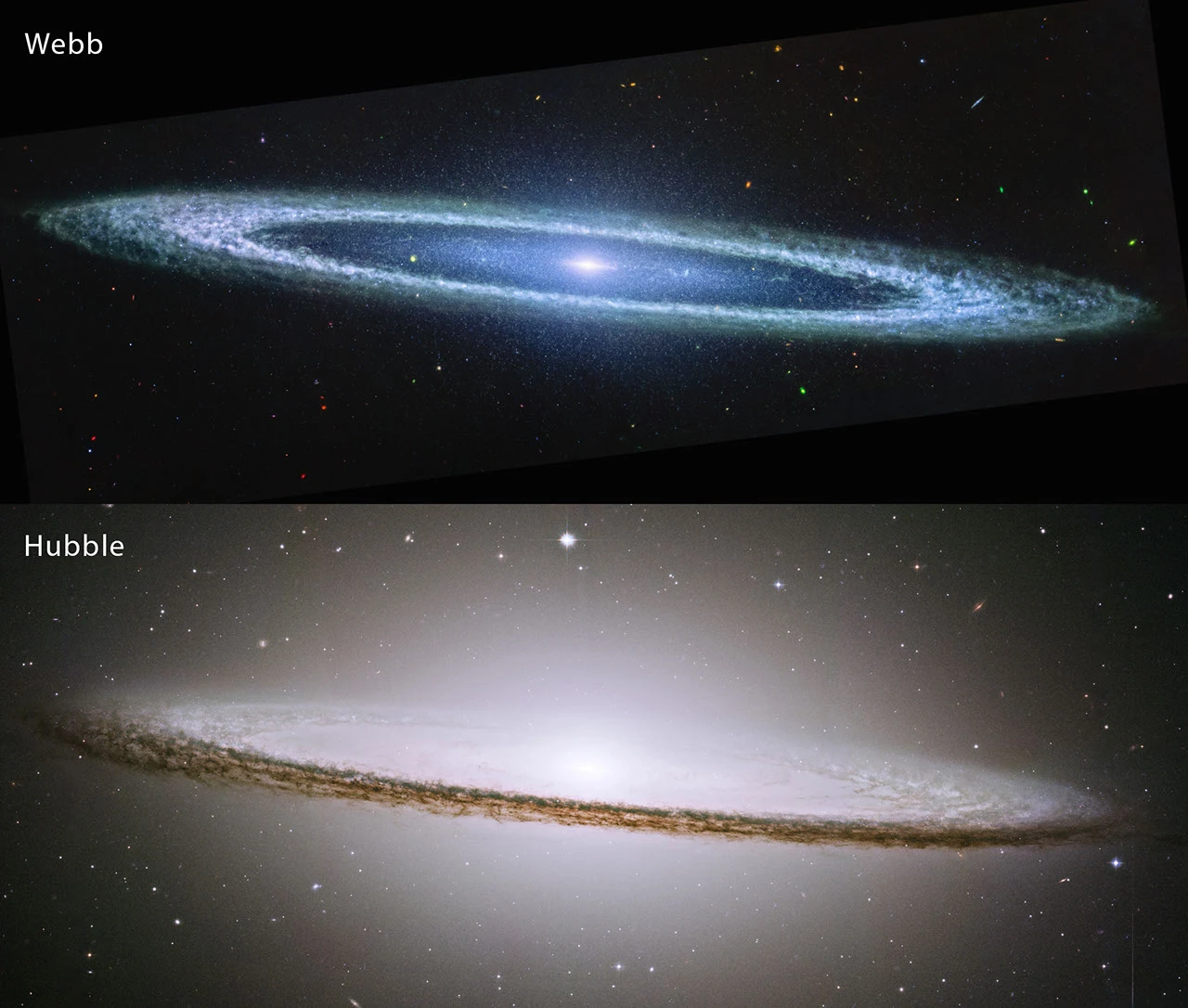 View larger ↗
10 / 100 · Galaxies beyond our own
One Galaxy, Two Views
James Webb · MIRI / Hubble · visible light
NASA’s comparison places Webb’s mid-infrared Sombrero view above Hubble’s visible-light view. Webb brings the dusty outer ring into prominence, while Hubble emphasizes the bright central bulge. Both images show the same galaxy through different wavelengths of light.
A reflection on God’s handiwork
Different windows reveal different wonders. Together, these views invite humility and curiosity as we explore the depth and richness of God’s creation.
Image credit: NASA, ESA, CSA, STScI, Hubble Heritage Project
Image story & original downloads ↗Back to gallery navigation ↑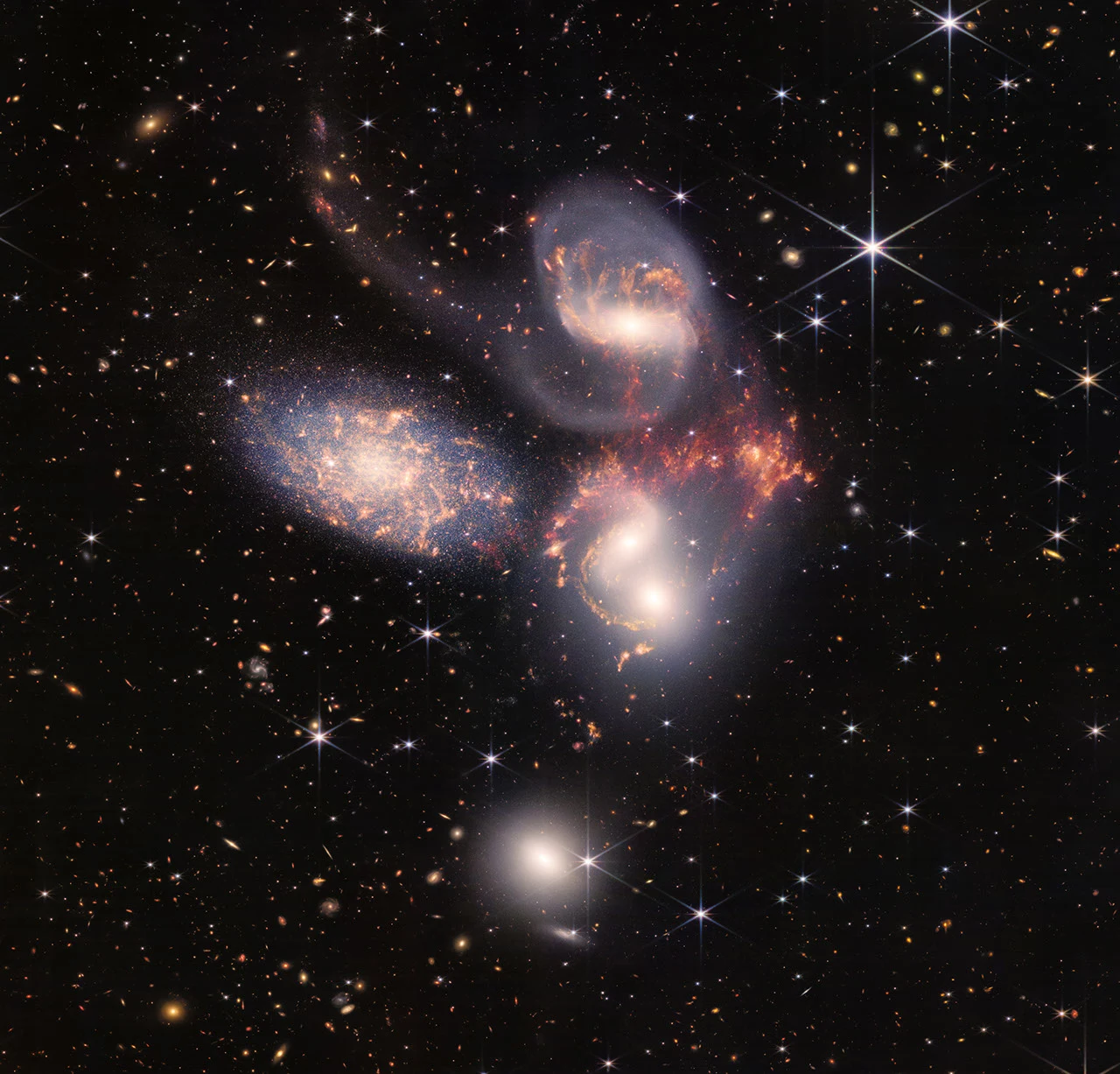 View larger ↗
11 / 100 · Galaxies beyond our own
Stephan’s Quintet
James Webb · NIRCam + MIRI
Five prominent galaxies share this field, but only four form a closely interacting group; the fifth lies nearer to us. Webb reveals sweeping structures, star-forming regions, and background galaxies. Gravity shapes the encounter across distances that dwarf our everyday experience.
A reflection on God’s handiwork
This gathering invites us to imagine a universe alive with movement and relationship, and to wonder at God’s handiwork woven through its immense reaches.
Image credit: NASA, ESA, CSA, STScI
Image story & original downloads ↗Back to gallery navigation ↑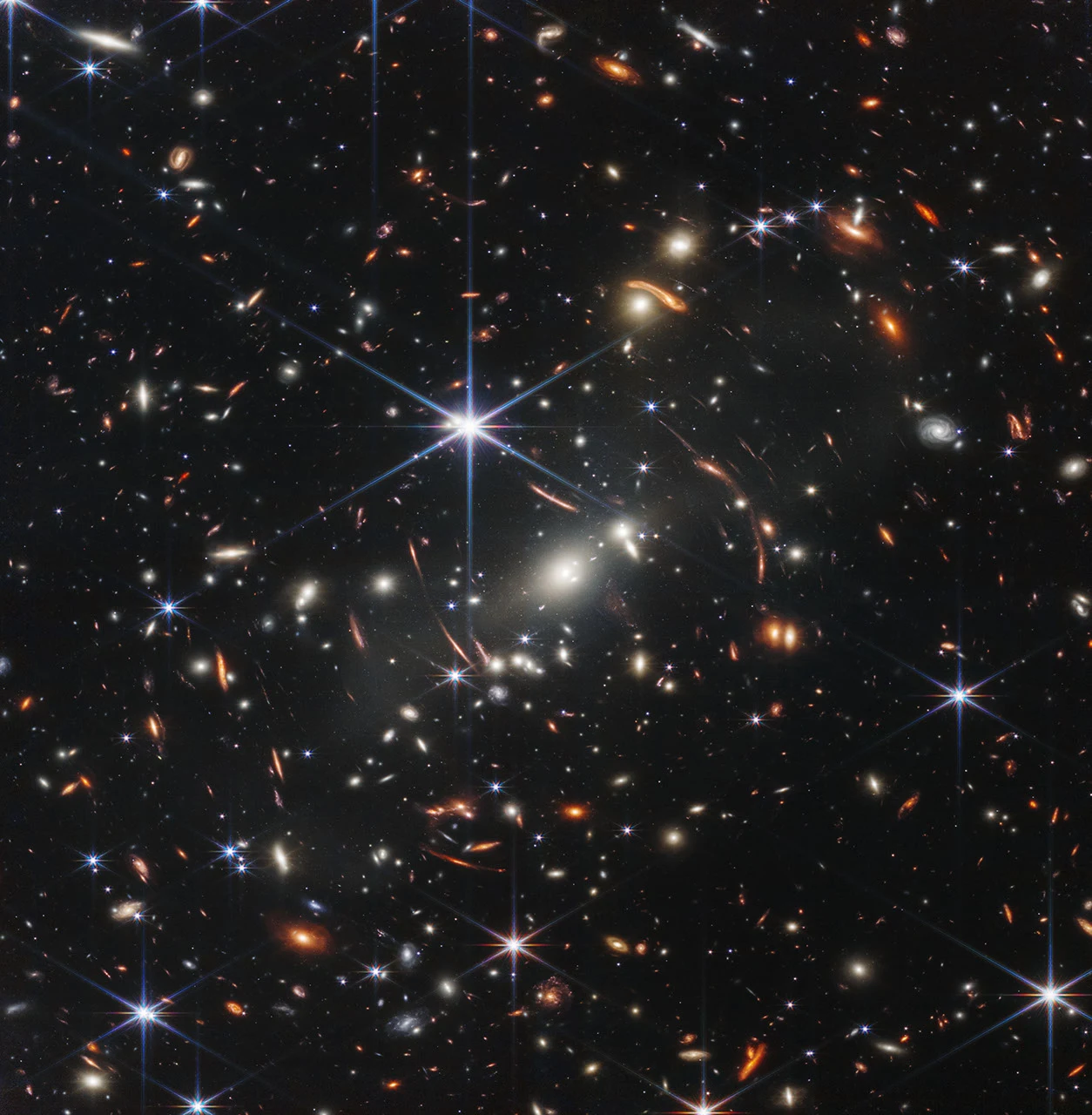 View larger ↗
12 / 100 · A window into immensity
Webb’s First Deep Field
James Webb · NIRCam
Around galaxy cluster SMACS 0723, thousands of distant galaxies fill a small patch of sky. The cluster’s gravity bends and magnifies light from galaxies behind it, producing stretched arcs. Bright spiked points are foreground stars within our own Milky Way.
A reflection on God’s handiwork
What seems a tiny window opens onto immense abundance. We close with awe: the heavens invite us to look beyond ourselves and give thanks for the Creator’s boundless handiwork.
Image credit: NASA, ESA, CSA, STScI
Image story & original downloads ↗Back to gallery navigation ↑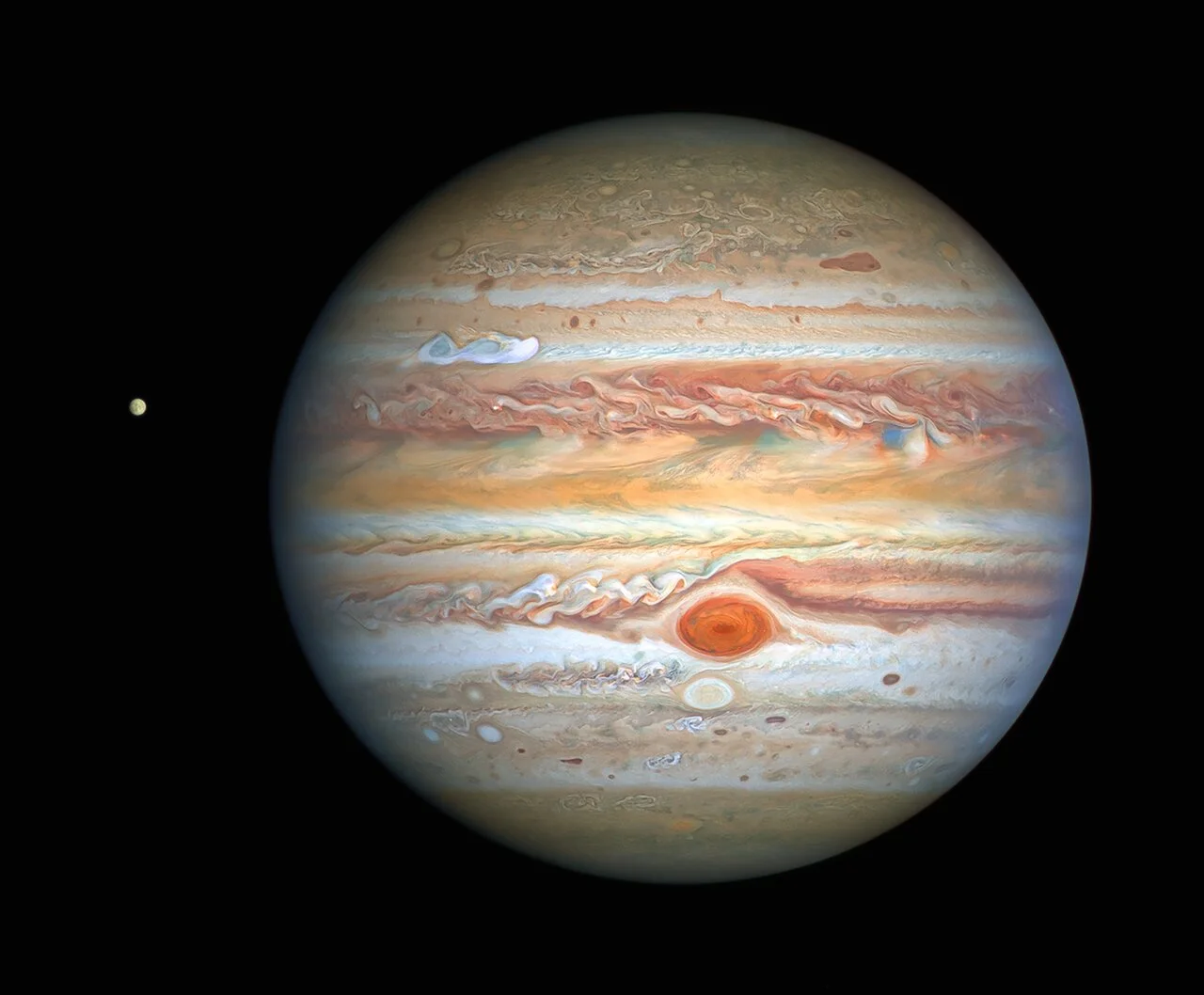 View larger ↗
13 / 100 · Our solar neighborhood
Jupiter and Europa
Hubble Space Telescope
Jupiter’s banded atmosphere and Great Red Spot dominate this 2020 portrait; the small moon Europa appears alongside the giant planet.
A reflection on God’s handiwork
Even our neighboring worlds invite gratitude for creation’s remarkable variety.
Image credit: NASA, ESA, A. Simon (Goddard Space Flight Center), and M. H. Wong (University of California, Berkeley) and the OPAL team.
Image story & original downloads ↗CC BY 4.0 · Image resized and converted for web display; caption adapted from ESA/Hubble.
Back to gallery navigation ↑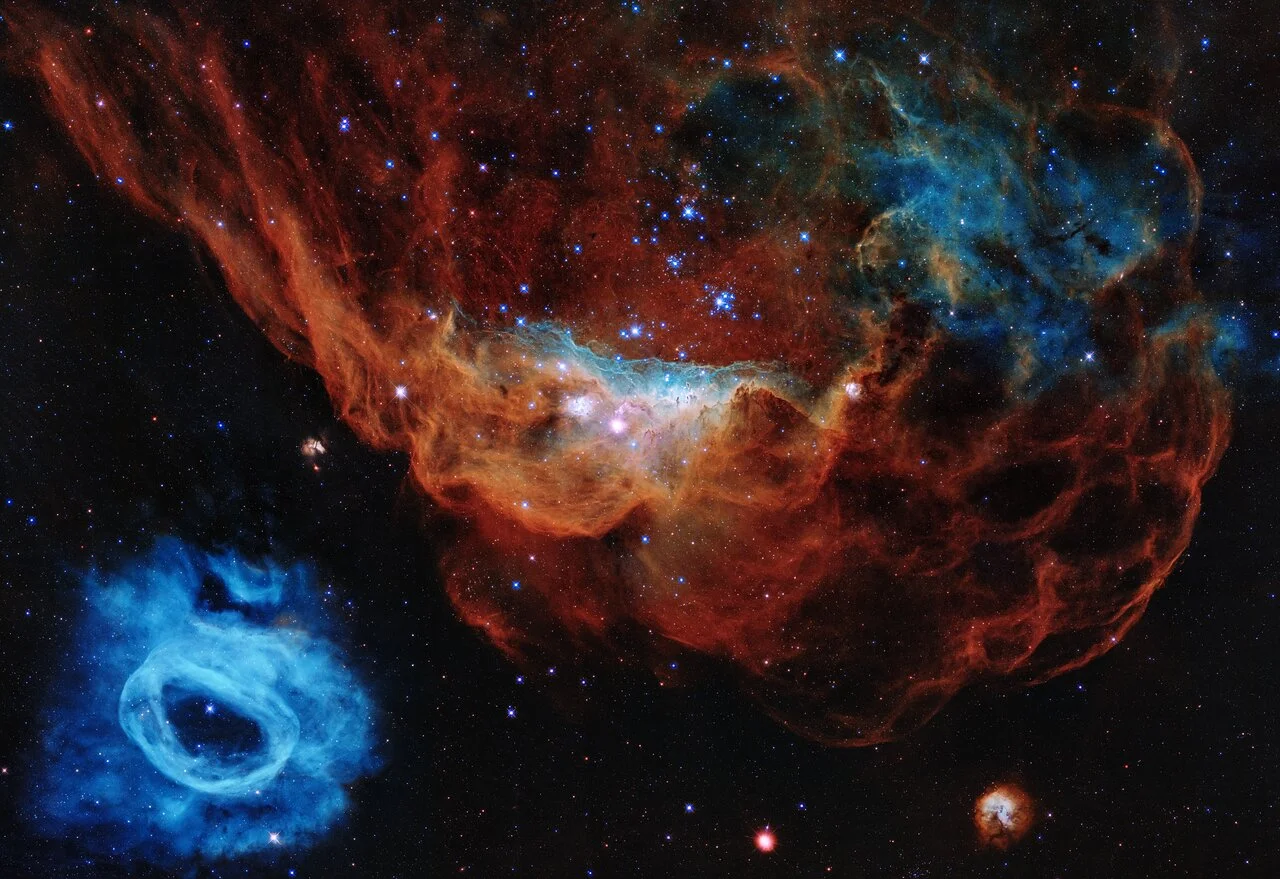 View larger ↗
14 / 100 · Where stars are born
A Tapestry of Starbirth
Hubble Space Telescope
The neighboring nebulae NGC 2014 and NGC 2020 glow within a stellar nursery in the Large Magellanic Cloud.
A reflection on God’s handiwork
These luminous clouds invite us to contemplate the abundance of God’s creativity.
Image credit: NASA, ESA, and STScI
Image story & original downloads ↗CC BY 4.0 · Image resized and converted for web display; caption adapted from ESA/Hubble.
Back to gallery navigation ↑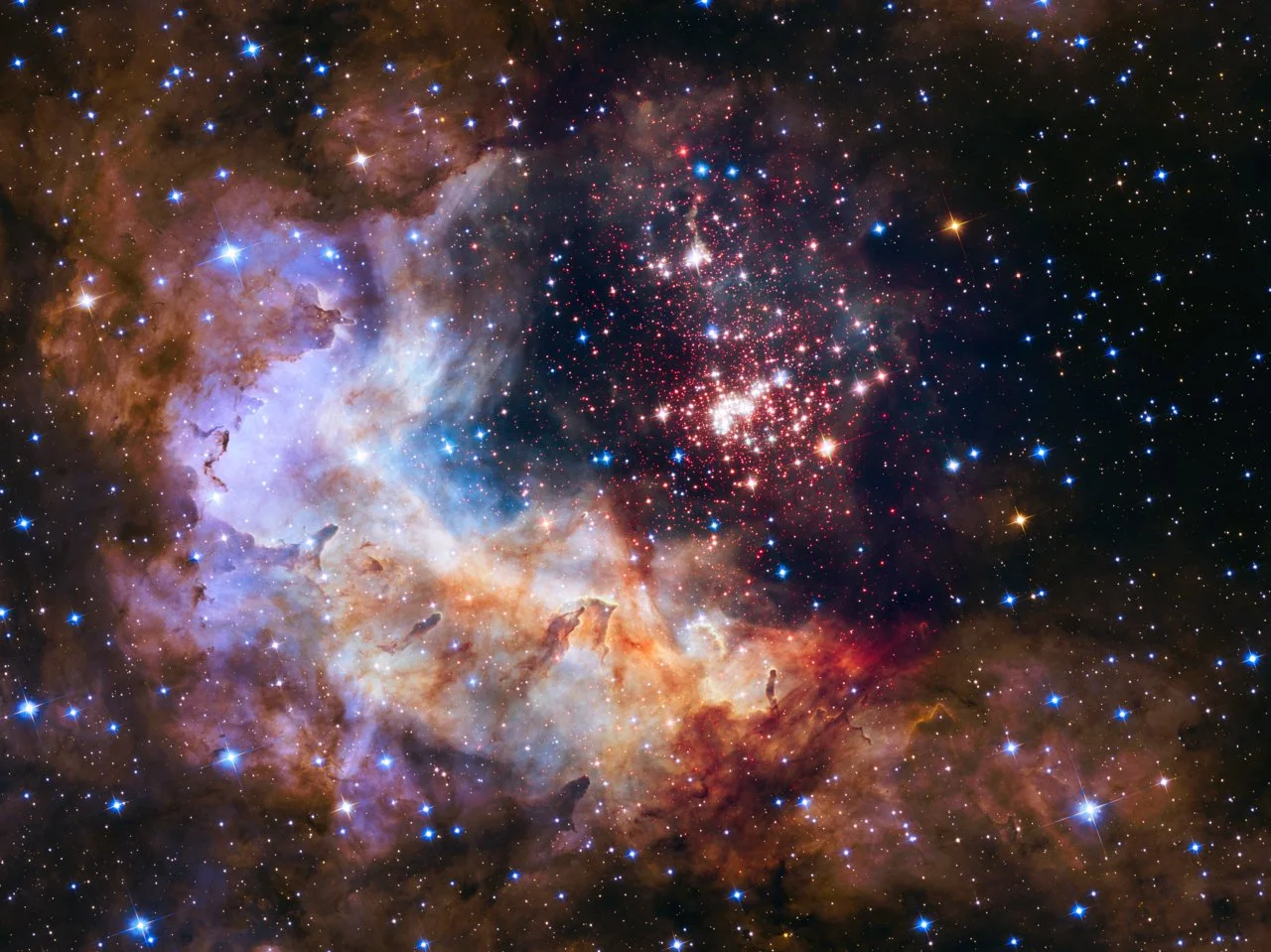 View larger ↗
15 / 100 · Gatherings of stars
The Stars of Westerlund 2
Hubble Space Telescope
A brilliant young cluster shines within its surrounding clouds. This anniversary portrait combines Hubble observations in visible and near-infrared light.
A reflection on God’s handiwork
Many lights share one landscape, a beautiful invitation to consider belonging within creation.
CC BY 4.0 · Image resized and converted for web display; caption adapted from ESA/Hubble.
Back to gallery navigation ↑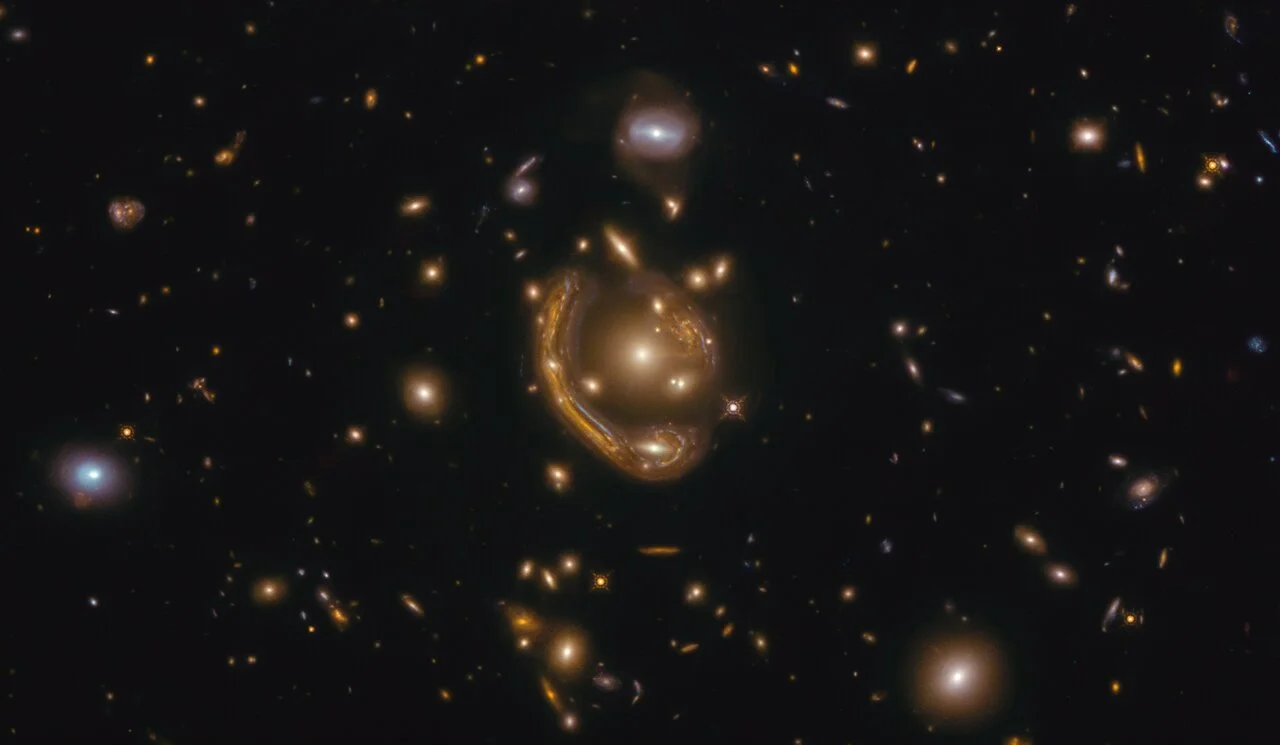 View larger ↗
16 / 100 · A window into immensity
Rings of Relativity
Hubble Space Telescope
Gravity bends light from a background galaxy into a sweeping arc around foreground objects, creating the striking appearance of an Einstein ring.
A reflection on God’s handiwork
The unexpected paths of light remind us how much wonder awaits discovery.
Image credit: ESA/Hubble & NASA, S. Jha Acknowledgement: L. Shatz
Image story & original downloads ↗CC BY 4.0 · Image resized and converted for web display; caption adapted from ESA/Hubble.
Back to gallery navigation ↑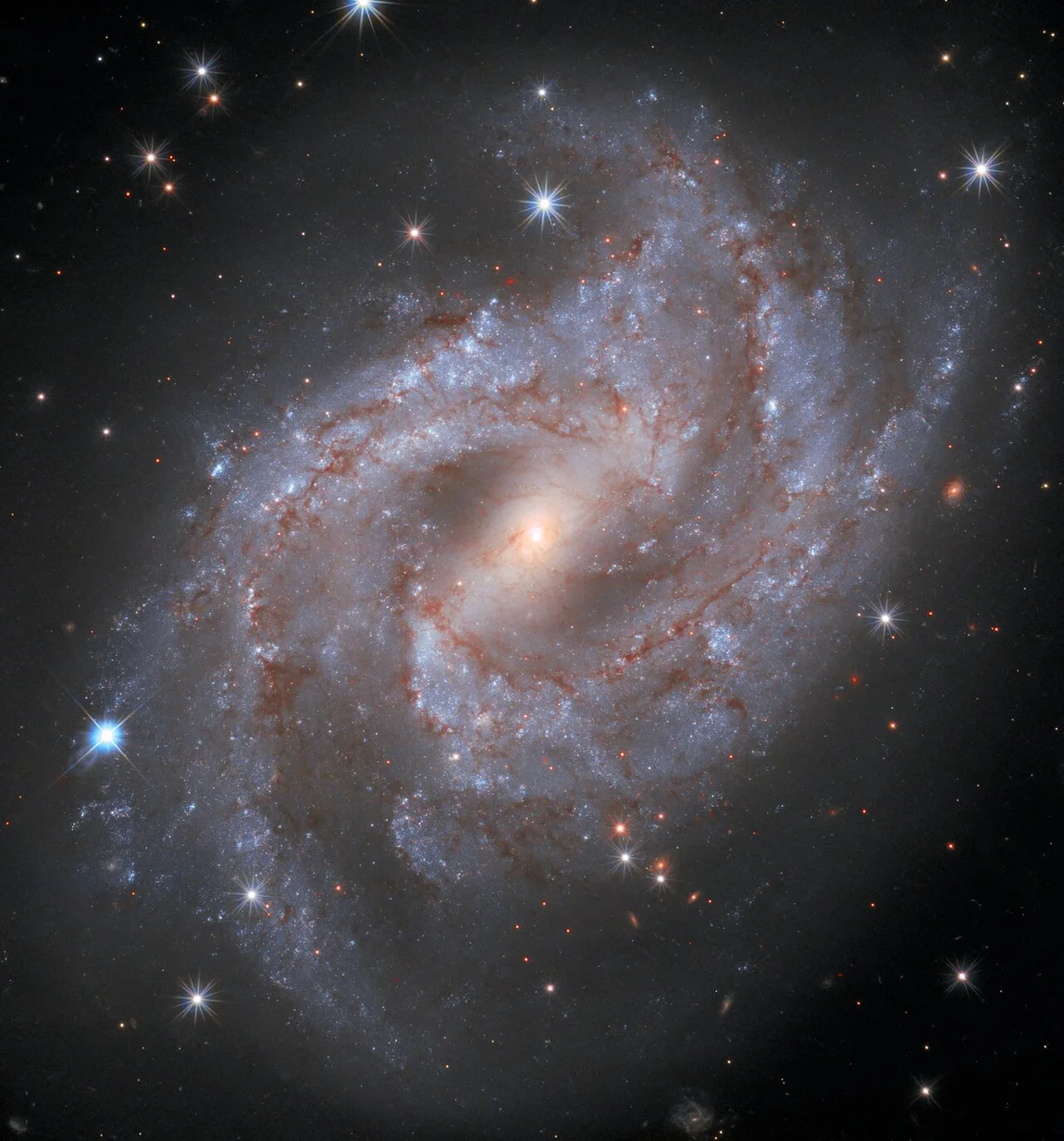 View larger ↗
17 / 100 · Galaxies beyond our own
Spiral Galaxy NGC 2525
Hubble Space Telescope
Hubble captures the spiral structure of NGC 2525, a galaxy in Puppis that also contains a supermassive black hole at its center.
A reflection on God’s handiwork
Beyond familiar skies lie countless forms of beauty worthy of patient attention.
Image credit: ESA/Hubble & NASA, A. Riess and the SH0ES team Acknowledgment: Mahdi Zamani
Image story & original downloads ↗CC BY 4.0 · Image resized and converted for web display; caption adapted from ESA/Hubble.
Back to gallery navigation ↑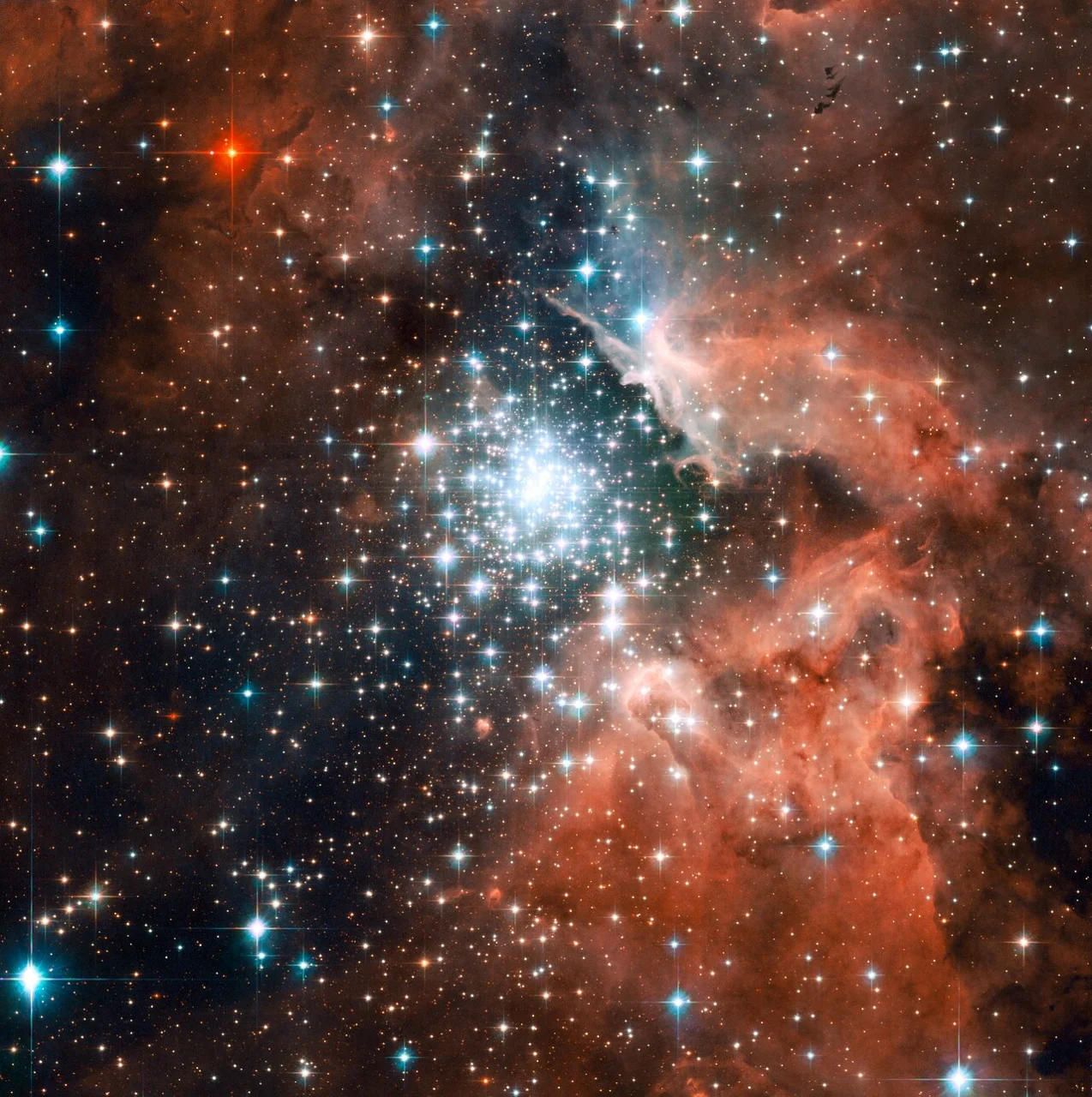 View larger ↗
18 / 100 · Gatherings of stars
The Young Stars of NGC 3603
Hubble Space Telescope
Massive blue stars illuminate this crowded young cluster. Their energy is clearing a cavity in the surrounding gas and dust.
A reflection on God’s handiwork
The radiance of new stars offers an image through which to contemplate beginnings.
Image credit: NASA, ESA and the Hubble Heritage (STScI/AURA)-ESA/Hubble Collaboration
Image story & original downloads ↗CC BY 4.0 · Image resized and converted for web display; caption adapted from ESA/Hubble.
Back to gallery navigation ↑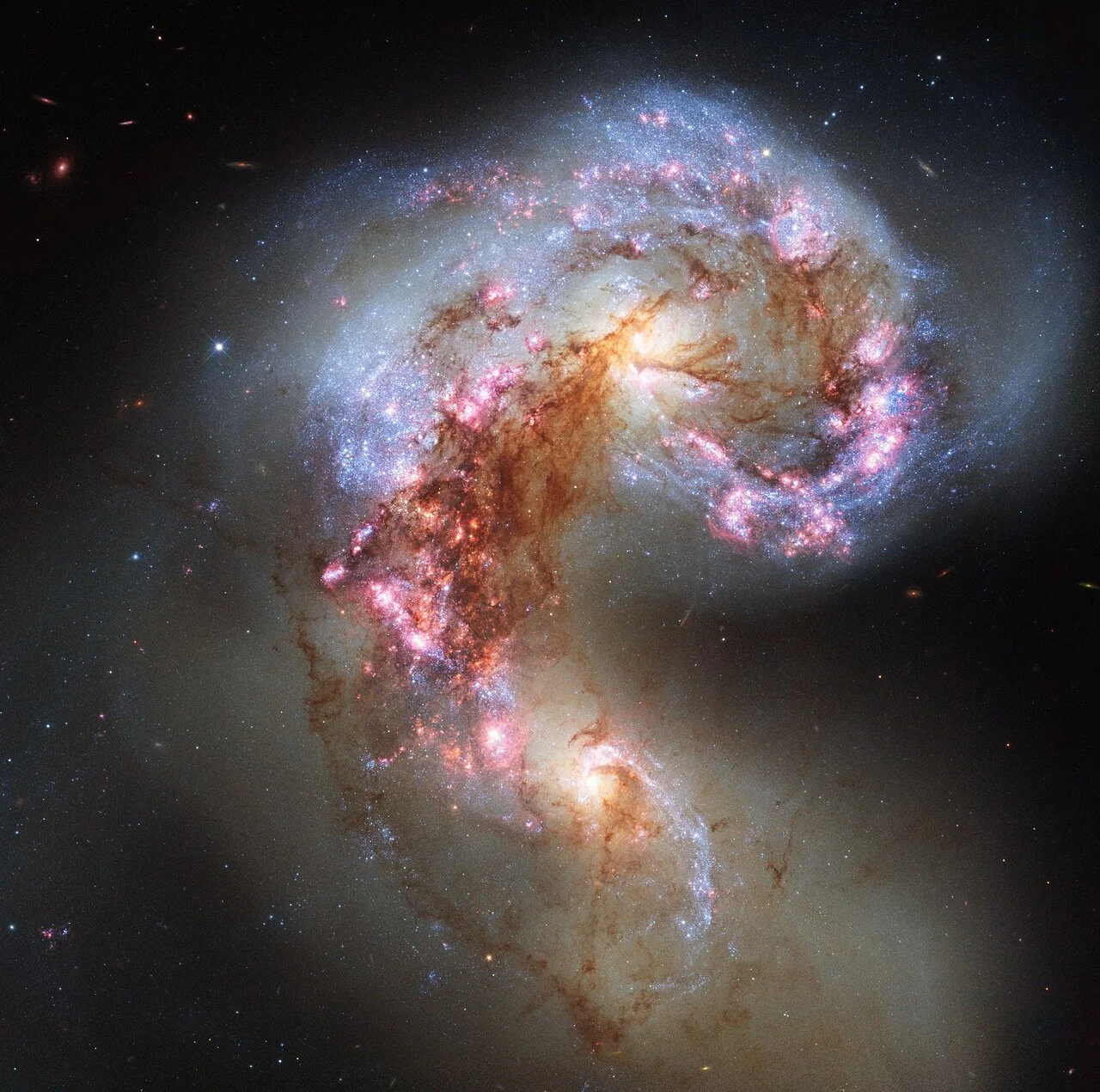 View larger ↗
19 / 100 · Galaxies beyond our own
The Antennae Galaxies
Hubble Space Telescope
NGC 4038 and NGC 4039 are interacting galaxies whose encounter has reshaped their structures and encouraged vigorous star formation.
A reflection on God’s handiwork
Even a turbulent encounter can invite reflection on beauty emerging through change.
Image credit: ESA/Hubble & NASA
Image story & original downloads ↗CC BY 4.0 · Image resized and converted for web display; caption adapted from ESA/Hubble.
Back to gallery navigation ↑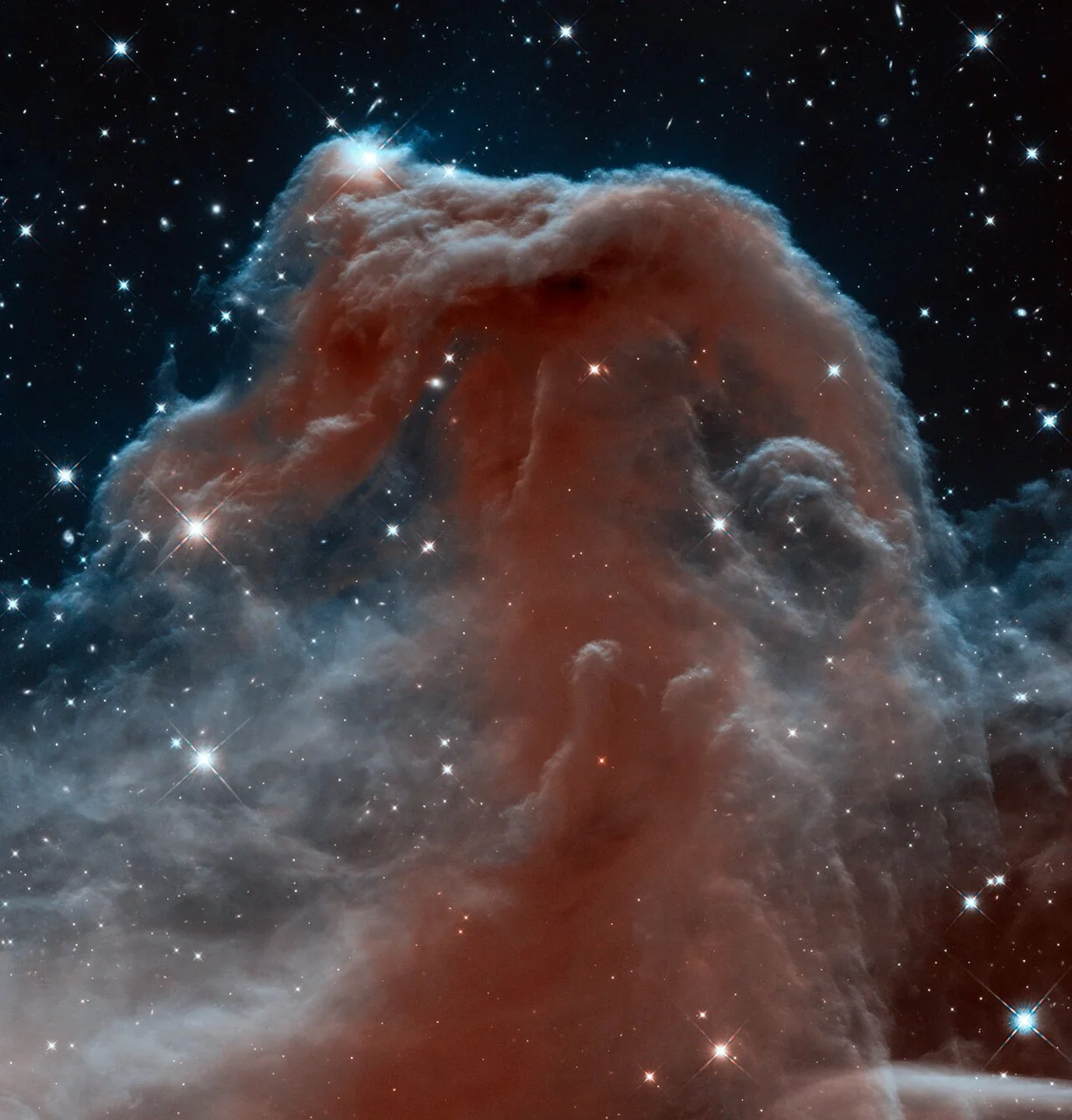 View larger ↗
20 / 100 · Where stars are born
The Horsehead in Infrared
Hubble Space Telescope
Infrared observations reveal delicate structure in the Horsehead Nebula, a dense cloud in Orion whose familiar silhouette changes with wavelength.
A reflection on God’s handiwork
Another way of seeing can reveal grace in a familiar shape.
Image credit: NASA, ESA, and the Hubble Heritage Team ( AURA / STScI )
Image story & original downloads ↗CC BY 4.0 · Image resized and converted for web display; caption adapted from ESA/Hubble.
Back to gallery navigation ↑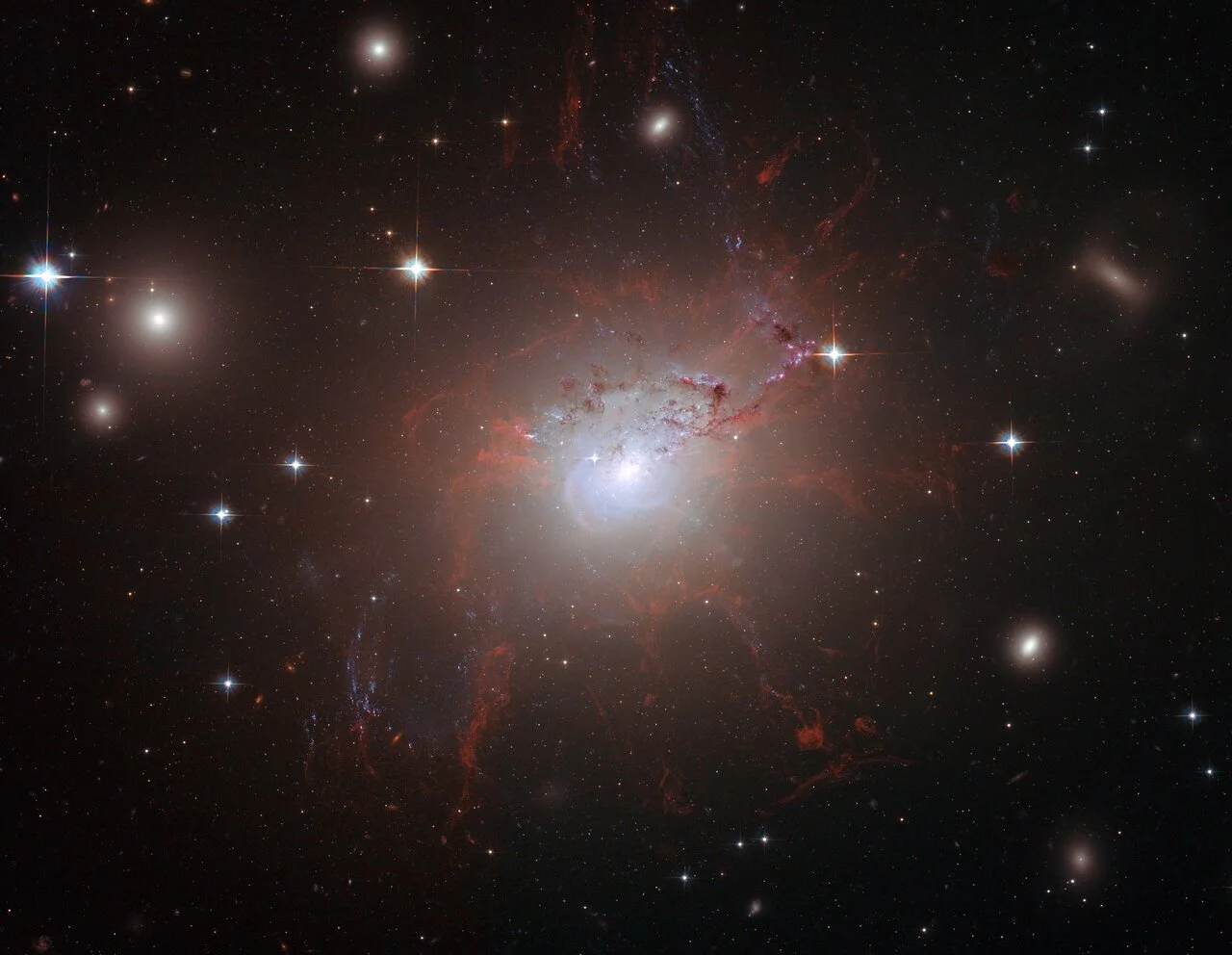 View larger ↗
21 / 100 · Galaxies beyond our own
The Filaments of NGC 1275
Hubble Space Telescope
Fine reddish strands surround NGC 1275. Magnetic fields help preserve these relatively cool filaments within the galaxy’s much hotter surroundings.
A reflection on God’s handiwork
These slender threads invite wonder at the unseen forces shaping visible beauty.
Image credit: NASA , ESA and Andy Fabian (University of Cambridge, UK)
Image story & original downloads ↗CC BY 4.0 · Image resized and converted for web display; caption adapted from ESA/Hubble.
Back to gallery navigation ↑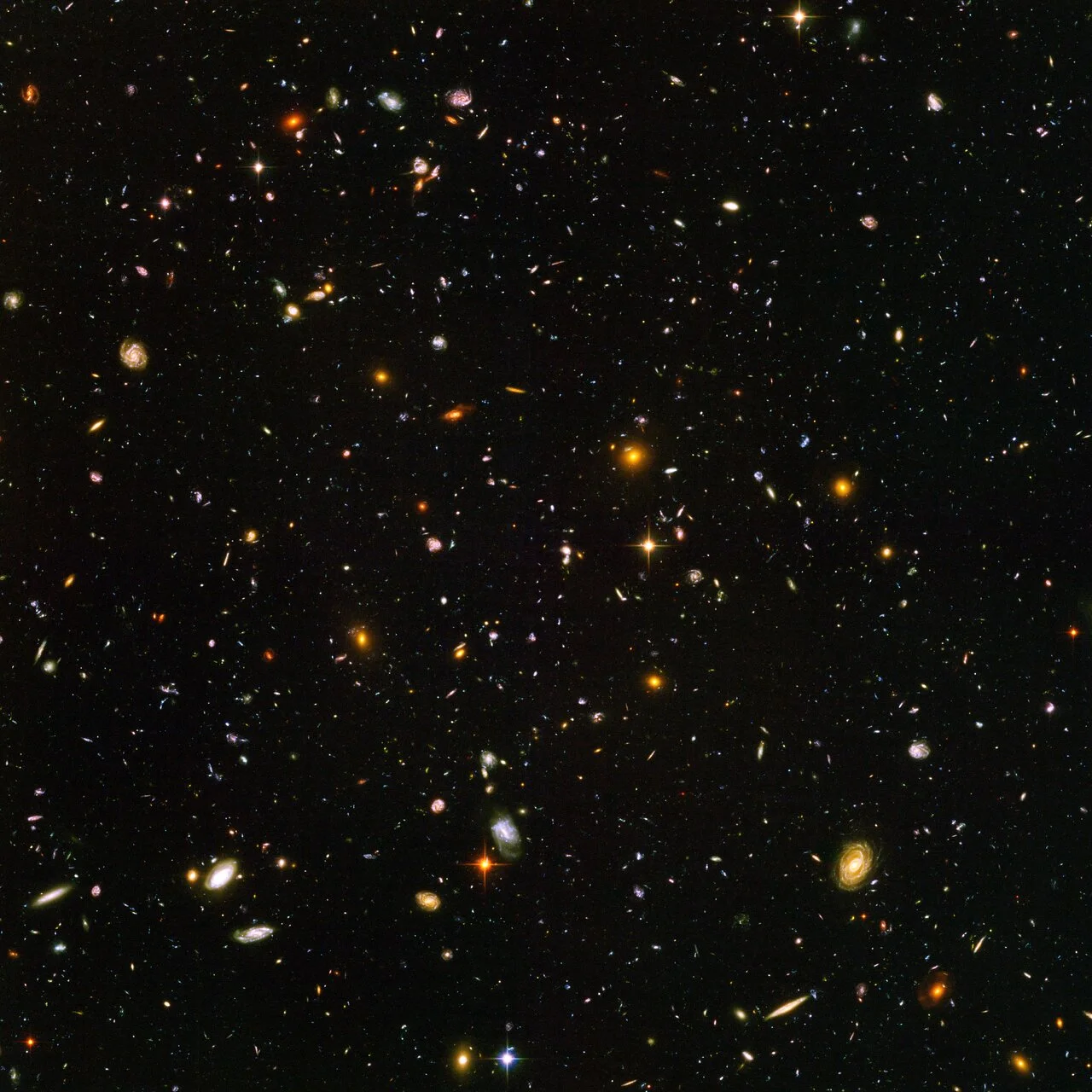 View larger ↗
22 / 100 · A window into immensity
The Hubble Ultra Deep Field
Hubble Space Telescope
Thousands of galaxies populate this deep view, offering a glimpse of many shapes, colors, and stages in the universe’s history.
A reflection on God’s handiwork
A small patch of sky becomes an invitation to humility before creation’s immensity.
Image credit: NASA , ESA , and S. Beckwith ( STScI ) and the HUDF Team
Image story & original downloads ↗CC BY 4.0 · Image resized and converted for web display; caption adapted from ESA/Hubble.
Back to gallery navigation ↑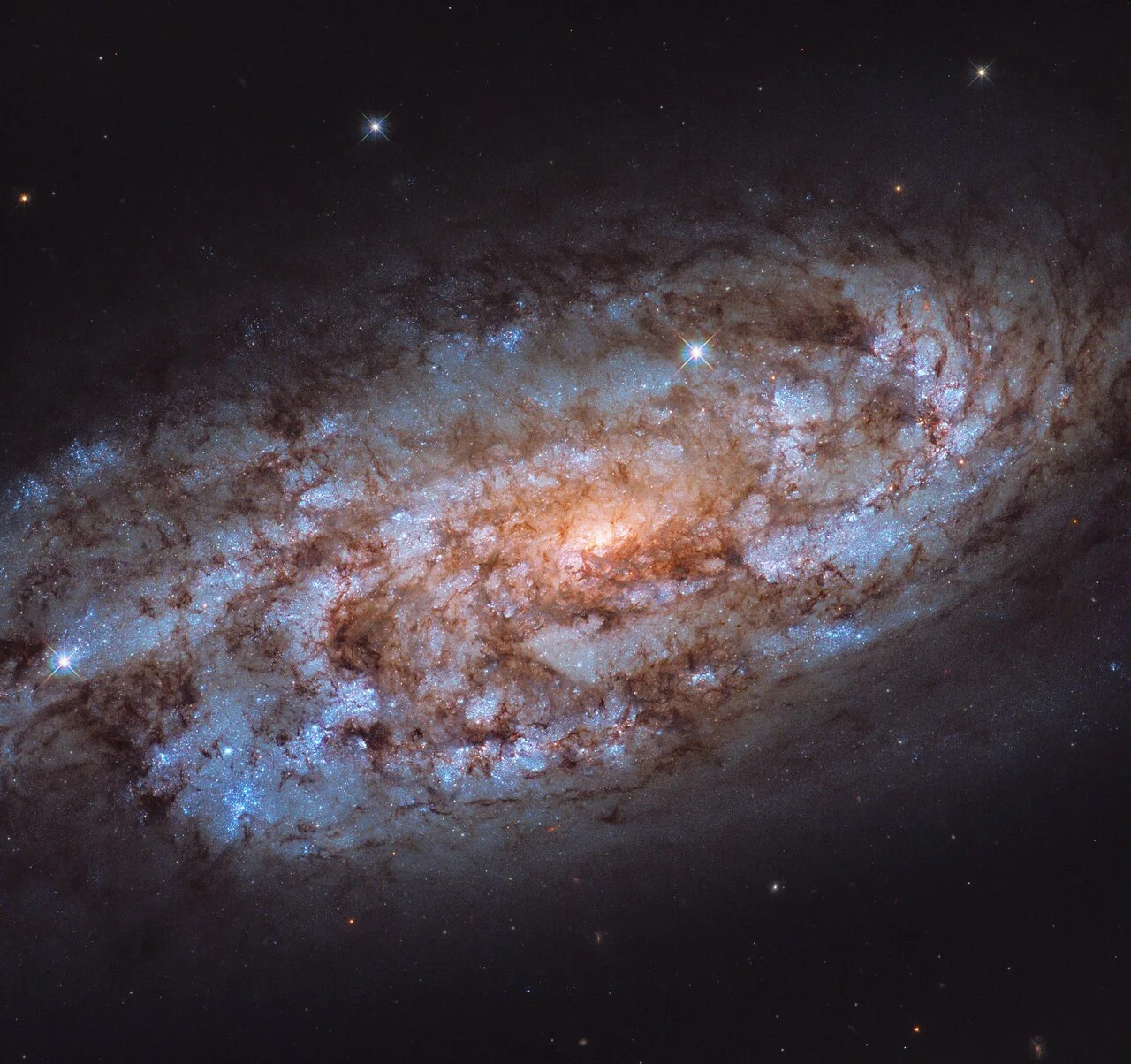 View larger ↗
23 / 100 · Where stars are born
The Stellar Forge: NGC 1792
Hubble Space Telescope
Blue regions trace young, hot stars in NGC 1792, while warmer central tones reveal a population of older, cooler stars.
A reflection on God’s handiwork
Different generations of light share one galaxy, inviting reflection on continuity and renewal.
Image credit: ESA/Hubble & NASA, J. Lee Acknowledgement: Leo Shatz
Image story & original downloads ↗CC BY 4.0 · Image resized and converted for web display; caption adapted from ESA/Hubble.
Back to gallery navigation ↑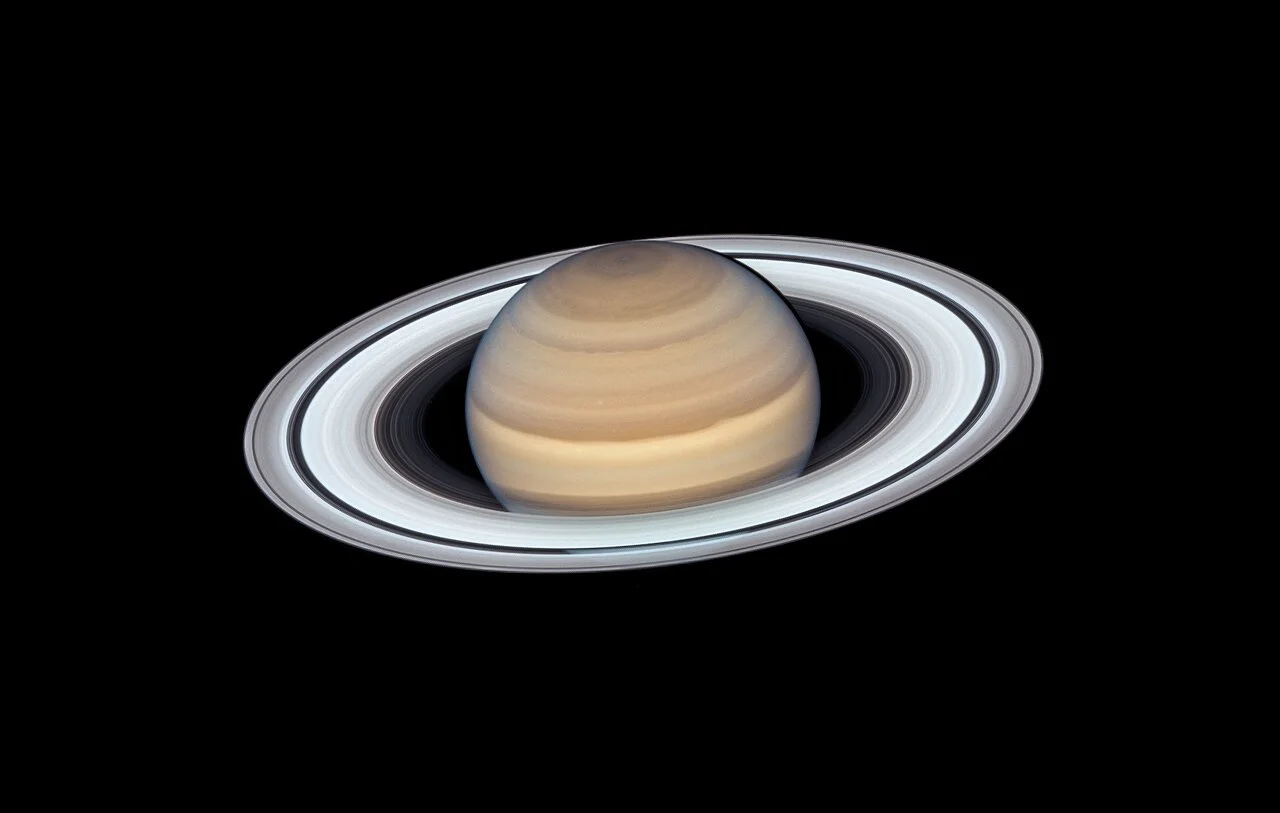 View larger ↗
24 / 100 · Our solar neighborhood
Saturn in 2019
Hubble Space Telescope
Hubble’s 2019 portrait displays Saturn’s broad ring system and subtle atmospheric bands during a close approach relative to Earth.
A reflection on God’s handiwork
The elegance of these rings encourages quiet appreciation of God’s handiwork nearby.
Image credit: NASA, ESA, A. Simon (Goddard Space Flight Center), and M.H. Wong (University of California, Berkeley)
Image story & original downloads ↗CC BY 4.0 · Image resized and converted for web display; caption adapted from ESA/Hubble.
Back to gallery navigation ↑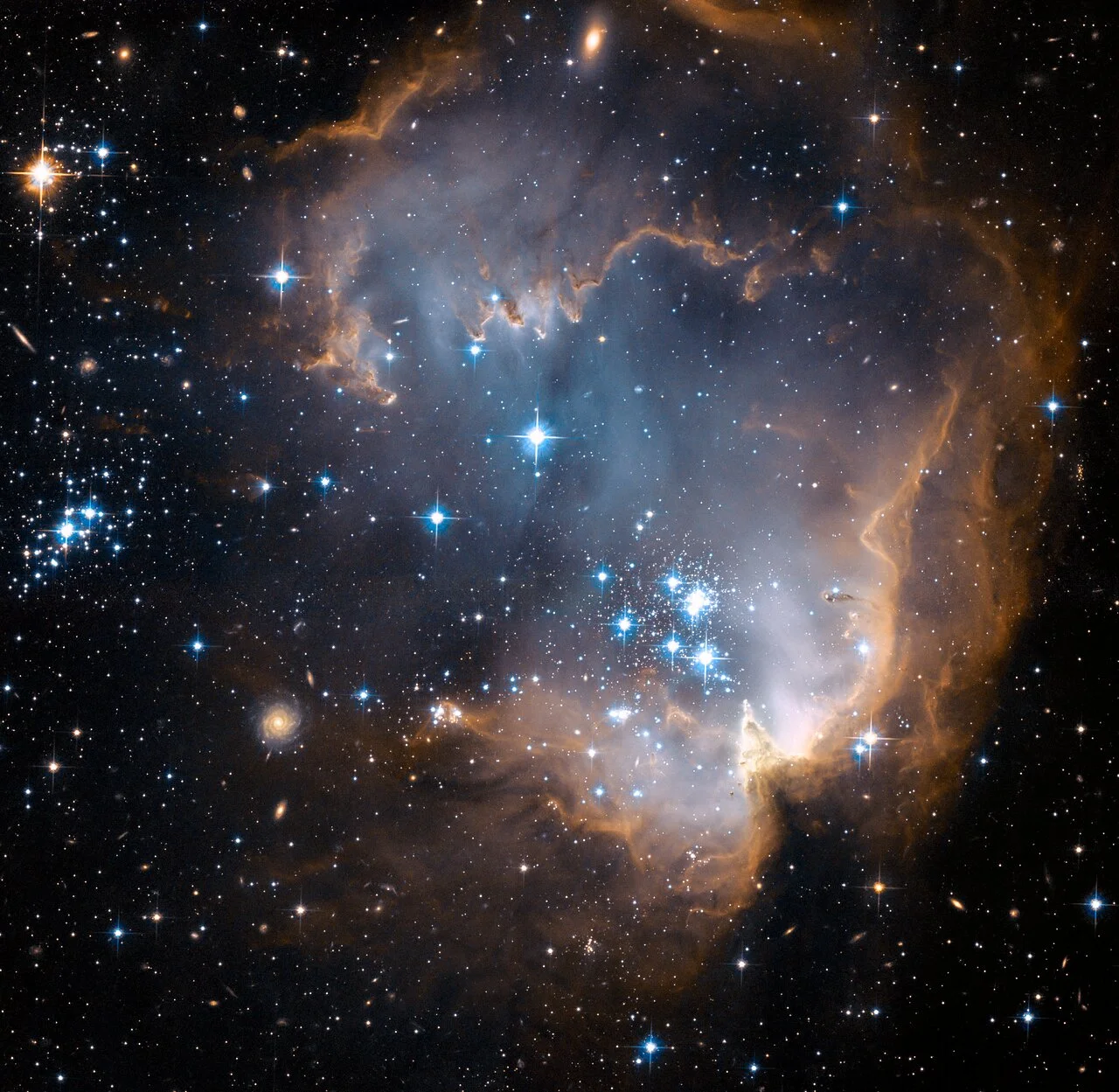 View larger ↗
25 / 100 · Where stars are born
New Stars in N90
Hubble Space Telescope
Young blue stars are carving an opening in N90, a star-forming region near the outskirts of the Small Magellanic Cloud.
A reflection on God’s handiwork
The clearing clouds offer a visual meditation on light finding room to shine.
Image credit: NASA , ESA and the Hubble Heritage Team ( STScI / AURA )- ESA / Hubble Collaboration
Image story & original downloads ↗CC BY 4.0 · Image resized and converted for web display; caption adapted from ESA/Hubble.
Back to gallery navigation ↑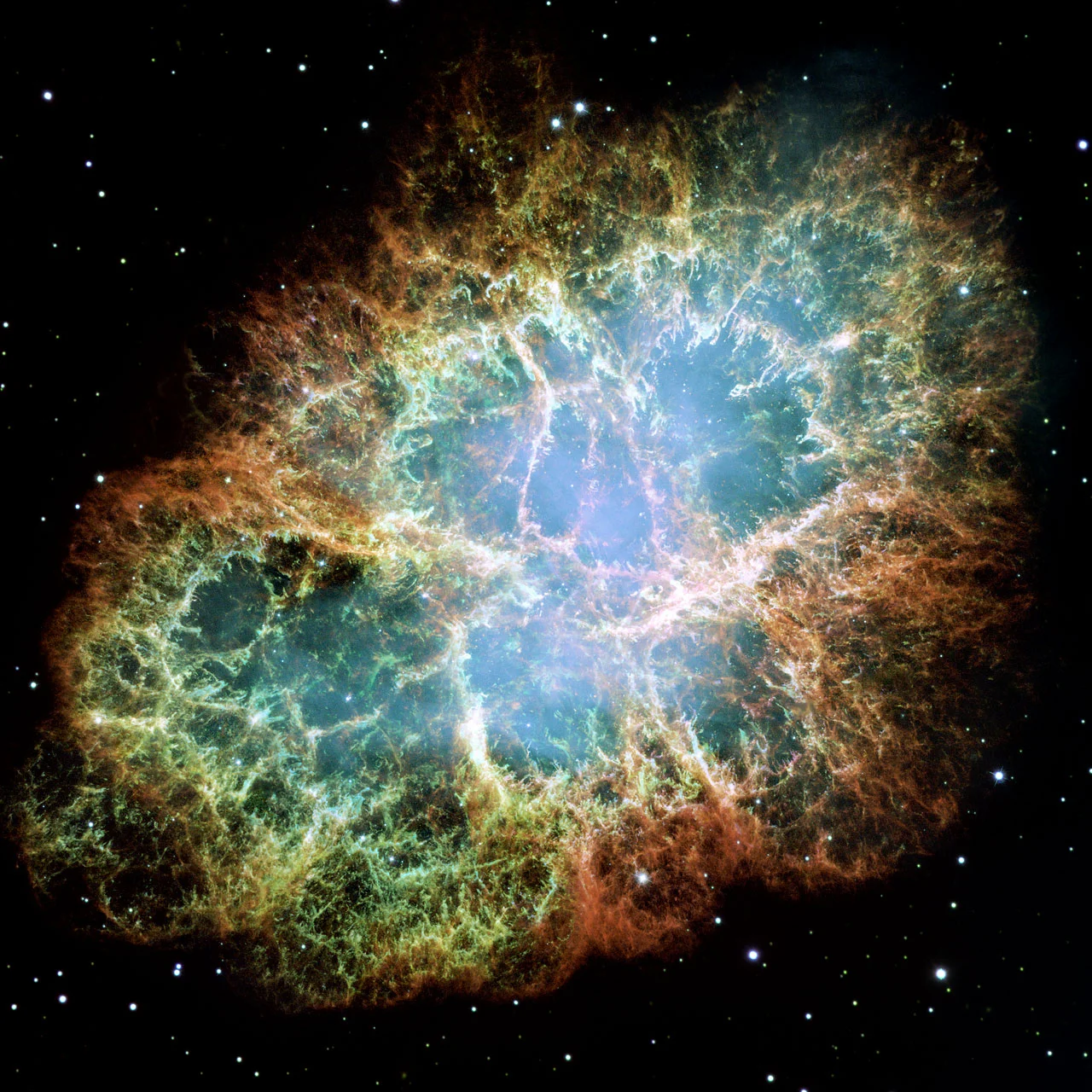 View larger ↗
26 / 100 · The changing lives of stars
The Crab Nebula
Hubble Space Telescope
This detailed mosaic shows the Crab Nebula, a supernova remnant filled with intricate strands of gas and an energetic central region.
A reflection on God’s handiwork
Its delicate-looking threads invite reverence for beauty that carries a powerful history.
Image credit: NASA , ESA and Allison Loll/Jeff Hester (Arizona State University). Acknowledgement: Davide De Martin ( ESA / Hubble )
Image story & original downloads ↗CC BY 4.0 · Image resized and converted for web display; caption adapted from ESA/Hubble.
Back to gallery navigation ↑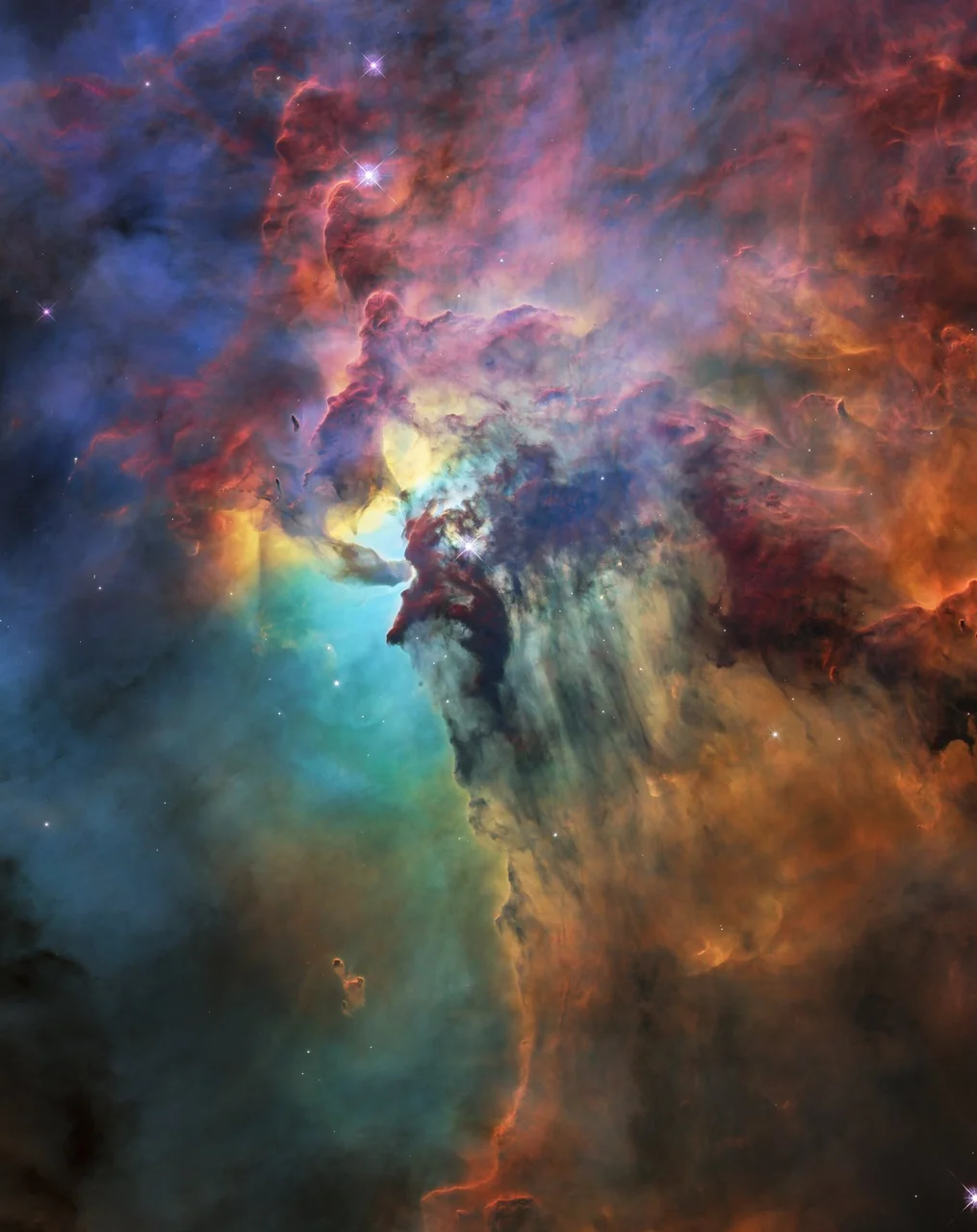 View larger ↗
27 / 100 · Where stars are born
Inside the Lagoon Nebula
Hubble Space Telescope
This portrait explores a small part of the Lagoon Nebula, revealing a turbulent environment where stars form amid luminous gas and dust.
A reflection on God’s handiwork
Look beyond the name’s stillness to find creation alive with movement.
Image credit: NASA, ESA, STScI
Image story & original downloads ↗CC BY 4.0 · Image resized and converted for web display; caption adapted from ESA/Hubble.
Back to gallery navigation ↑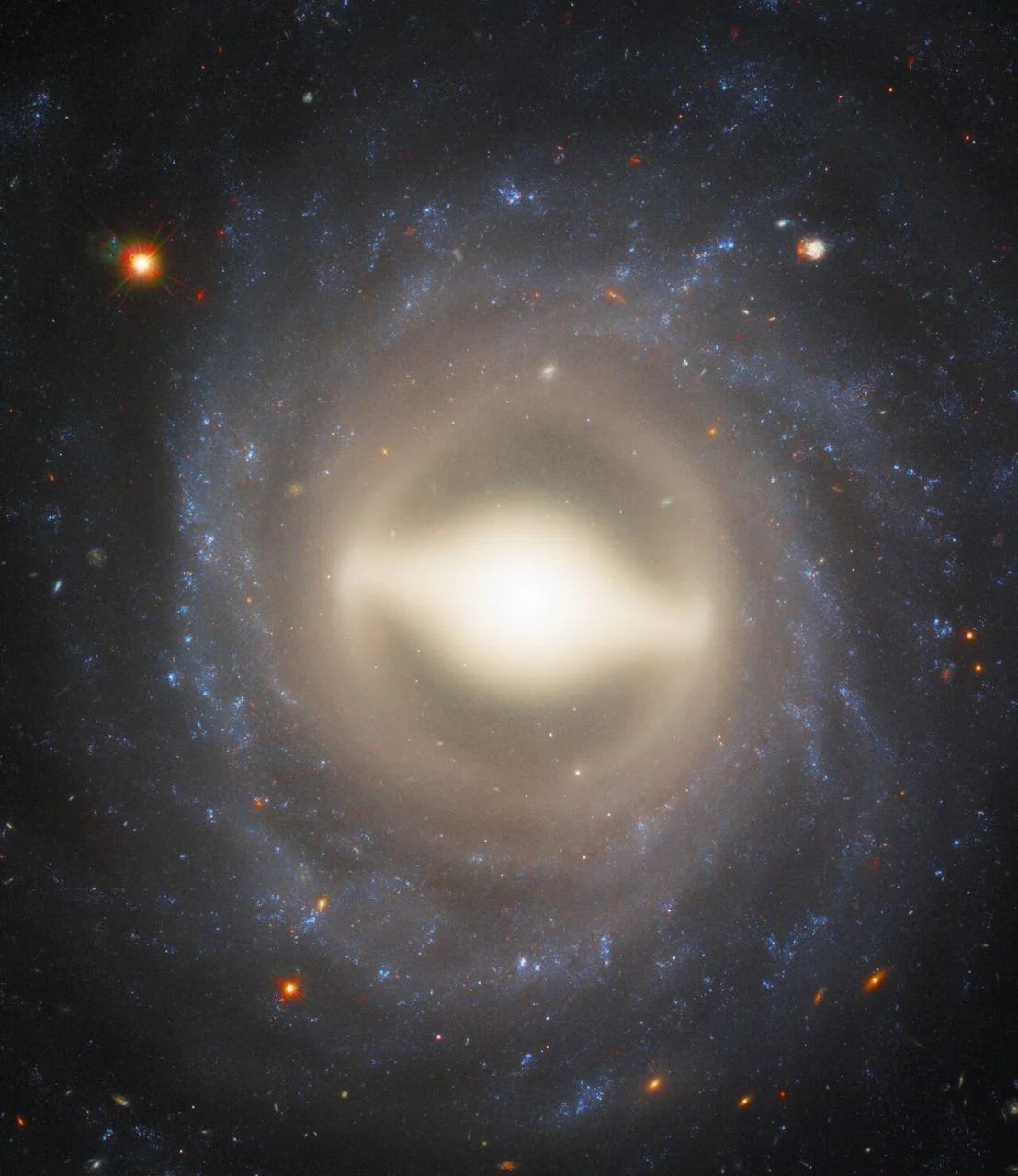 View larger ↗
28 / 100 · Galaxies beyond our own
The Spiral of NGC 1015
Hubble Space Telescope
Seen face-on, NGC 1015 displays tightly curving arms and a central bar, features of a barred spiral galaxy.
A reflection on God’s handiwork
Its recurring curves invite contemplation of pattern and variety across the heavens.
Image credit: ESA/Hubble & NASA, A. Riess (STScl/JHU)
Image story & original downloads ↗CC BY 4.0 · Image resized and converted for web display; caption adapted from ESA/Hubble.
Back to gallery navigation ↑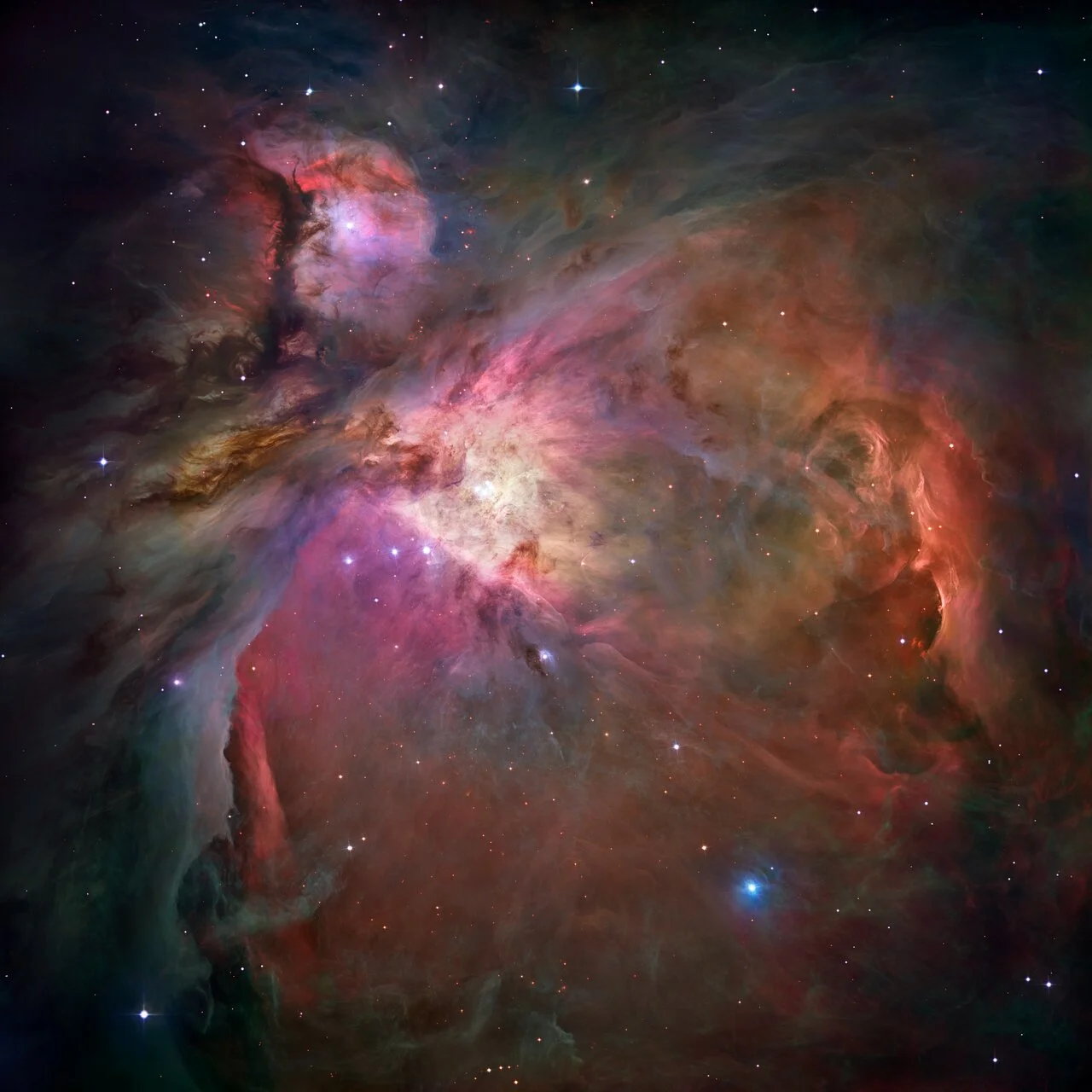 View larger ↗
29 / 100 · Where stars are born
The Orion Nebula
Hubble Space Telescope
Thousands of stars shine through Orion’s vast nursery, where sculpted clouds and dusty regions reveal many stages of stellar formation.
A reflection on God’s handiwork
A familiar constellation holds far more wonder than our unaided eyes can perceive.
CC BY 4.0 · Image resized and converted for web display; caption adapted from ESA/Hubble.
Back to gallery navigation ↑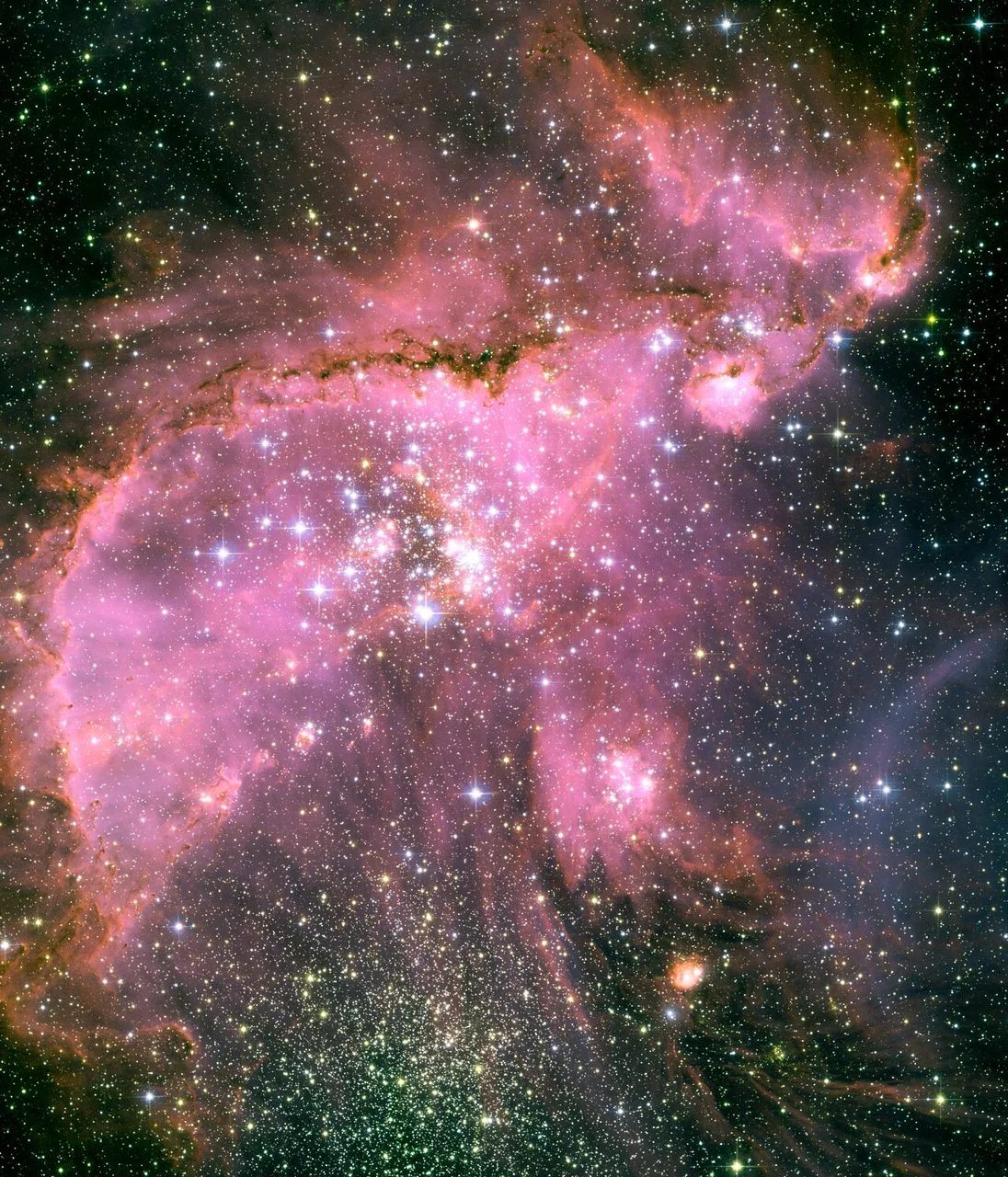 View larger ↗
30 / 100 · Gatherings of stars
NGC 346: Stars Sculpting Clouds
Hubble Space Telescope
Radiation from the central star cluster shapes surrounding gas in NGC 346, a star-forming region in the Small Magellanic Cloud.
A reflection on God’s handiwork
Light does more than illuminate; here it helps shape a landscape of astonishing beauty.
Image credit: NASA , ESA and A. Nota ( ESA / STScI , STScI / AURA )
Image story & original downloads ↗CC BY 4.0 · Image resized and converted for web display; caption adapted from ESA/Hubble.
Back to gallery navigation ↑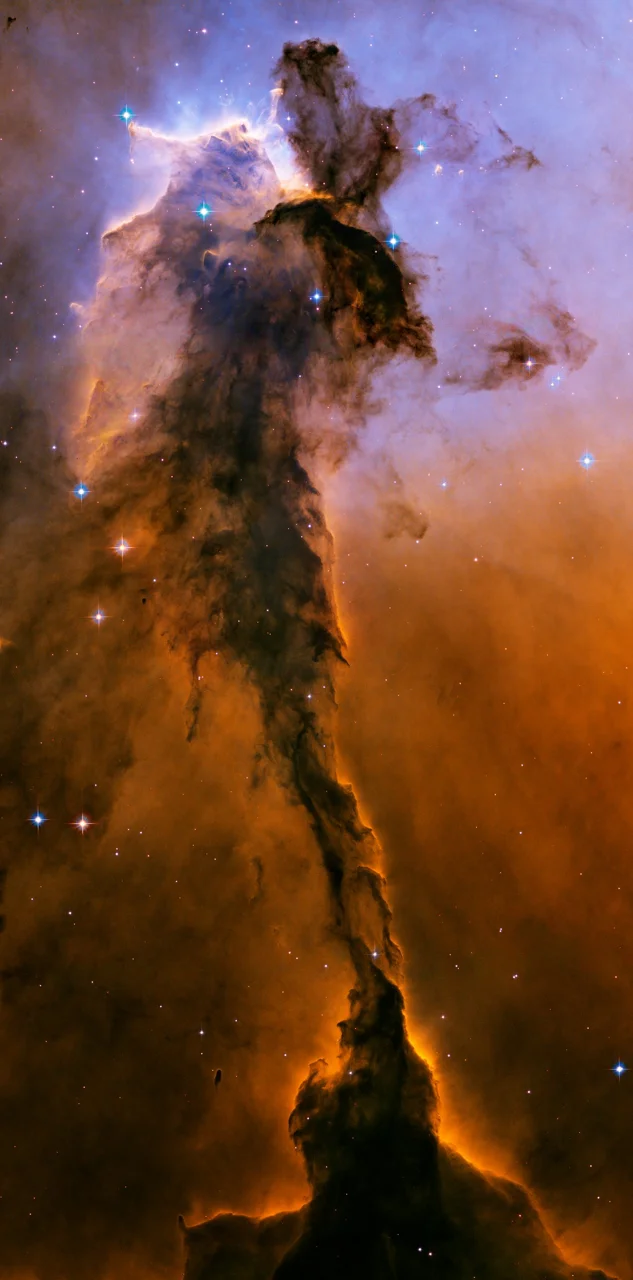 View larger ↗
31 / 100 · Where stars are born
The Eagle Nebula’s Tower
Hubble Space Telescope
A towering column of cold dust and gas rises within the Eagle Nebula, where nearby young stars sculpt the surrounding clouds.
A reflection on God’s handiwork
This distant spire invites us to lift our thoughts beyond the limits of daily life.
Image credit: NASA , ESA , and The Hubble Heritage Team ( STScI / AURA )
Image story & original downloads ↗CC BY 4.0 · Image resized and converted for web display; caption adapted from ESA/Hubble.
Back to gallery navigation ↑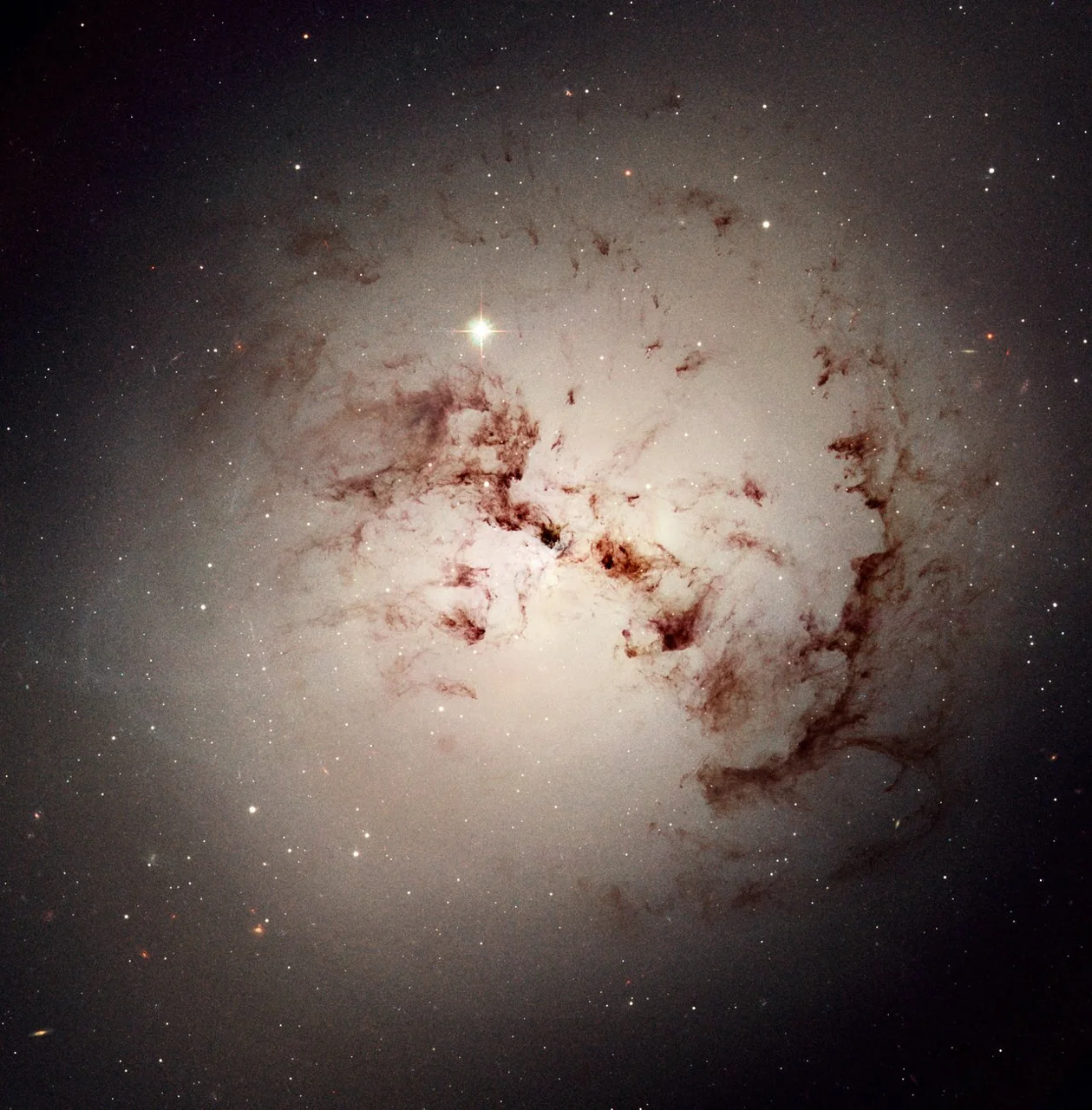 View larger ↗
32 / 100 · Galaxies beyond our own
The Dust of NGC 1316
Hubble Space Telescope
Loops of dust and clusters of stars in the elliptical galaxy NGC 1316 preserve evidence of earlier galactic encounters.
A reflection on God’s handiwork
The details of this galaxy invite reflection on histories woven into creation’s present beauty.
Image credit: NASA , ESA , and The Hubble Heritage Team ( STScI / AURA )
Image story & original downloads ↗CC BY 4.0 · Image resized and converted for web display; caption adapted from ESA/Hubble.
Back to gallery navigation ↑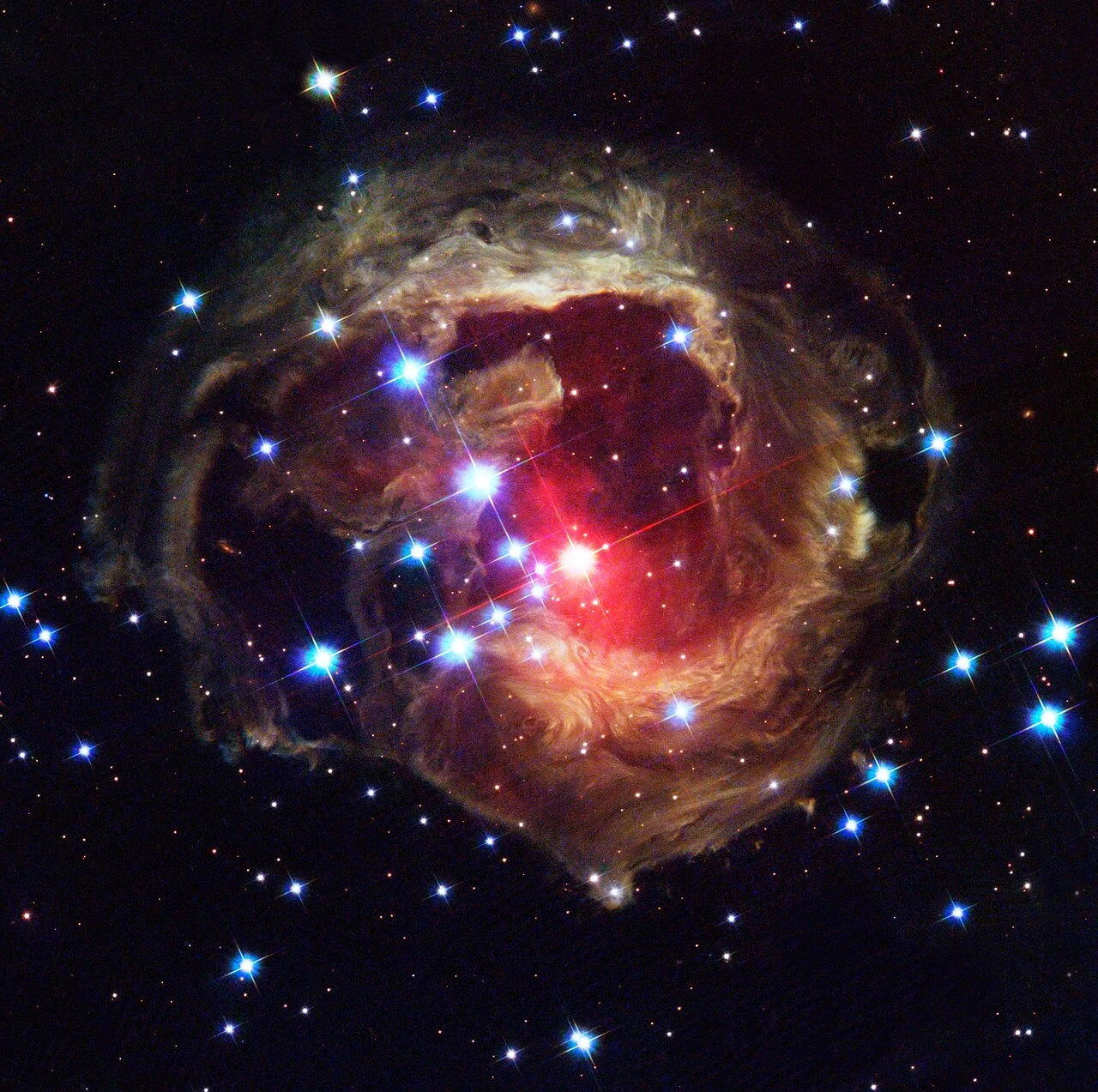 View larger ↗
33 / 100 · The changing lives of stars
Light Echoes Around V838 Monocerotis
Hubble Space Telescope
Light from a stellar outburst illuminates surrounding dust in changing patterns, producing a light echo around V838 Monocerotis.
A reflection on God’s handiwork
The returning glow offers a meditation on how light can reveal what once remained hidden.
Image credit: NASA , ESA , and The Hubble Heritage Team ( AURA / STScI )
Image story & original downloads ↗CC BY 4.0 · Image resized and converted for web display; caption adapted from ESA/Hubble.
Back to gallery navigation ↑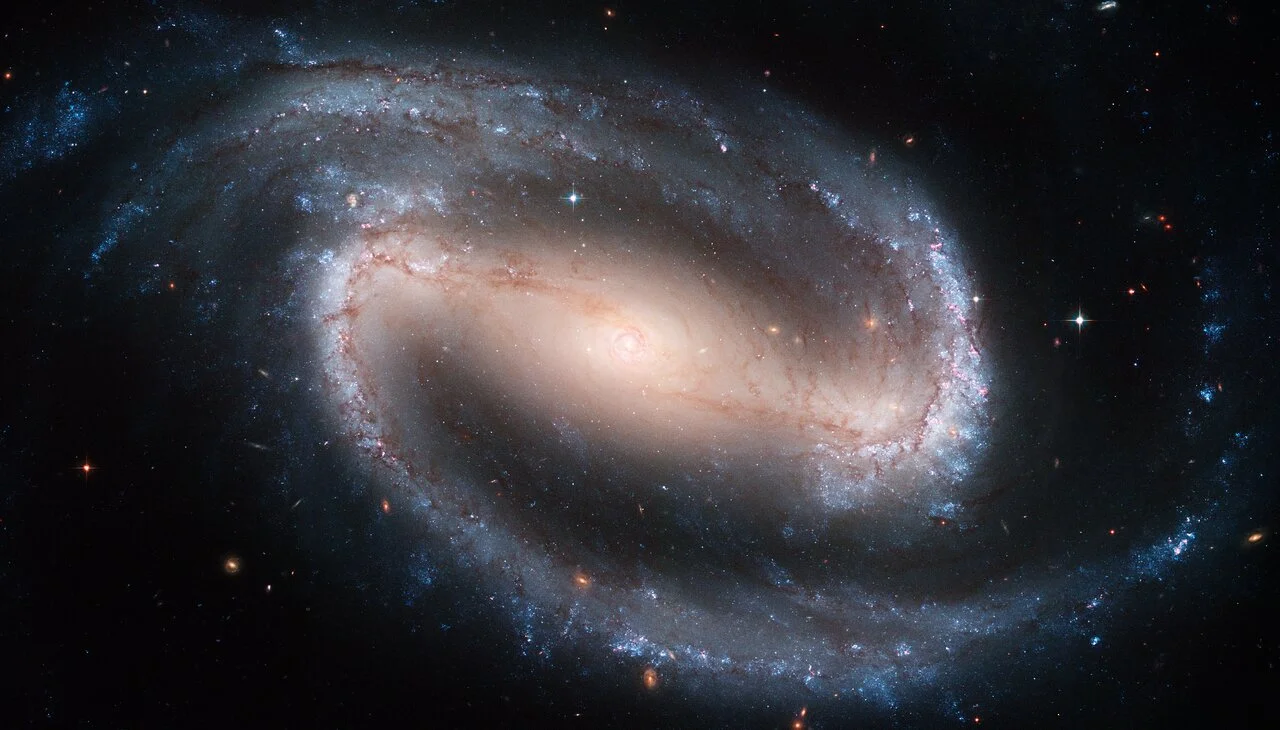 View larger ↗
34 / 100 · Where stars are born
The Barred Spiral NGC 1300
Hubble Space Telescope
A broad central bar connects the sweeping arms of NGC 1300, with luminous stars and dark dust tracing its structure.
A reflection on God’s handiwork
Its grand symmetry encourages us to slow down and notice creation’s intricate arrangement.
Image credit: NASA , ESA , and The Hubble Heritage Team ( STScI / AURA )
Image story & original downloads ↗CC BY 4.0 · Image resized and converted for web display; caption adapted from ESA/Hubble.
Back to gallery navigation ↑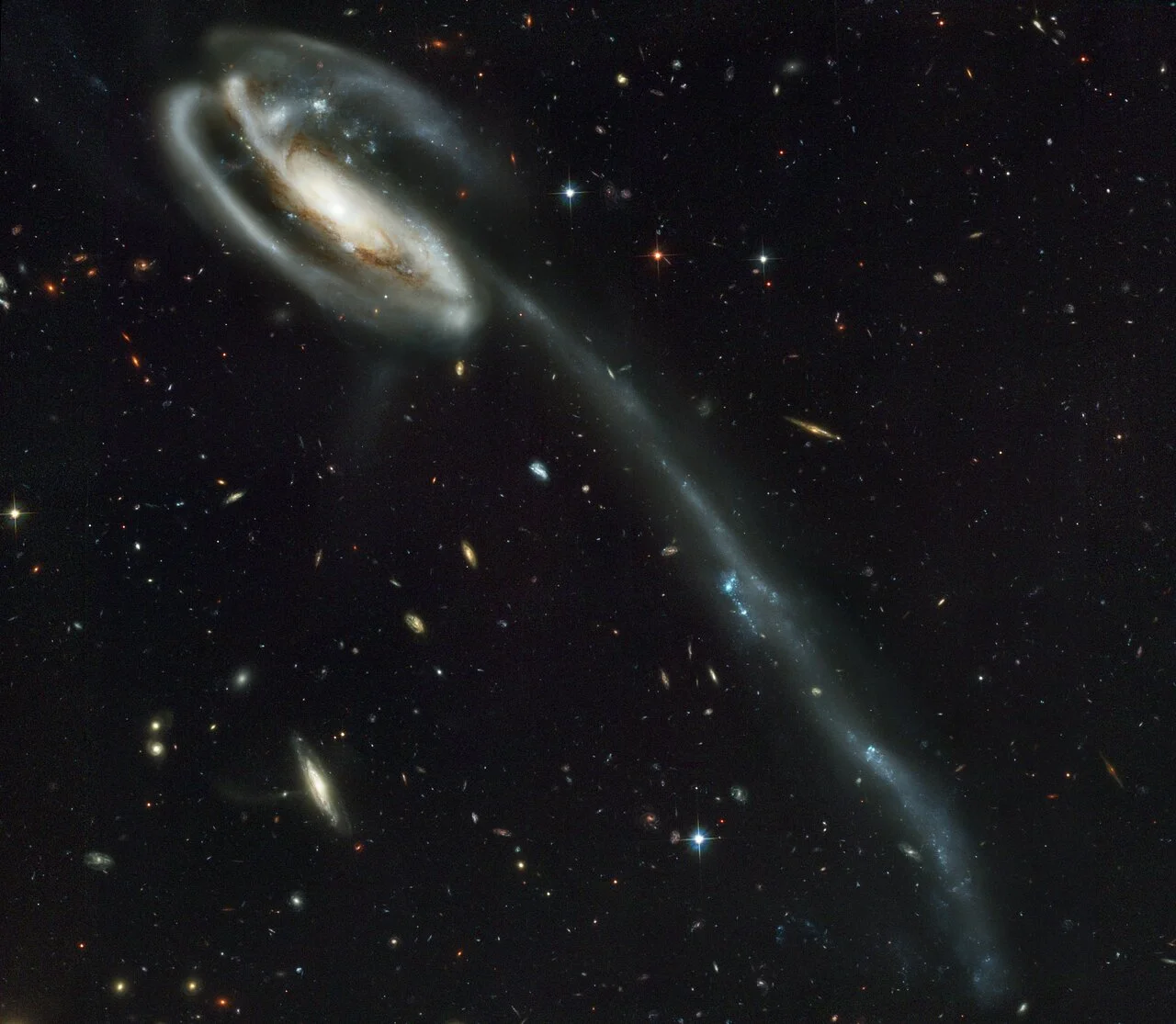 View larger ↗
35 / 100 · Galaxies beyond our own
The Tadpole Galaxy
Hubble Space Telescope
A long stream of stars extends from UGC 10214, the Tadpole Galaxy, against a background crowded with more distant galaxies.
A reflection on God’s handiwork
One dramatic form opens onto many others, inviting wonder without an obvious boundary.
Image credit: NASA , Holland Ford (JHU), the ACS Science Team and ESA
Image story & original downloads ↗CC BY 4.0 · Image resized and converted for web display; caption adapted from ESA/Hubble.
Back to gallery navigation ↑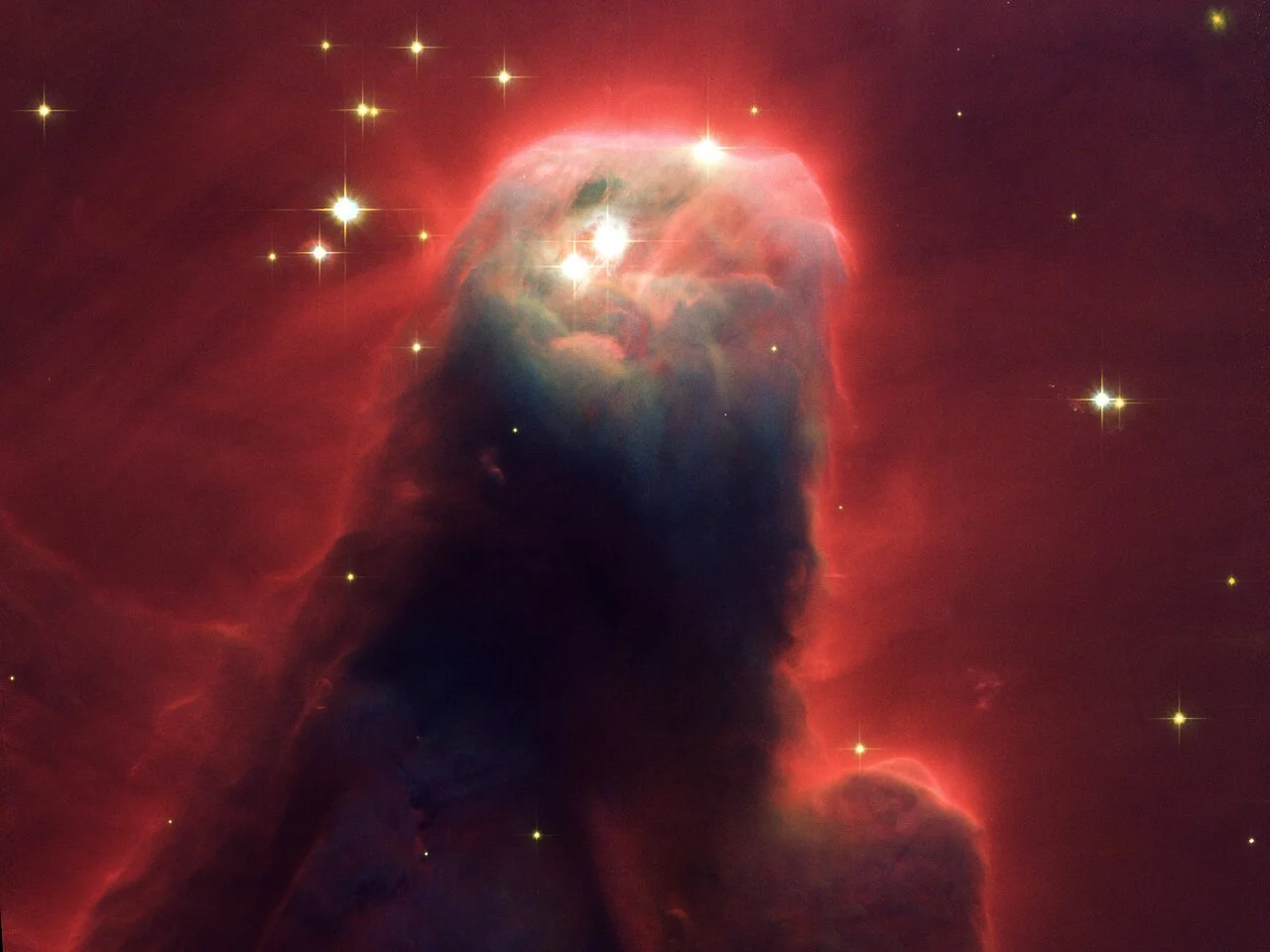 View larger ↗
36 / 100 · Where stars are born
The Cone Nebula
Hubble Space Telescope
A dark pillar rises against glowing gas in the Cone Nebula, part of the active star-forming region NGC 2264.
A reflection on God’s handiwork
Light and darkness together reveal contours that invite thoughtful attention.
Image credit: NASA , Holland Ford (JHU), the ACS Science Team and ESA
Image story & original downloads ↗CC BY 4.0 · Image resized and converted for web display; caption adapted from ESA/Hubble.
Back to gallery navigation ↑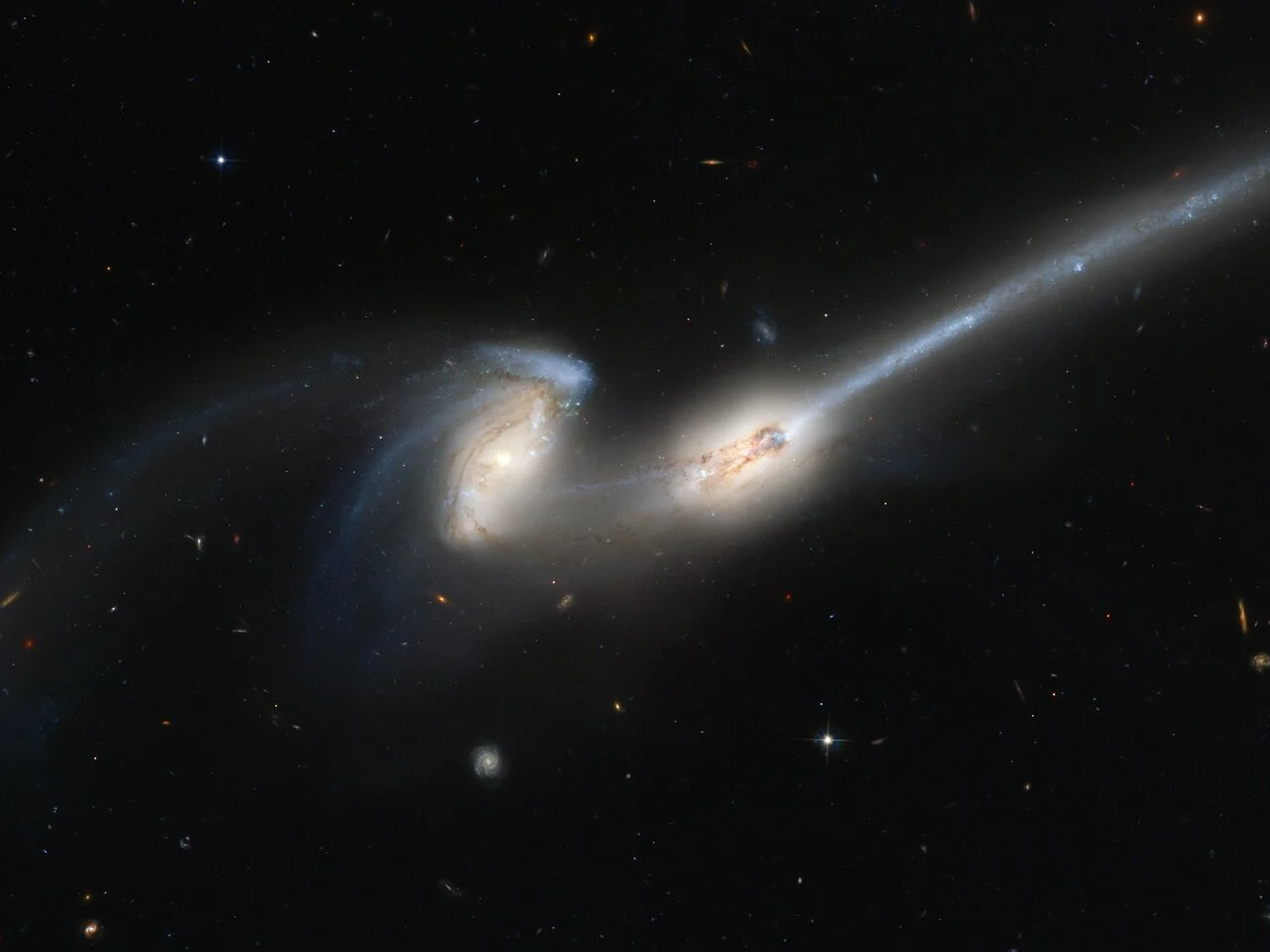 View larger ↗
37 / 100 · Galaxies beyond our own
The Mice Galaxies
Hubble Space Telescope
The interacting galaxies NGC 4676 trail elongated streams of stars and gas as their gravitational encounter reshapes both systems.
A reflection on God’s handiwork
Their sweeping forms invite reflection on the relationships that shape the wider universe.
Image credit: NASA , Holland Ford (JHU), the ACS Science Team and ESA
Image story & original downloads ↗CC BY 4.0 · Image resized and converted for web display; caption adapted from ESA/Hubble.
Back to gallery navigation ↑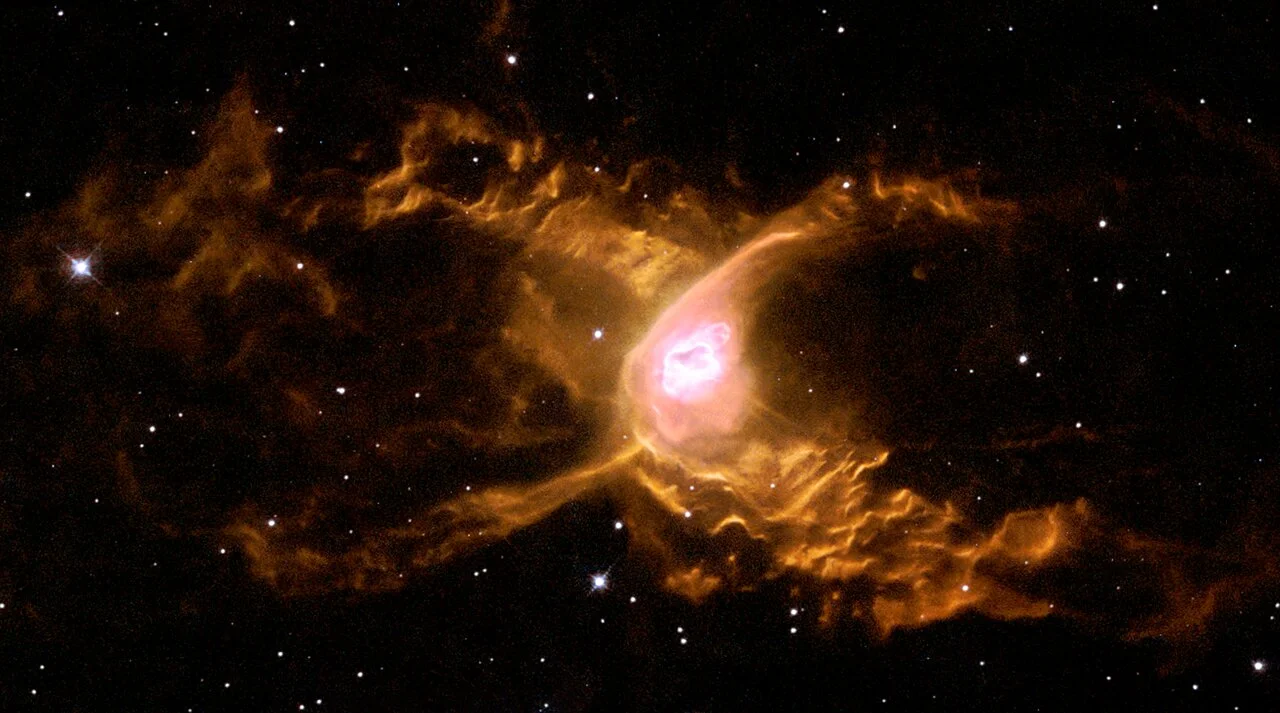 View larger ↗
38 / 100 · Where stars are born
The Red Spider Nebula
Hubble Space Telescope
A hot central star drives powerful outflows through this two-lobed nebula, generating shocks and waves in the expanding gas.
A reflection on God’s handiwork
A delicate appearance can hold immense power, deepening our sense of awe.
Image credit: ESA & Garrelt Mellema (Leiden University, the Netherlands)
Image story & original downloads ↗CC BY 4.0 · Image resized and converted for web display; caption adapted from ESA/Hubble.
Back to gallery navigation ↑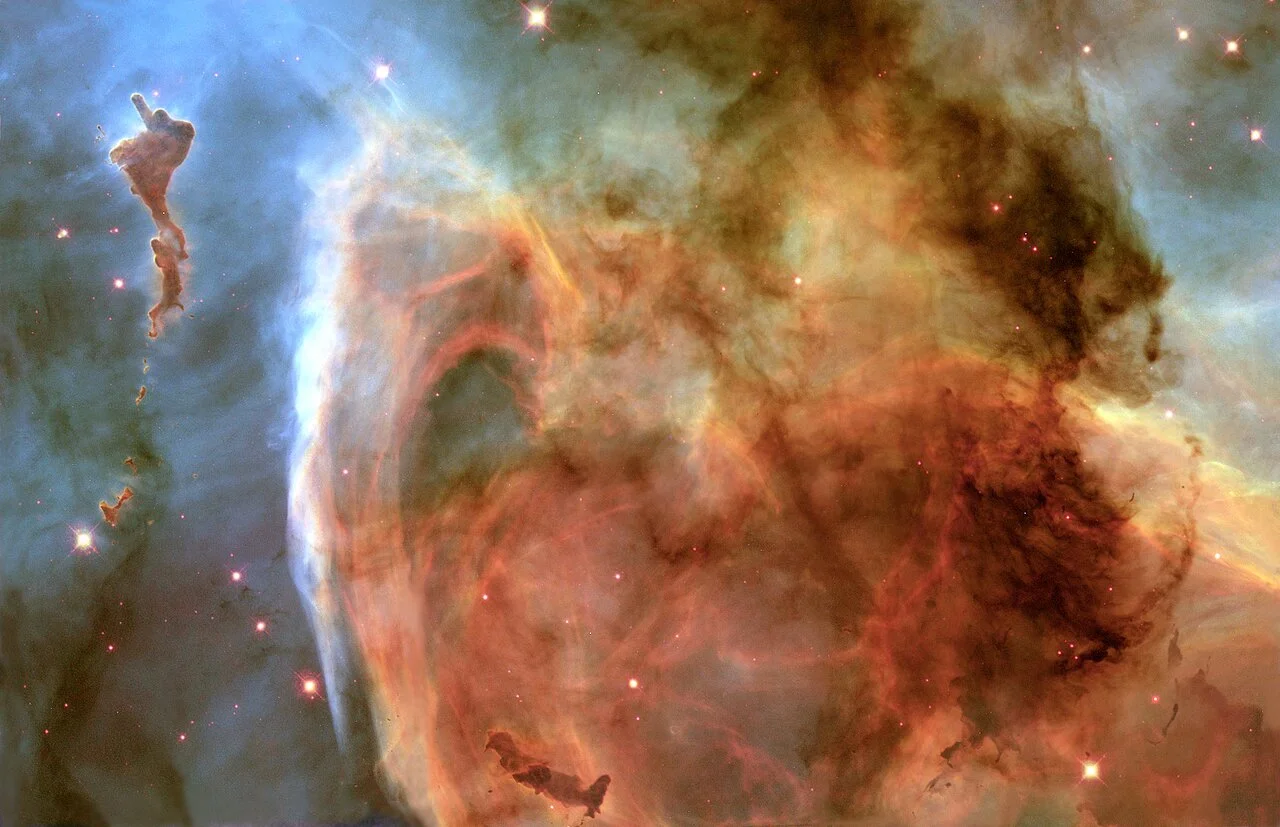 View larger ↗
39 / 100 · Where stars are born
The Keyhole in Carina
Hubble Space Telescope
Hubble’s mosaic reveals overlapping dark clouds and luminous structures around the Keyhole Nebula within the larger Carina complex.
A reflection on God’s handiwork
Layer upon layer, this view invites appreciation for the richness of God’s handiwork.
Image credit: NASA / ESA , The Hubble Heritage Team ( AURA / STScI )
Image story & original downloads ↗CC BY 4.0 · Image resized and converted for web display; caption adapted from ESA/Hubble.
Back to gallery navigation ↑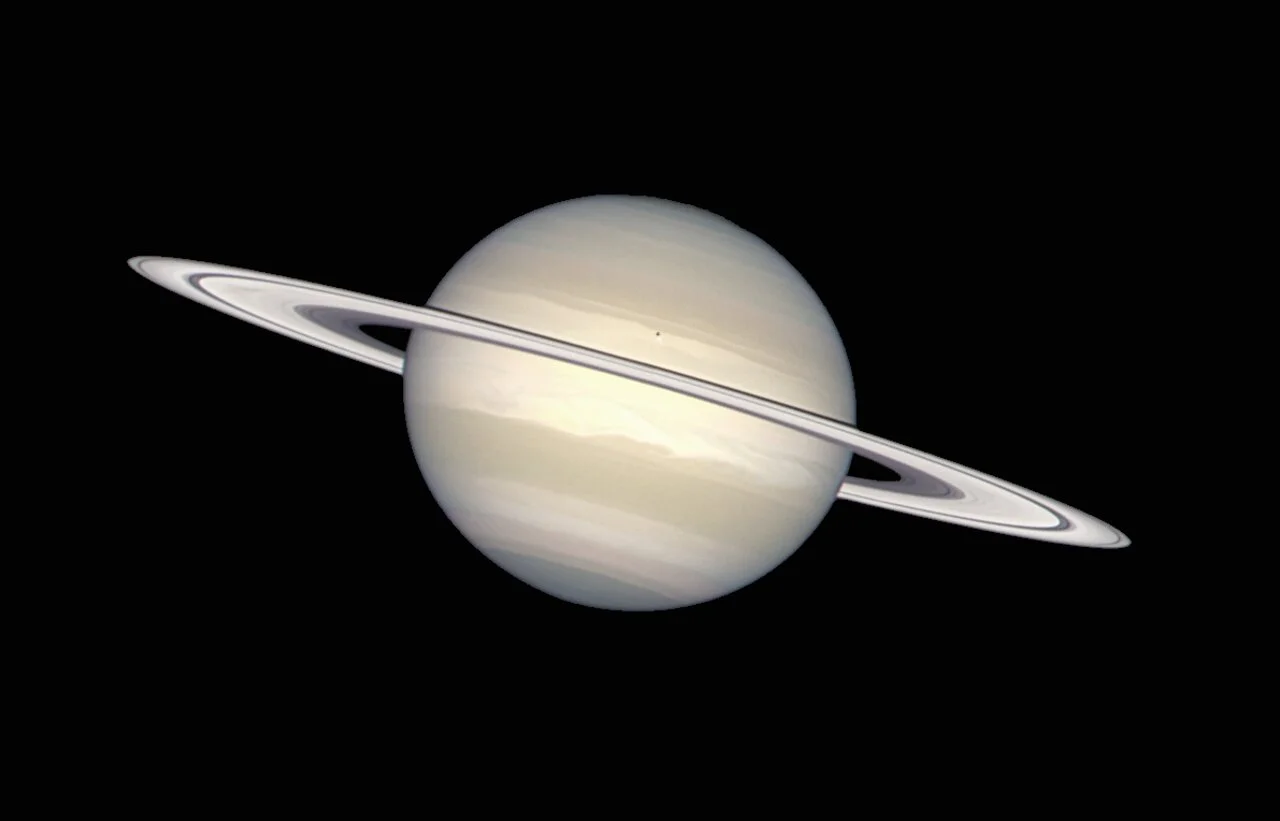 View larger ↗
40 / 100 · Our solar neighborhood
Saturn’s Subtle Colors
Hubble Space Telescope
This processed view aims to reproduce Saturn’s natural appearance, showing soft atmospheric bands framed by the planet’s famous rings.
A reflection on God’s handiwork
Beauty need not be brilliant to be profound; quiet colors also reward attention.
Image credit: Hubble Heritage Team ( AURA / STScI / NASA / ESA )
Image story & original downloads ↗CC BY 4.0 · Image resized and converted for web display; caption adapted from ESA/Hubble.
Back to gallery navigation ↑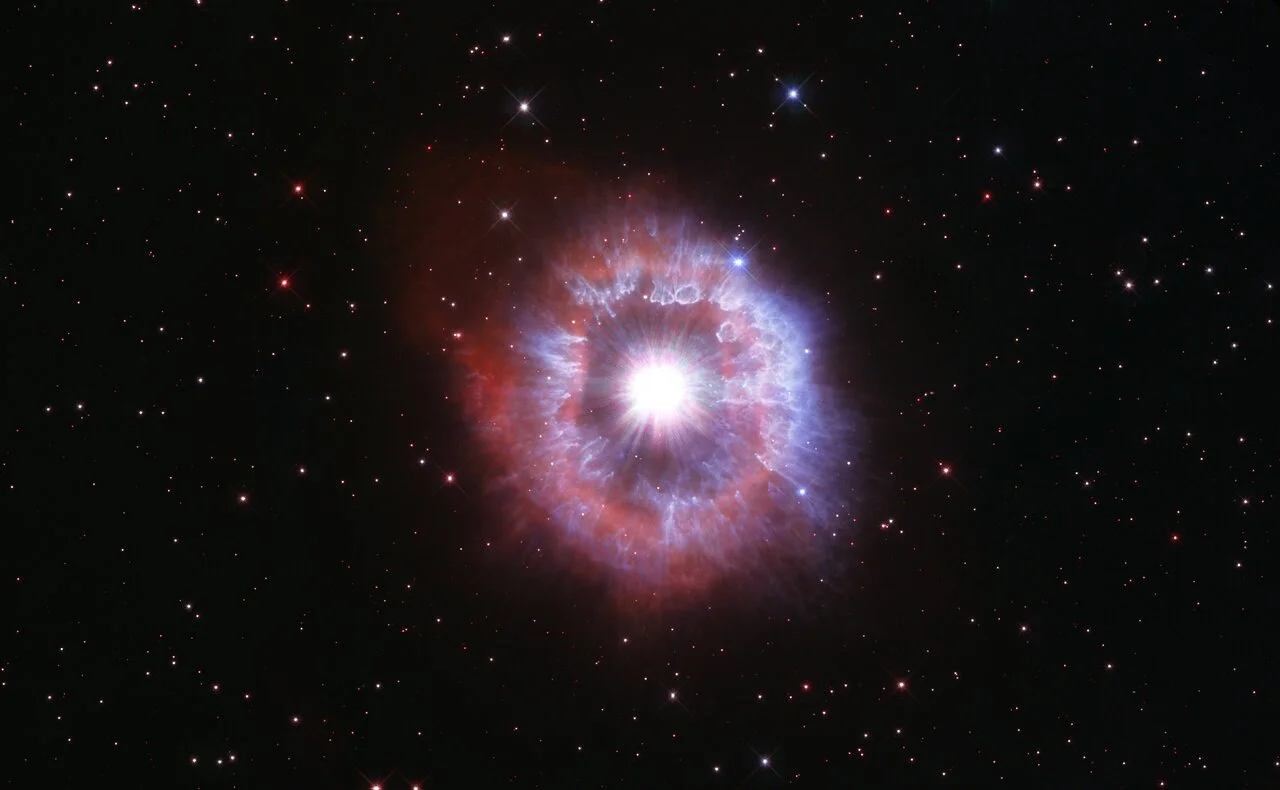 View larger ↗
41 / 100 · The changing lives of stars
The Expanding Shell of AG Carinae
Hubble Space Telescope
The luminous star AG Carinae is surrounded by a large shell of material expelled during its unstable stellar life.
A reflection on God’s handiwork
Its encircling glow invites contemplation of transformation on scales beyond human experience.
Image credit: NASA, ESA and STScI
Image story & original downloads ↗CC BY 4.0 · Image resized and converted for web display; caption adapted from ESA/Hubble.
Back to gallery navigation ↑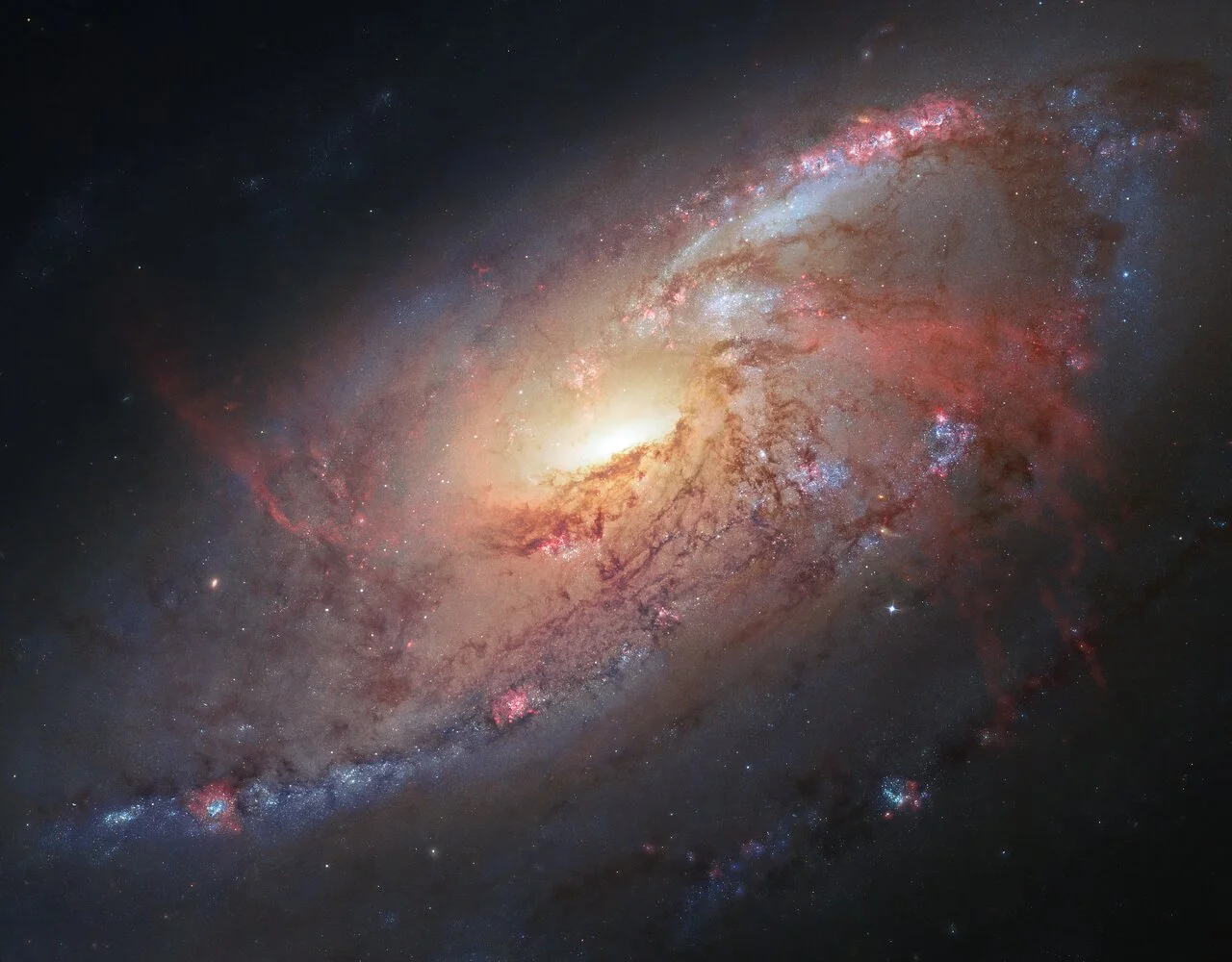 View larger ↗
42 / 100 · Galaxies beyond our own
Messier 106
Hubble + ground-based observations
This portrait of the spiral galaxy Messier 106 combines Hubble data with observations contributed by astronomers Robert Gendler and Jay GaBany.
A reflection on God’s handiwork
Shared observation reveals more beauty, reminding us of the value of curiosity pursued together.
Image credit: NASA, ESA, the Hubble Heritage Team (STScI/AURA), and R. Gendler (for the Hubble Heritage Team). Acknowledgment: J. GaBany
Image story & original downloads ↗CC BY 4.0 · Image resized and converted for web display; caption adapted from ESA/Hubble.
Back to gallery navigation ↑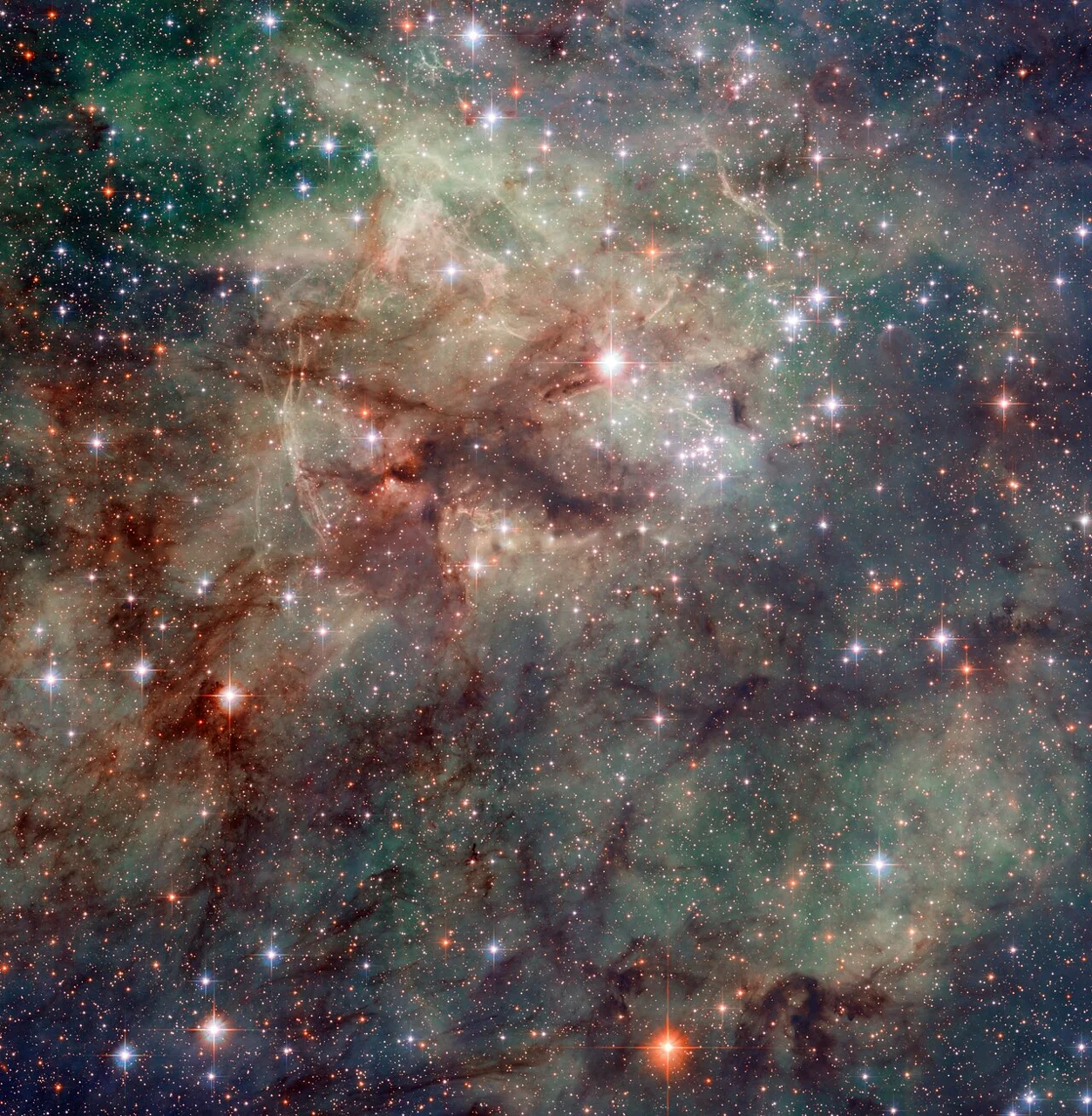 View larger ↗
43 / 100 · Where stars are born
Inside the Tarantula Nebula
Hubble Space Telescope
Glowing hydrogen and intricate clouds fill this close view of the Tarantula Nebula, an intense stellar nursery in the Large Magellanic Cloud.
A reflection on God’s handiwork
This intricate landscape invites gratitude for the abundance of places where stars begin.
Image credit: NASA, ESA
Image story & original downloads ↗CC BY 4.0 · Image resized and converted for web display; caption adapted from ESA/Hubble.
Back to gallery navigation ↑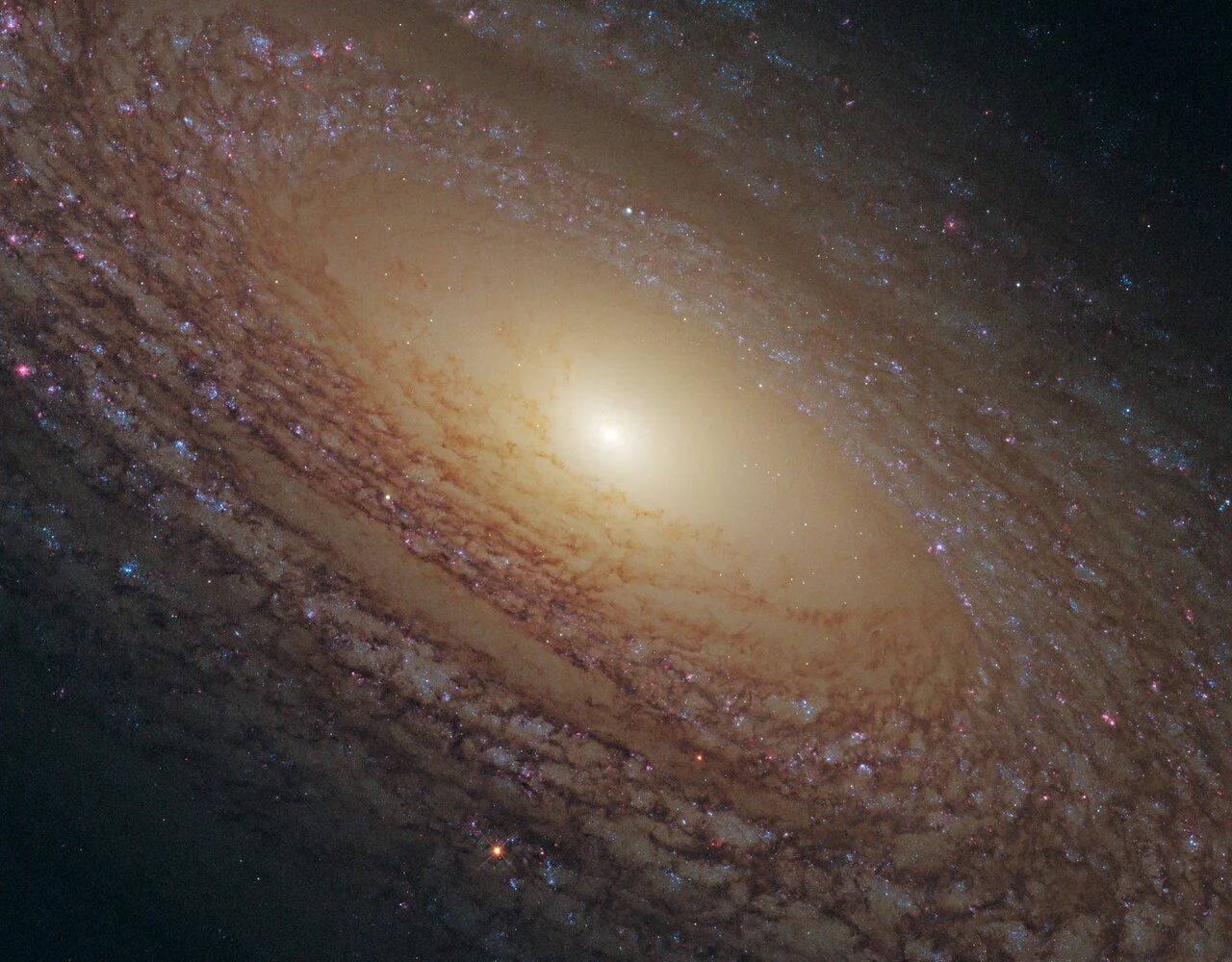 View larger ↗
44 / 100 · Where stars are born
The Textured Spiral NGC 2841
Hubble Space Telescope
Hubble reveals NGC 2841’s patchwork spiral structure, where dust and stellar populations offer clues to the conditions that govern star formation.
A reflection on God’s handiwork
Creation’s beauty includes texture and complexity as well as sweeping symmetry.
CC BY 4.0 · Image resized and converted for web display; caption adapted from ESA/Hubble.
Back to gallery navigation ↑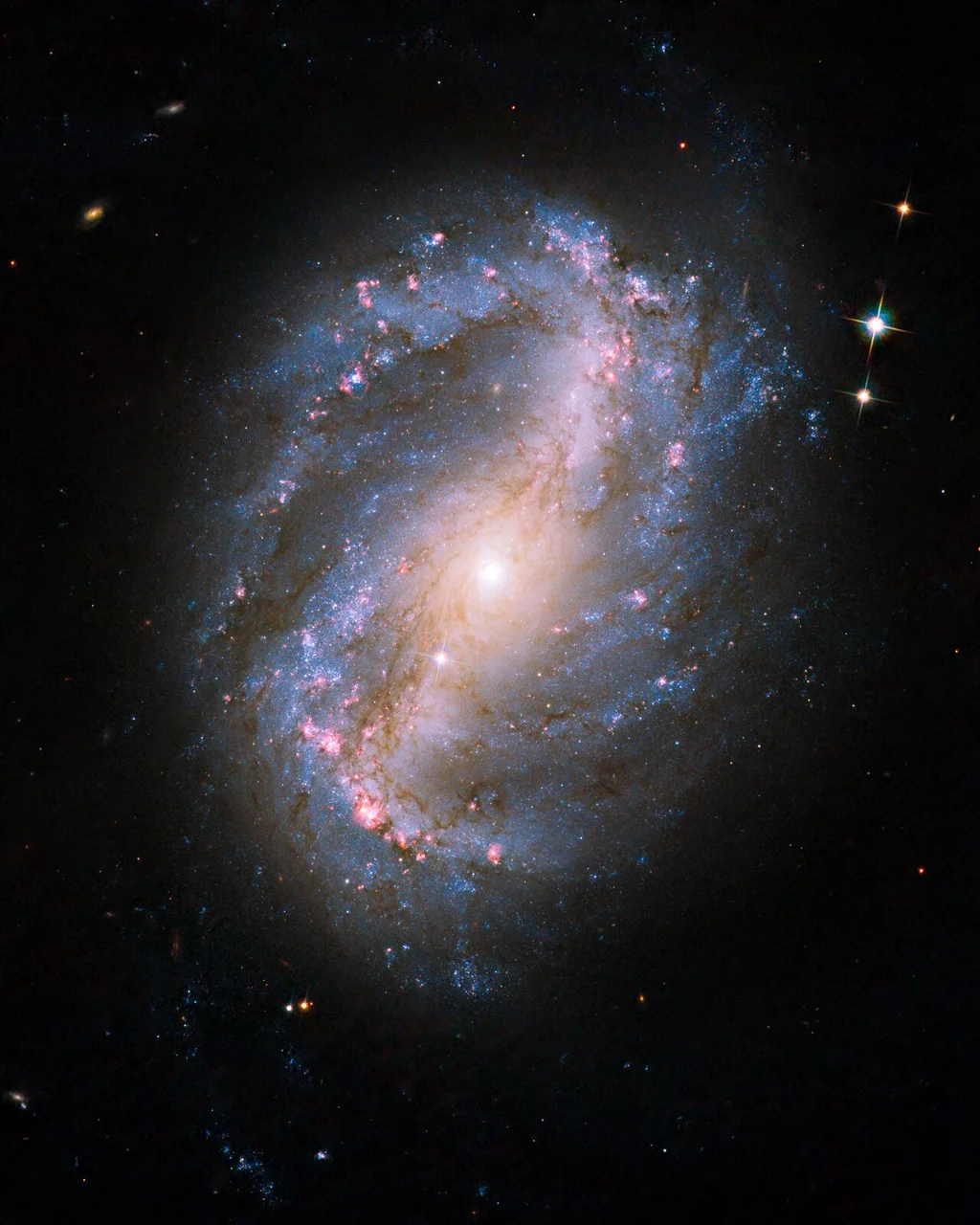 View larger ↗
45 / 100 · Galaxies beyond our own
The Barred Spiral NGC 6217
Hubble Space Telescope
Hubble’s restored Advanced Camera for Surveys recorded this barred spiral galaxy during tests following the 2009 servicing mission.
A reflection on God’s handiwork
Human care and patient craftsmanship open new windows onto God’s handiwork.
Image credit: NASA, ESA and the Hubble SM4 ERO Team
Image story & original downloads ↗CC BY 4.0 · Image resized and converted for web display; caption adapted from ESA/Hubble.
Back to gallery navigation ↑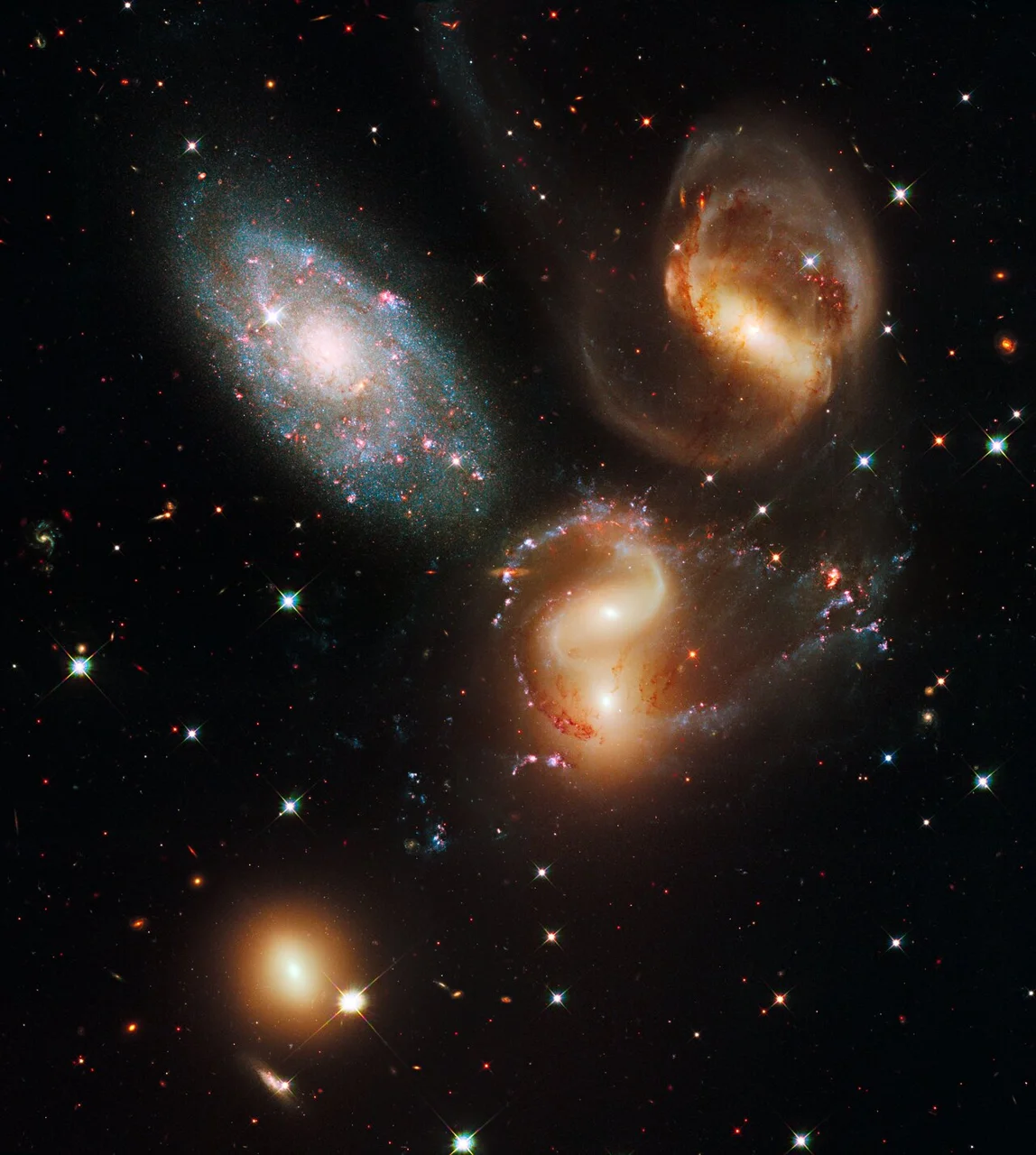 View larger ↗
46 / 100 · Galaxies beyond our own
Stephan’s Quintet — Hubble
Hubble Space Telescope
Interacting members of Stephan’s Quintet reveal differently colored stellar populations, disturbed structures, and evidence of continuing galactic encounters.
A reflection on God’s handiwork
Compare this view with Webb’s portrait and consider how understanding grows through different perspectives.
Image credit: NASA, ESA and the Hubble SM4 ERO Team
Image story & original downloads ↗CC BY 4.0 · Image resized and converted for web display; caption adapted from ESA/Hubble.
Back to gallery navigation ↑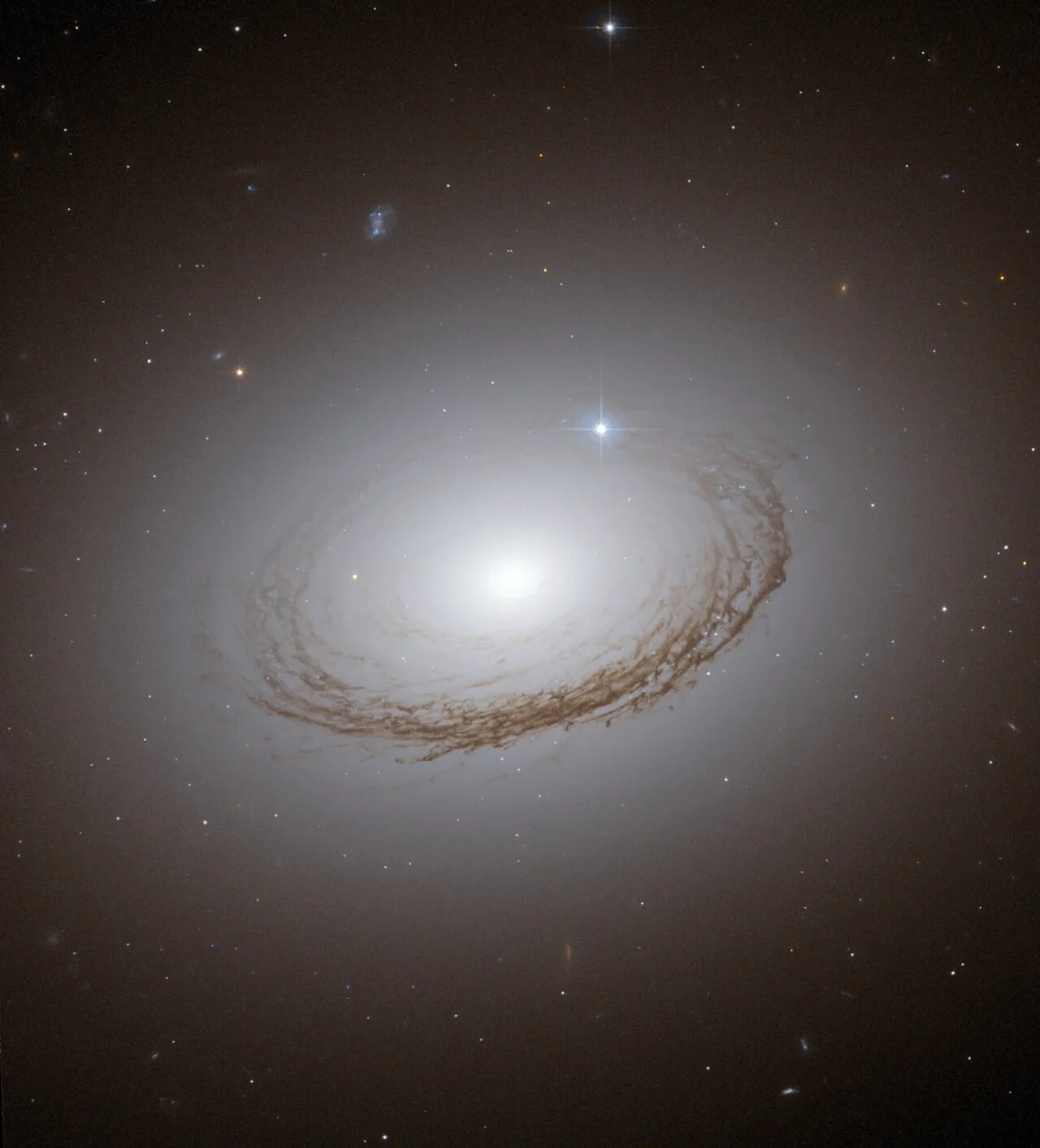 View larger ↗
47 / 100 · Gatherings of stars
Dust and Light in NGC 7049
Hubble Space Telescope
Dark dust structures stand out against NGC 7049’s luminous body, while surrounding globular clusters appear as small points of light.
A reflection on God’s handiwork
The interplay of shadow and radiance invites contemplation of beauty revealed by contrast.
Image credit: NASA, ESA and W. Harris (McMaster University, Ontario, Canada)
Image story & original downloads ↗CC BY 4.0 · Image resized and converted for web display; caption adapted from ESA/Hubble.
Back to gallery navigation ↑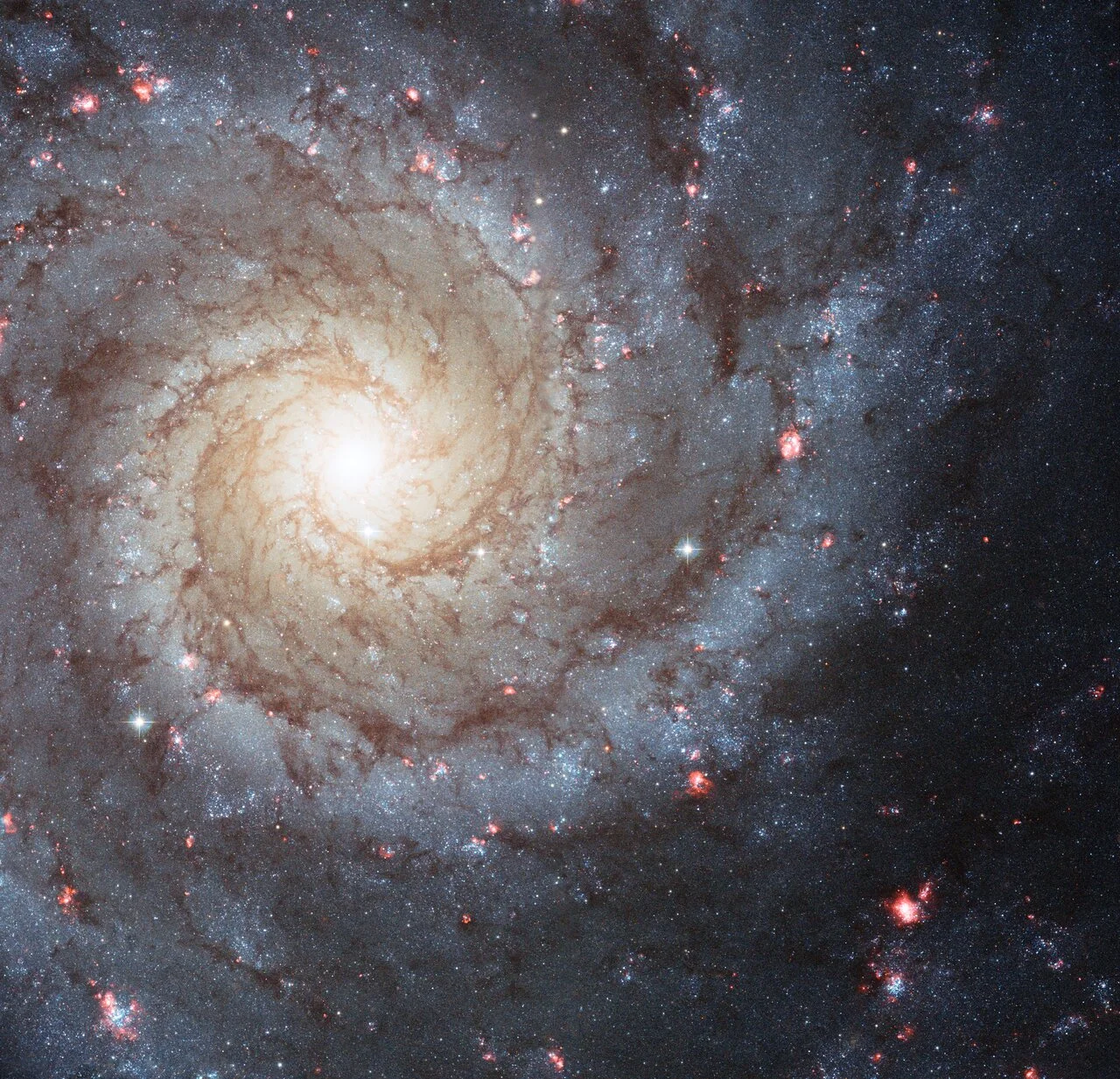 View larger ↗
48 / 100 · Where stars are born
The Spiral Arms of Messier 74
Hubble Space Telescope
Pink clouds mark star-forming regions along Messier 74’s arms, where young stars energize the surrounding hydrogen gas.
A reflection on God’s handiwork
These scattered lights invite reflection on new beginnings within a much larger whole.
Image credit: NASA , ESA , and The Hubble Heritage (STScI/AURA)-ESA/Hubble Collaboration
Image story & original downloads ↗CC BY 4.0 · Image resized and converted for web display; caption adapted from ESA/Hubble.
Back to gallery navigation ↑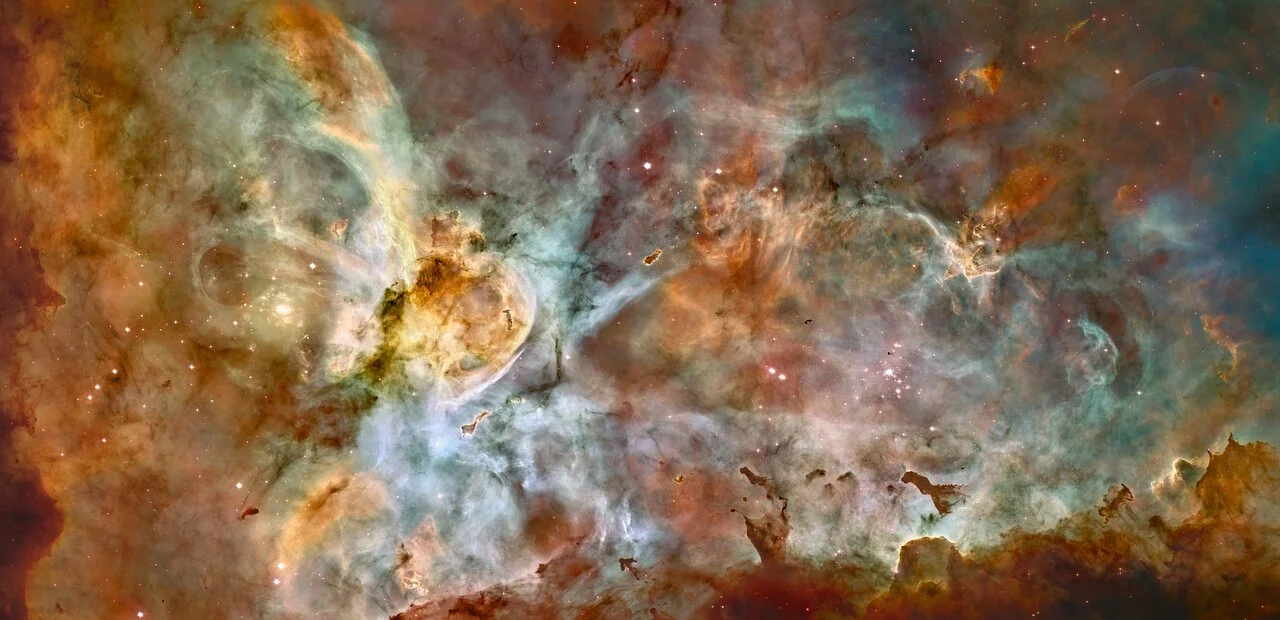 View larger ↗
49 / 100 · Where stars are born
The Carina Panorama
Hubble Space Telescope
Massive stars illuminate the Carina Nebula and sculpt its clouds with radiation and winds, creating a varied landscape of stellar birth.
A reflection on God’s handiwork
Across this sweeping scene, wonder grows from noticing both grandeur and small detail.
Image credit: NASA , ESA , N. Smith (University of California, Berkeley), and The Hubble Heritage Team (STScI/AURA)
Image story & original downloads ↗CC BY 4.0 · Image resized and converted for web display; caption adapted from ESA/Hubble.
Back to gallery navigation ↑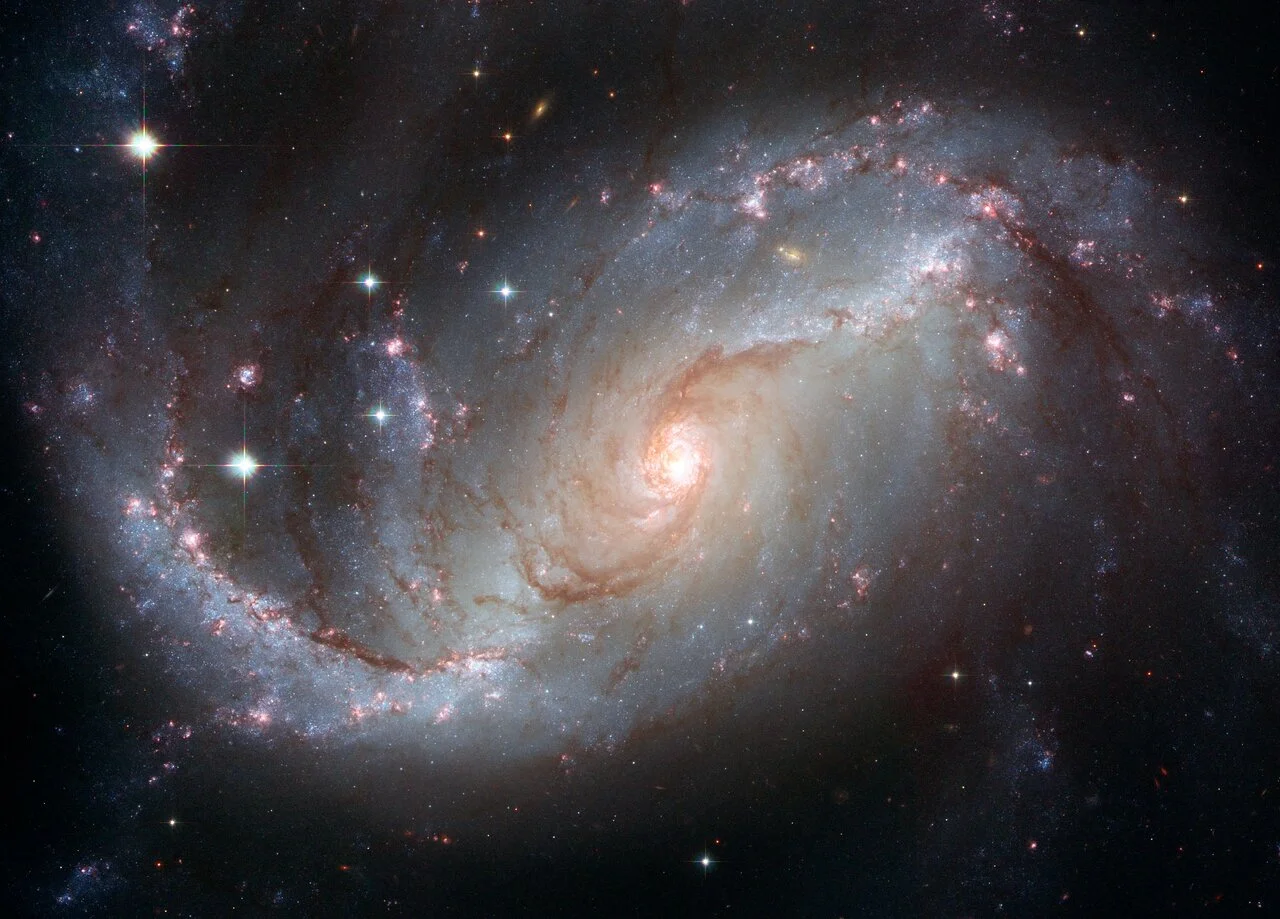 View larger ↗
50 / 100 · Gatherings of stars
Stars Along NGC 1672’s Arms
Hubble Space Telescope
Blue clusters and reddish gas outline NGC 1672’s spiral arms, while intervening dust obscures portions of the starlight.
A reflection on God’s handiwork
Its many colors invite gratitude for creation’s capacity to surprise the attentive eye.
Image credit: NASA , ESA
Image story & original downloads ↗CC BY 4.0 · Image resized and converted for web display; caption adapted from ESA/Hubble.
Back to gallery navigation ↑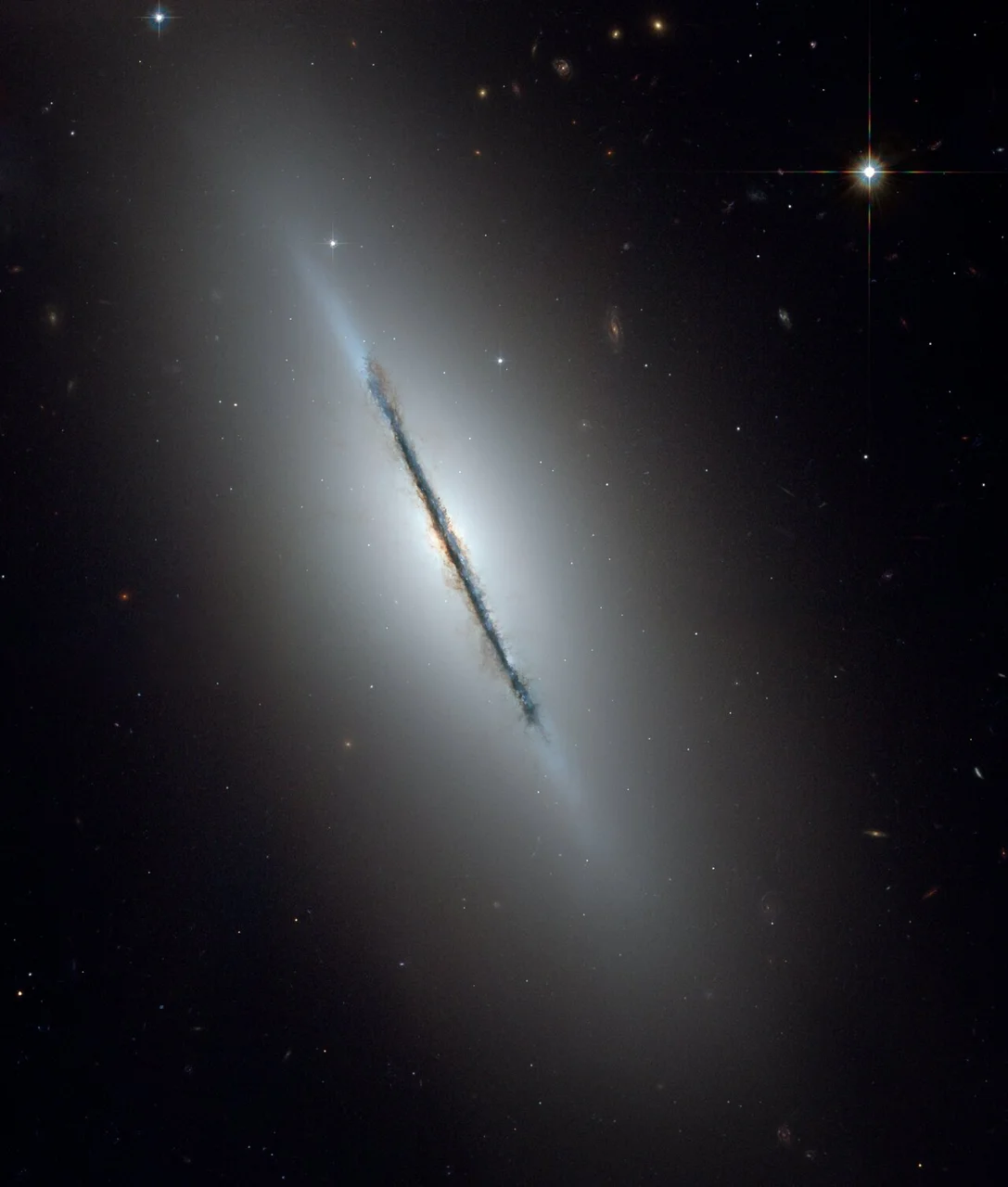 View larger ↗
51 / 100 · Galaxies beyond our own
NGC 5866 on Edge
Hubble Space Telescope
A sharply defined dust lane bisects NGC 5866 in this nearly edge-on view, revealing the thin profile of its galactic disk.
A reflection on God’s handiwork
A change of viewpoint can reveal a whole new kind of elegance.
Image credit: NASA , ESA , and The Hubble Heritage Team ( STScI / AURA )
Image story & original downloads ↗CC BY 4.0 · Image resized and converted for web display; caption adapted from ESA/Hubble.
Back to gallery navigation ↑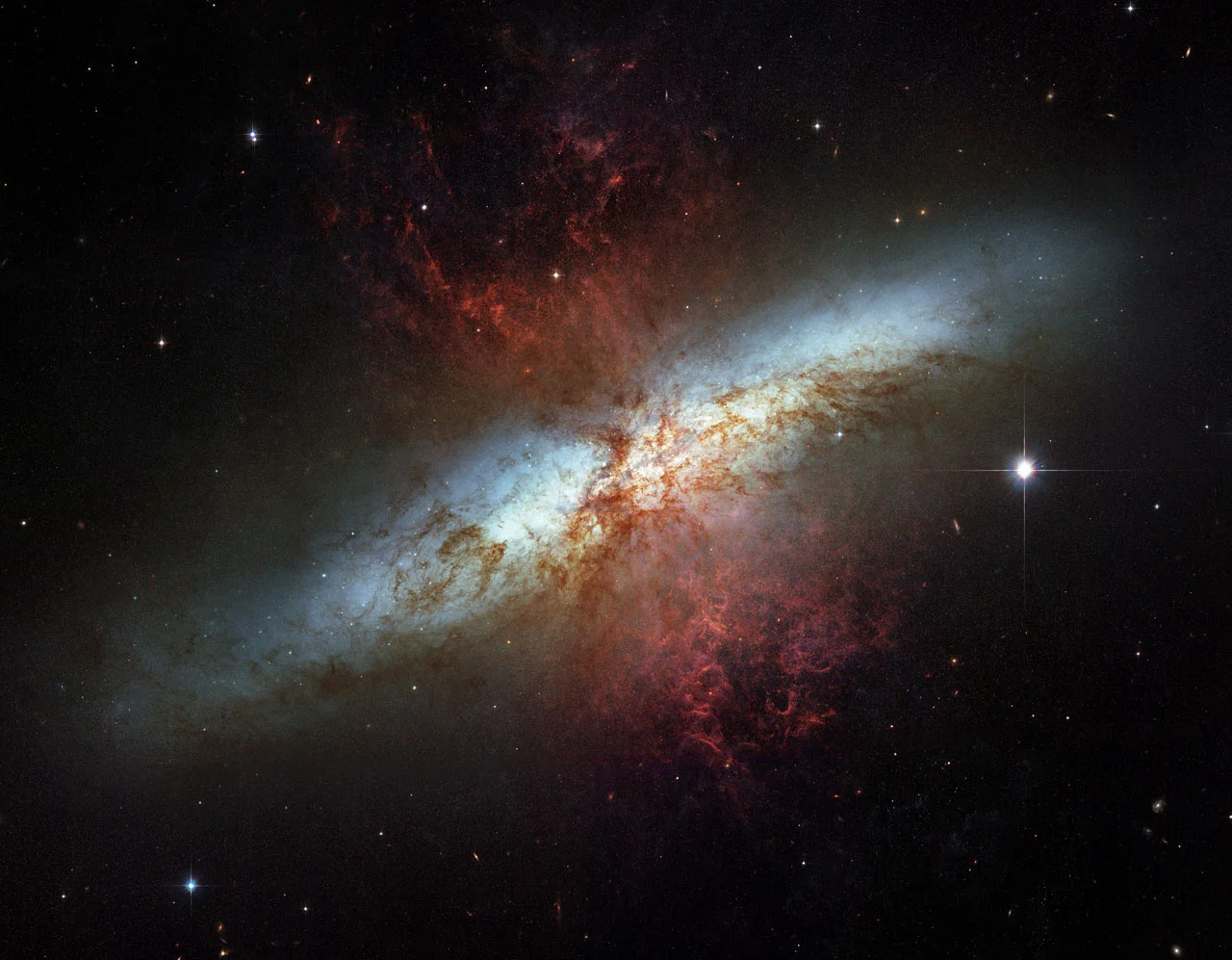 View larger ↗
52 / 100 · Galaxies beyond our own
The Starburst Galaxy Messier 82
Hubble Space Telescope
Messier 82 is filled with intense star formation and dramatic outflows, visible as glowing material extending beyond its crowded central region.
A reflection on God’s handiwork
Its energetic beauty invites awe at a universe that is continually changing.
CC BY 4.0 · Image resized and converted for web display; caption adapted from ESA/Hubble.
Back to gallery navigation ↑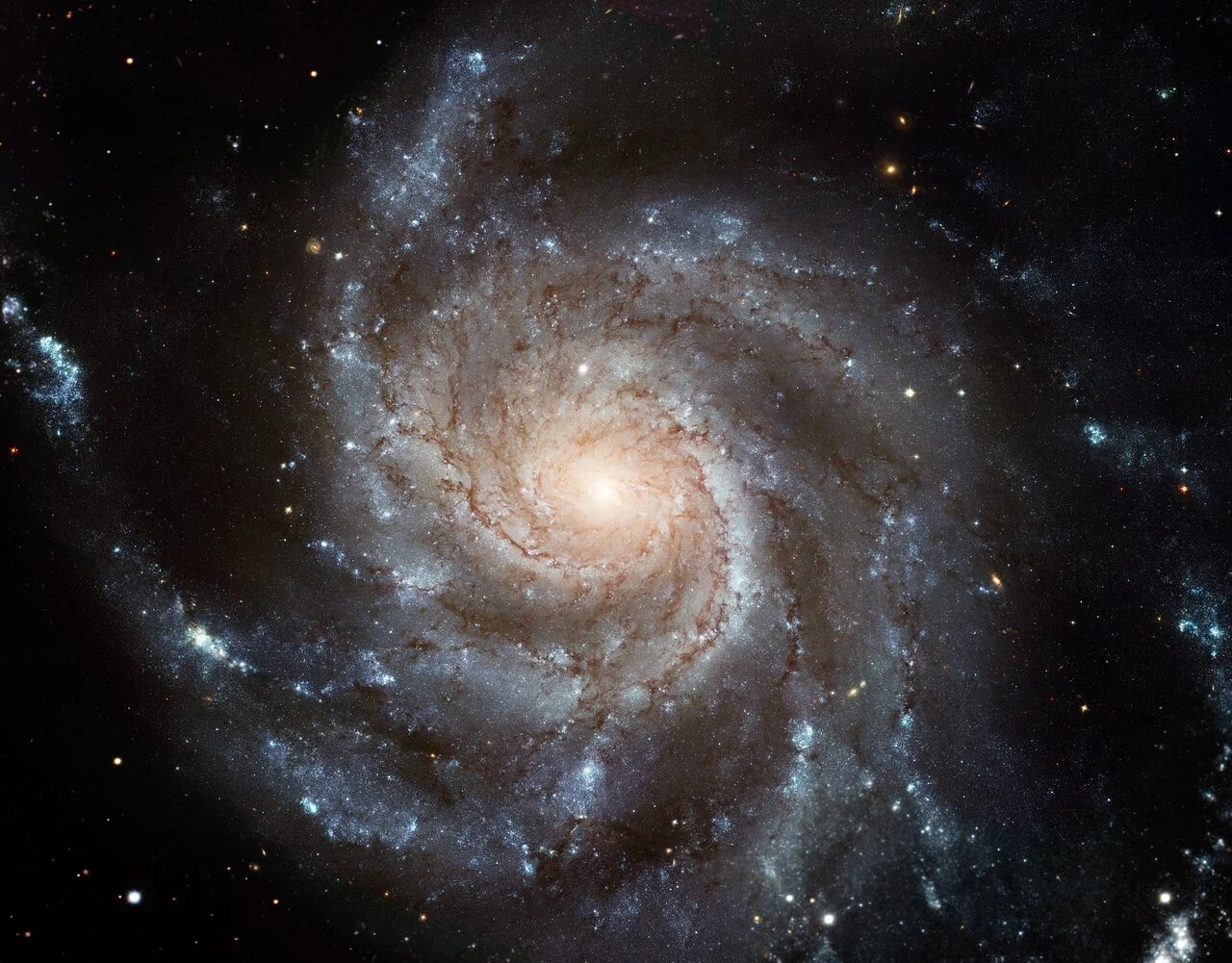 View larger ↗
53 / 100 · Galaxies beyond our own
The Pinwheel Galaxy
Hubble + ground-based observations
Hubble’s mosaic of Messier 101 traces an expansive spiral disk with bright star-forming regions scattered along its arms.
A reflection on God’s handiwork
Its open spiral offers a visual invitation to explore farther and look more closely.
CC BY 4.0 · Image resized and converted for web display; caption adapted from ESA/Hubble.
Back to gallery navigation ↑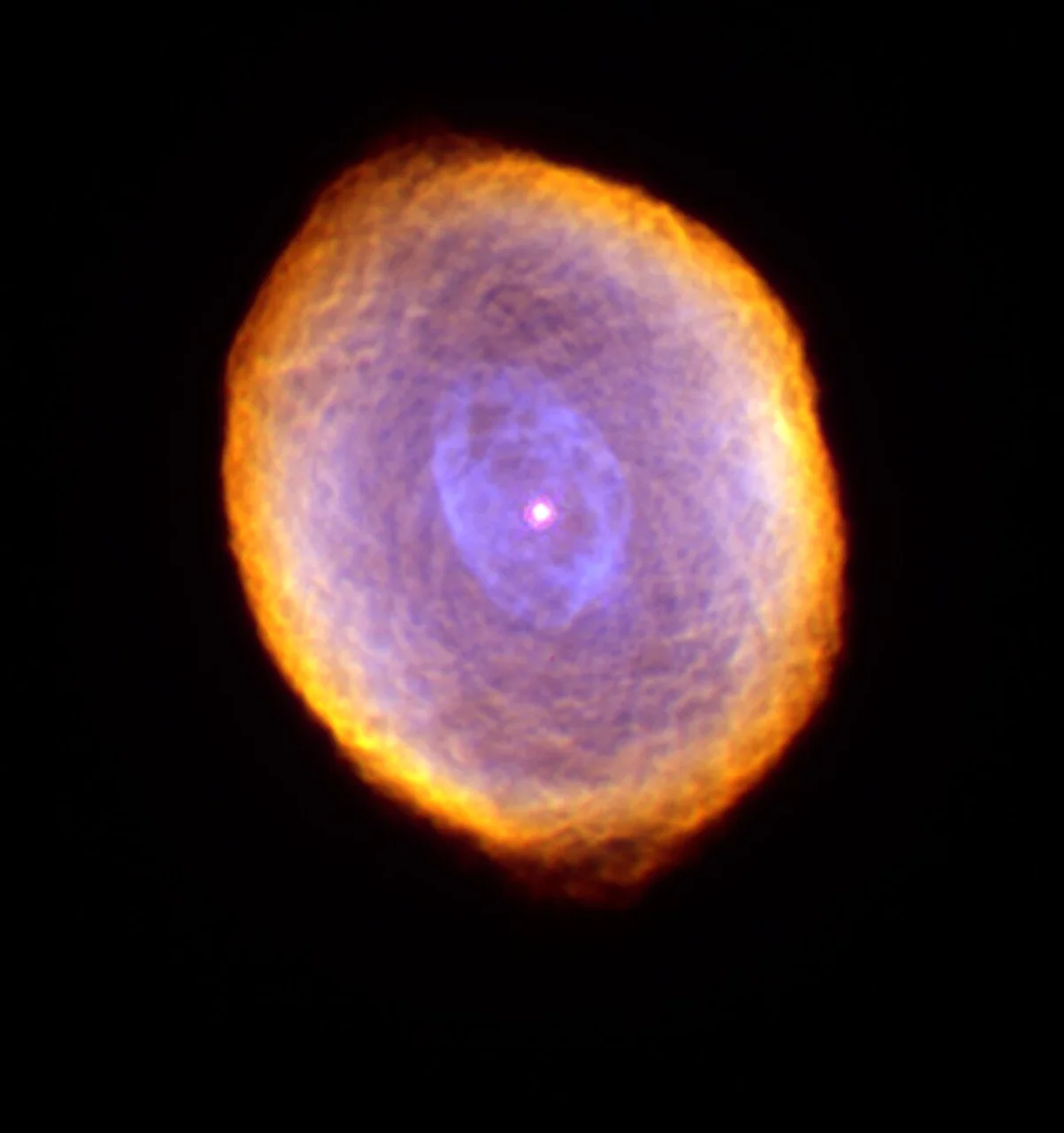 View larger ↗
54 / 100 · The changing lives of stars
The Spirograph Nebula
Hubble Space Telescope
The planetary nebula IC 418 shows fine, overlapping patterns within its glowing shell. Hubble’s image reveals textures whose origins remain uncertain.
A reflection on God’s handiwork
Its interwoven appearance invites reflection on intricate beauty that we can admire before fully understanding it.
Image credit: NASA / ESA and The Hubble Heritage Team ( STScI / AURA )
Image story & original downloads ↗CC BY 4.0 · Image resized and converted for web display; caption adapted from ESA/Hubble.
Back to gallery navigation ↑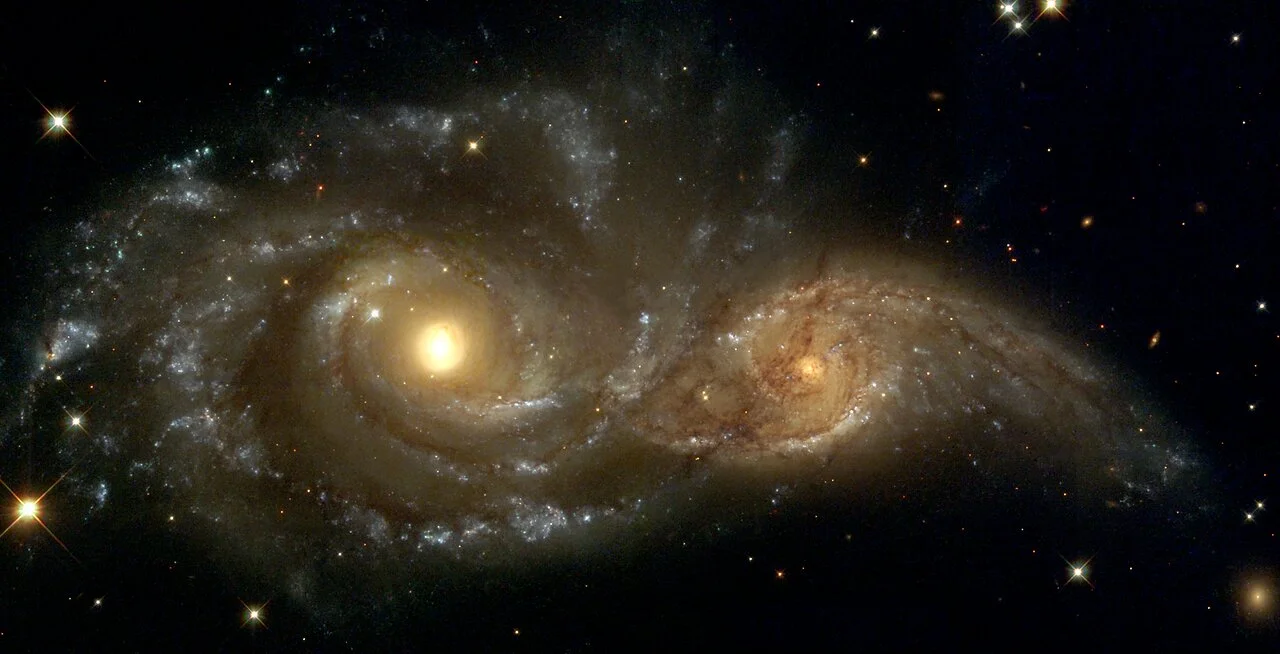 View larger ↗
55 / 100 · Galaxies beyond our own
A Grazing Encounter Between Galaxies
Hubble Space Telescope
Two spiral galaxies pass close to each other in this Hubble view, their gravitational encounter revealing how neighboring systems can influence one another.
A reflection on God’s handiwork
Their meeting invites contemplation of the relationships that shape creation on immense scales.
Image credit: NASA / ESA and The Hubble Heritage Team ( STScI )
Image story & original downloads ↗CC BY 4.0 · Image resized and converted for web display; caption adapted from ESA/Hubble.
Back to gallery navigation ↑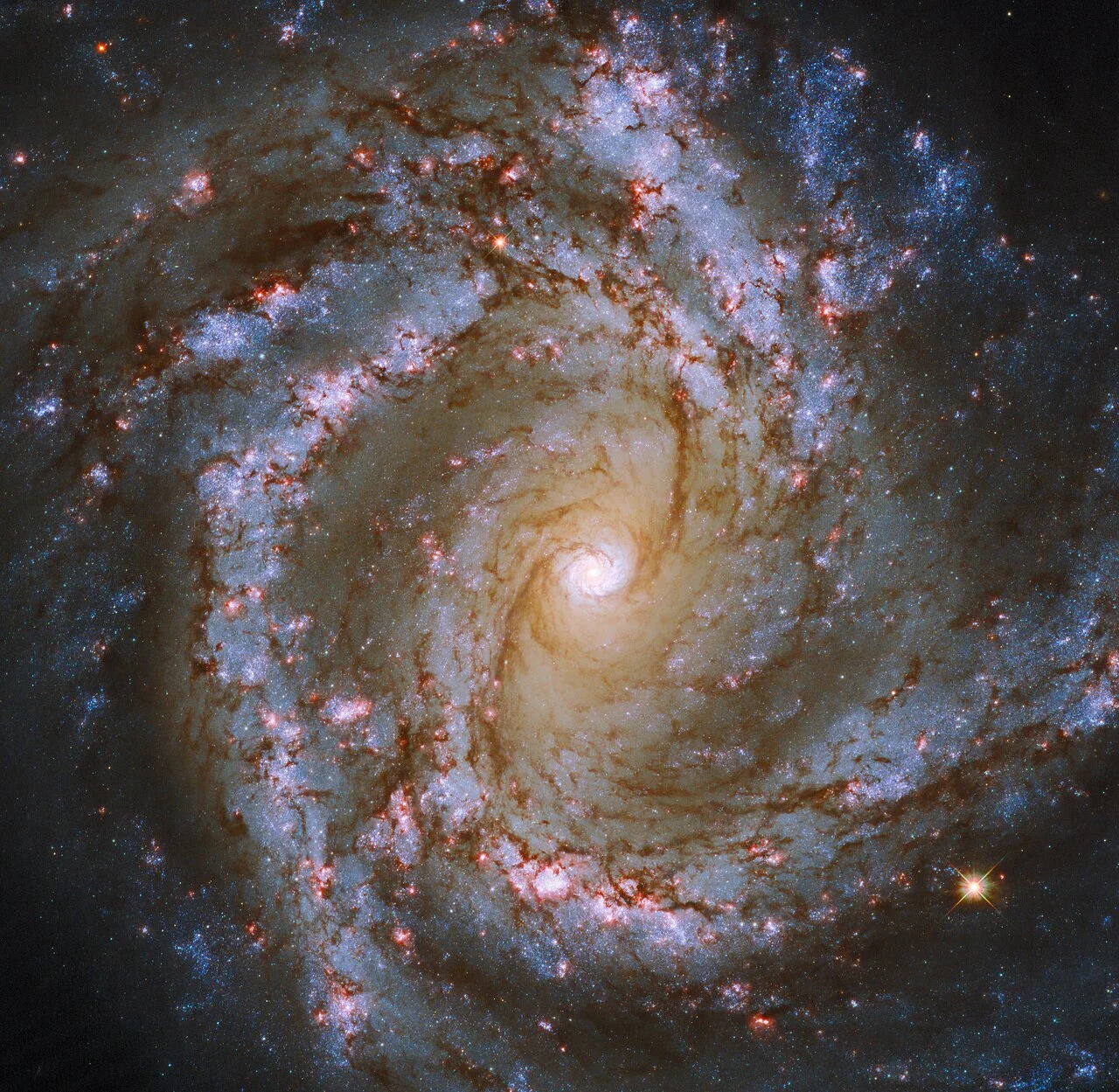 View larger ↗
56 / 100 · Galaxies beyond our own
The Spiral Galaxy Messier 61
Hubble + ESO Very Large Telescope
Combined Hubble and Very Large Telescope observations reveal Messier 61’s bright center, dusty arms, and reddish patches of recent star formation.
A reflection on God’s handiwork
Its radiant structure invites gratitude for the beauty revealed when people bring different views together.
Image credit: ESA/Hubble & NASA, ESO, J. Lee and the PHANGS-HST Team
Image story & original downloads ↗CC BY 4.0 · Image resized and converted for web display; caption adapted from ESA/Hubble.
Back to gallery navigation ↑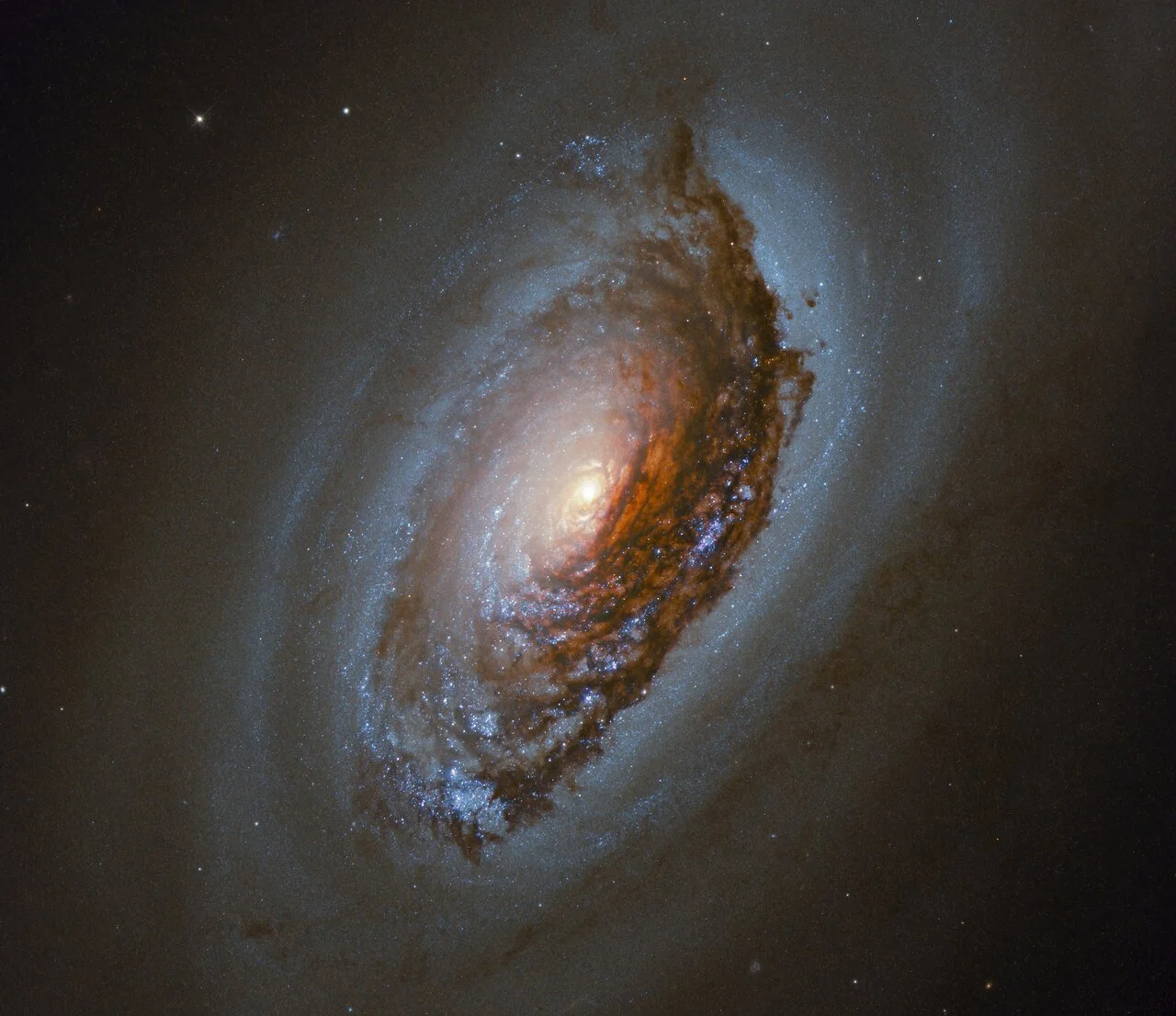 View larger ↗
57 / 100 · Galaxies beyond our own
The Black Eye Galaxy
Hubble Space Telescope
NGC 4826 is distinguished by a prominent dark dust band crossing its bright center, giving it the nickname Black Eye Galaxy.
A reflection on God’s handiwork
Shadow becomes part of the portrait, inviting us to see the whole with care.
Image credit: ESA/Hubble & NASA, J. Lee and the PHANGS-HST Team Acknowledgement: Judy Schmidt
Image story & original downloads ↗CC BY 4.0 · Image resized and converted for web display; caption adapted from ESA/Hubble.
Back to gallery navigation ↑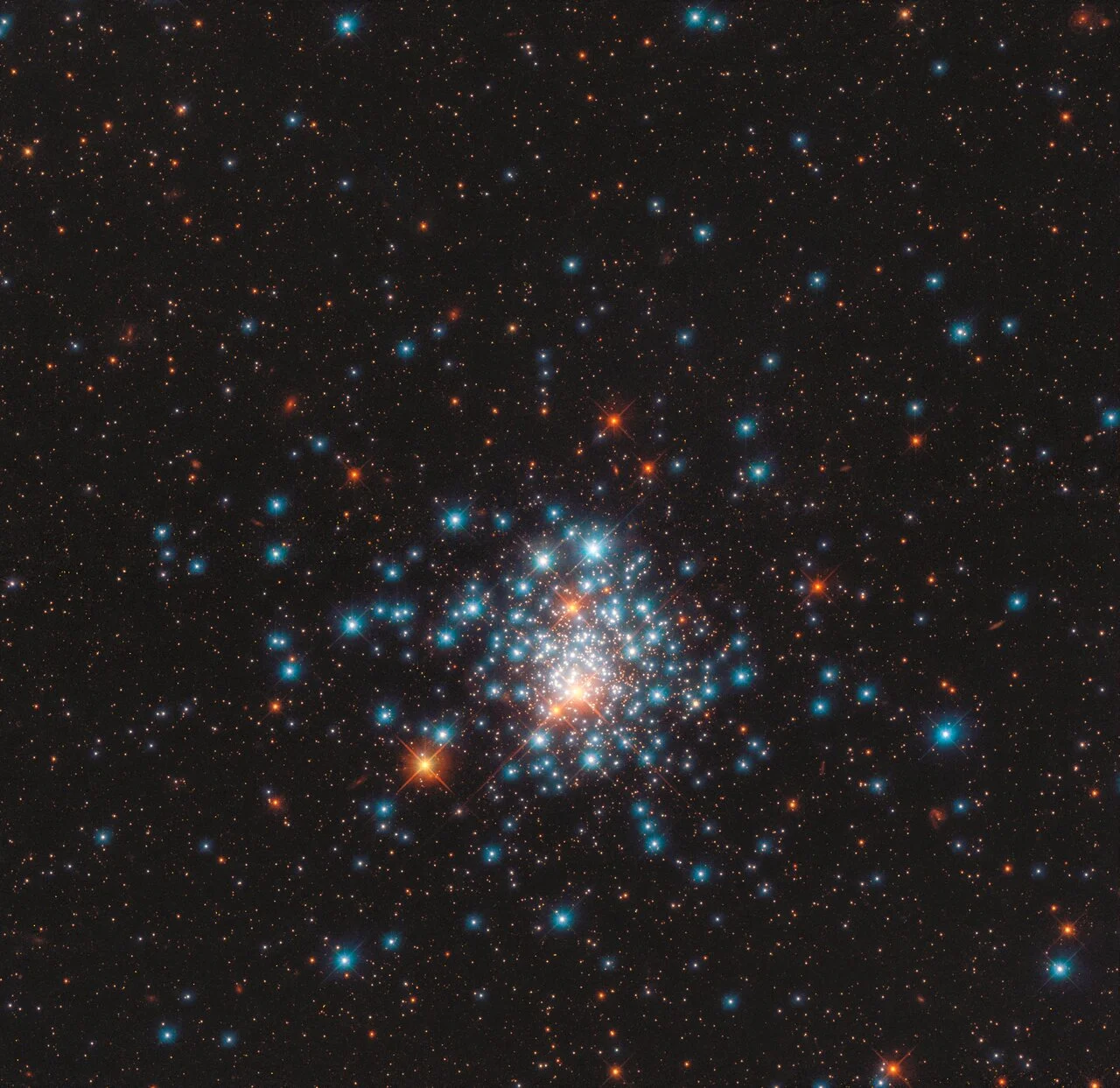 View larger ↗
58 / 100 · Gatherings of stars
A Pocketful of Stars: NGC 1805
Hubble Space Telescope
The compact cluster NGC 1805 contains many differently colored stars near the outer region of the Large Magellanic Cloud.
A reflection on God’s handiwork
Every point of light contributes to an abundance too rich to count at a glance.
Image credit: ESA/Hubble & NASA, J. Kalirai
Image story & original downloads ↗CC BY 4.0 · Image resized and converted for web display; caption adapted from ESA/Hubble.
Back to gallery navigation ↑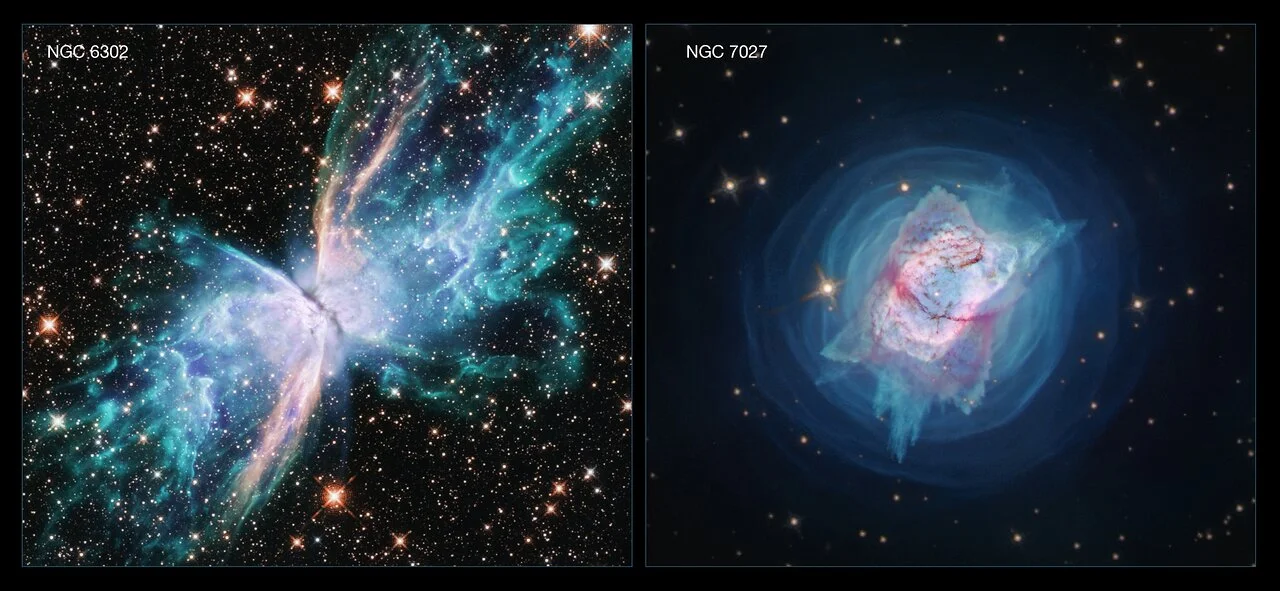 View larger ↗
59 / 100 · The changing lives of stars
Two Nebulae, Two Forms
Hubble Space Telescope
This paired image compares NGC 6302 and NGC 7027, young planetary nebulae whose dusty structures reveal markedly different shapes.
A reflection on God’s handiwork
Related beginnings can lead to striking variety, a fitting invitation to celebrate creation’s diversity.
Image credit: NASA, ESA, and J. Kastner (RIT)
Image story & original downloads ↗CC BY 4.0 · Image resized and converted for web display; caption adapted from ESA/Hubble.
Back to gallery navigation ↑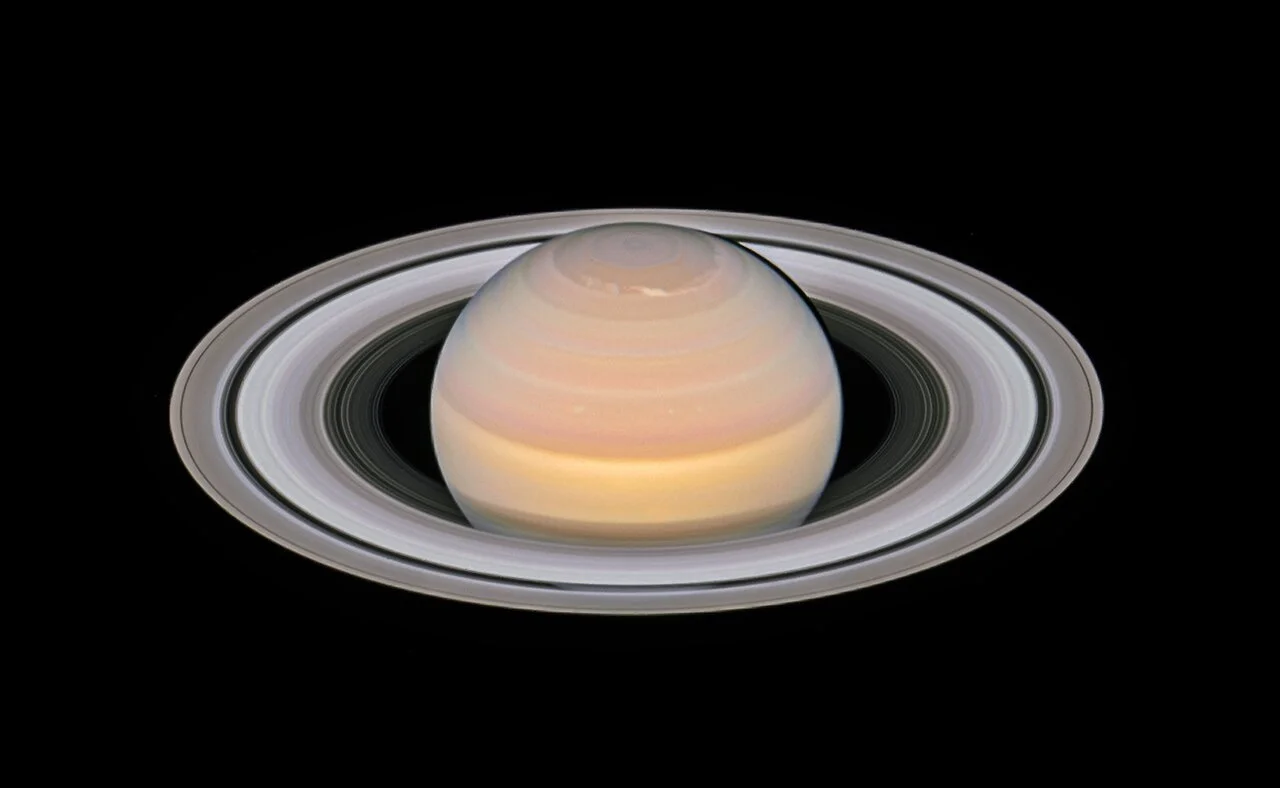 View larger ↗
60 / 100 · Our solar neighborhood
Saturn and Its Rings in 2018
Hubble Space Telescope
This 2018 observation presents Saturn’s rings and atmospheric details, offering another seasonal portrait of the changing giant planet.
A reflection on God’s handiwork
Returning to a familiar world can reveal fresh reasons for gratitude.
Image credit: NASA, ESA, A. Simon (GSFC) and the OPAL Team, and J. DePasquale (STScI)
Image story & original downloads ↗CC BY 4.0 · Image resized and converted for web display; caption adapted from ESA/Hubble.
Back to gallery navigation ↑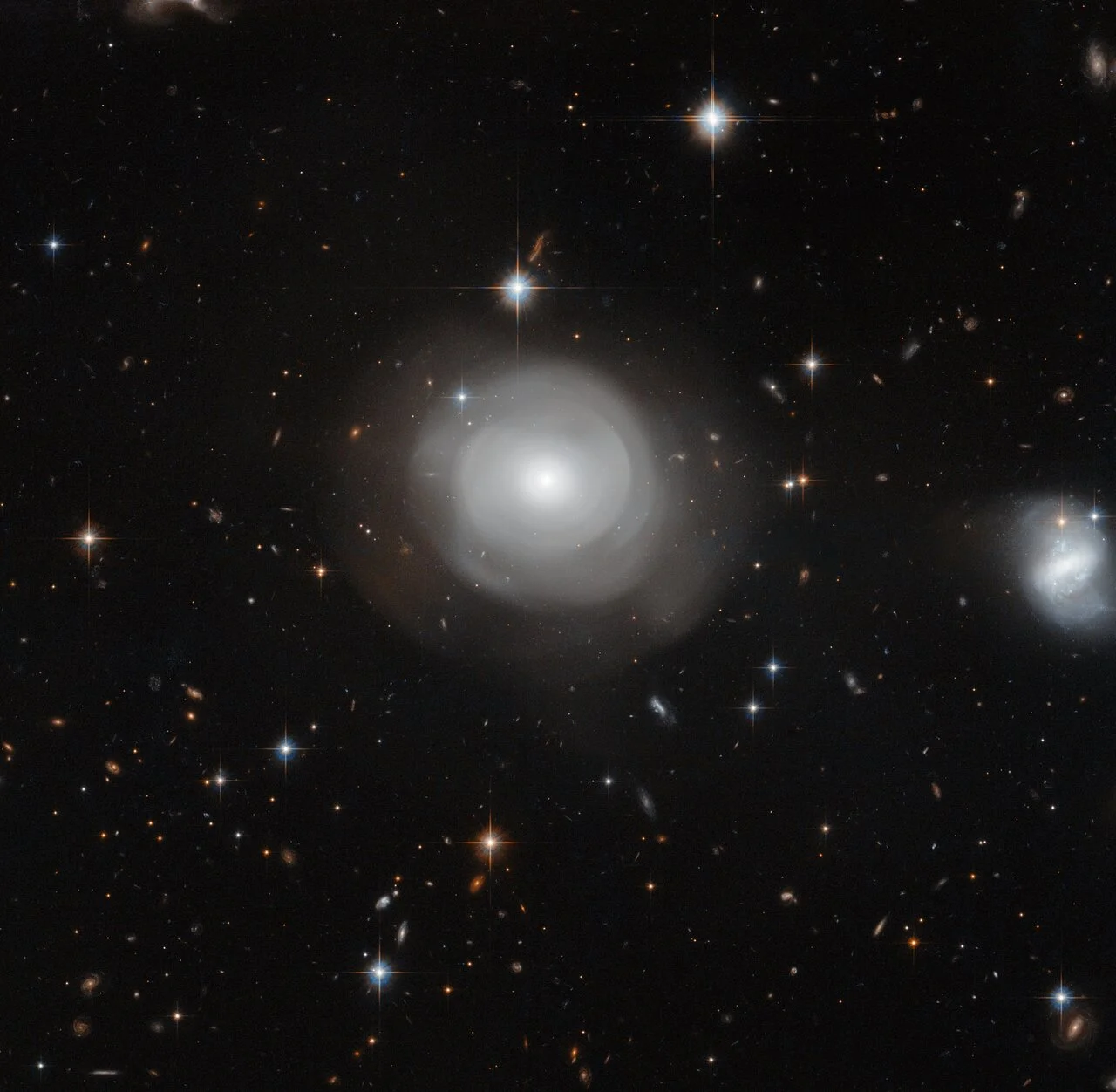 View larger ↗
61 / 100 · Galaxies beyond our own
The Shells of ESO 381-12
Hubble Space Telescope
Uneven, faint shells surround ESO 381-12, while distant galaxies form a background to its unusual stellar structure.
A reflection on God’s handiwork
Subtle forms reward a lingering gaze and invite us to value quieter kinds of beauty.
Image credit: NASA , ESA , P. Goudfrooij (STScI)
Image story & original downloads ↗CC BY 4.0 · Image resized and converted for web display; caption adapted from ESA/Hubble.
Back to gallery navigation ↑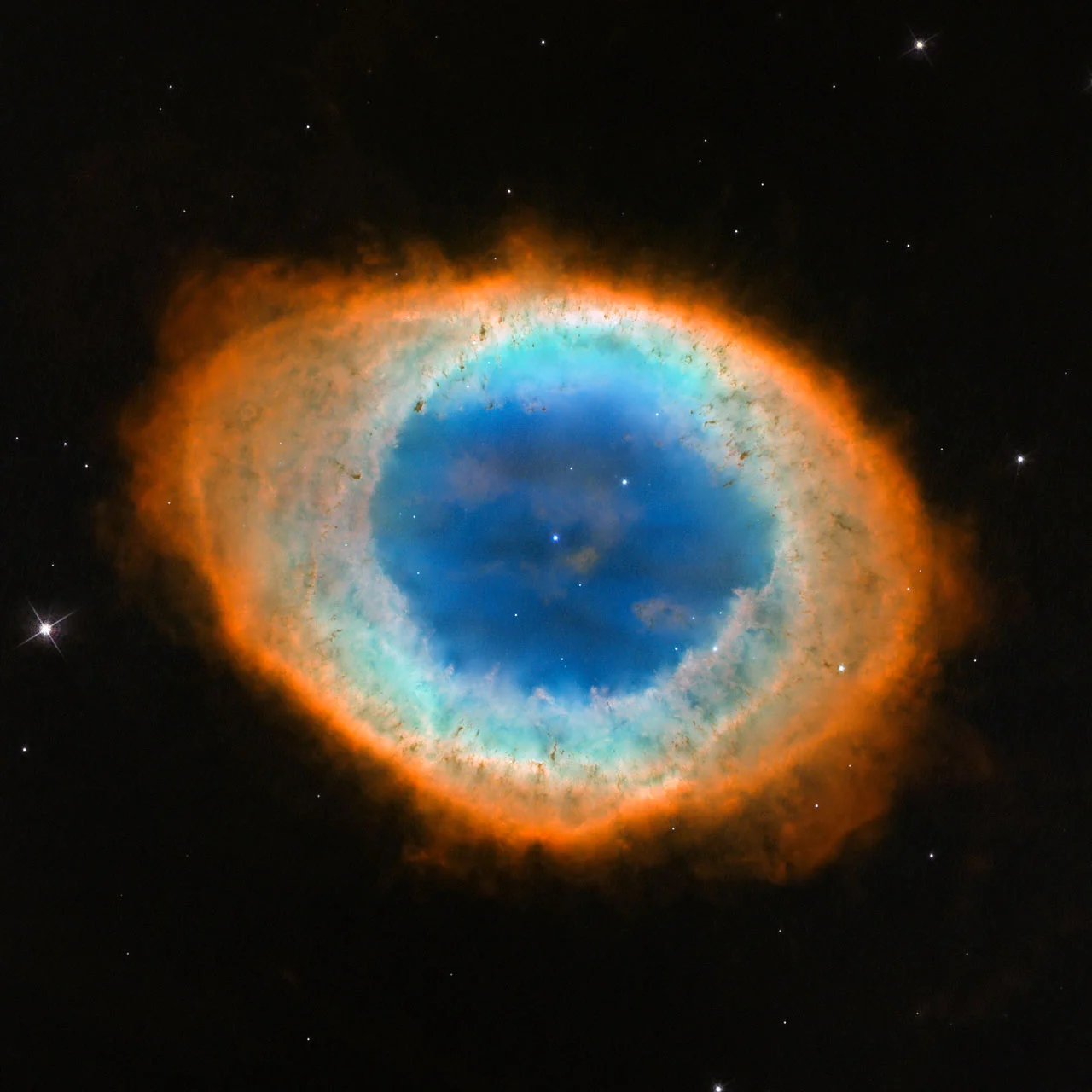 View larger ↗
62 / 100 · Where stars are born
The Ring Nebula
Hubble Space Telescope
Messier 57 appears as a glowing oval, though its three-dimensional structure is more complex than the ring suggested by its outline.
A reflection on God’s handiwork
What we see is only one view of a deeper reality, an invitation to humility.
Image credit: NASA, ESA, and C. Robert O’Dell (Vanderbilt University).
Image story & original downloads ↗CC BY 4.0 · Image resized and converted for web display; caption adapted from ESA/Hubble.
Back to gallery navigation ↑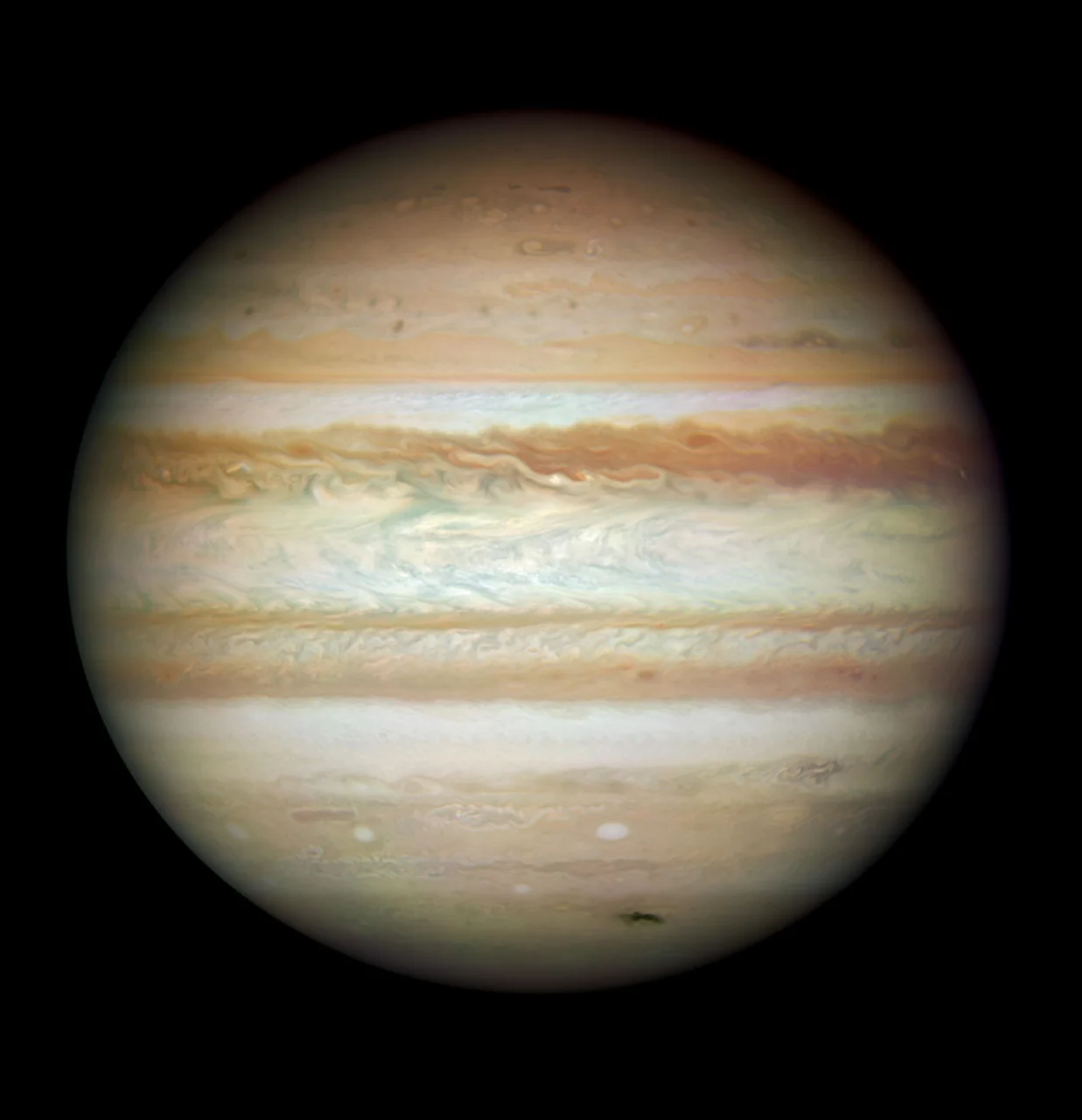 View larger ↗
63 / 100 · Our solar neighborhood
Jupiter After an Impact
Hubble Space Telescope
This 2009 Hubble portrait records a dark mark in Jupiter’s atmosphere following an impact, alongside the planet’s familiar cloud bands.
A reflection on God’s handiwork
Even familiar worlds carry changing stories that encourage attentive observation.
CC BY 4.0 · Image resized and converted for web display; caption adapted from ESA/Hubble.
Back to gallery navigation ↑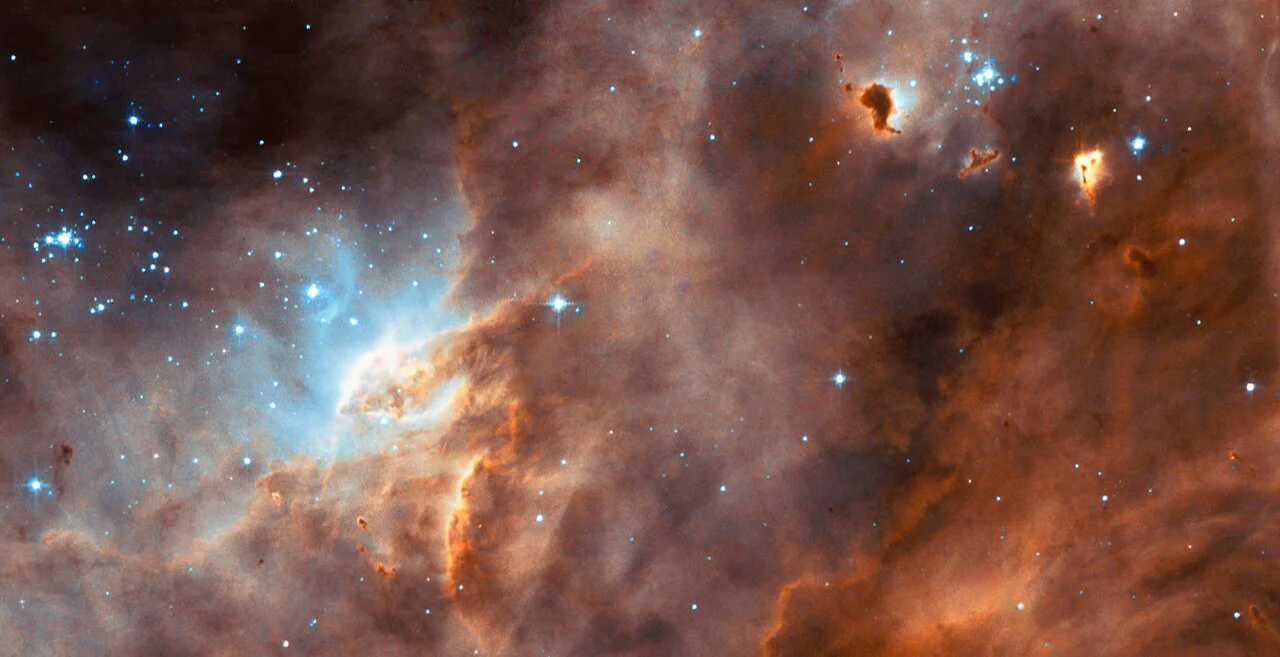 View larger ↗
64 / 100 · Gatherings of stars
Star Formation in N11
Hubble Space Telescope
Hubble’s panorama of N11 in the Large Magellanic Cloud reveals bright gas, dusty clouds, and clusters of young stars.
A reflection on God’s handiwork
Many sites of new light fill one landscape, inviting reflection on abundance and renewal.
Image credit: NASA/ ESA and the Hubble Heritage Team ( AURA / STScI /HEIC)
Image story & original downloads ↗CC BY 4.0 · Image resized and converted for web display; caption adapted from ESA/Hubble.
Back to gallery navigation ↑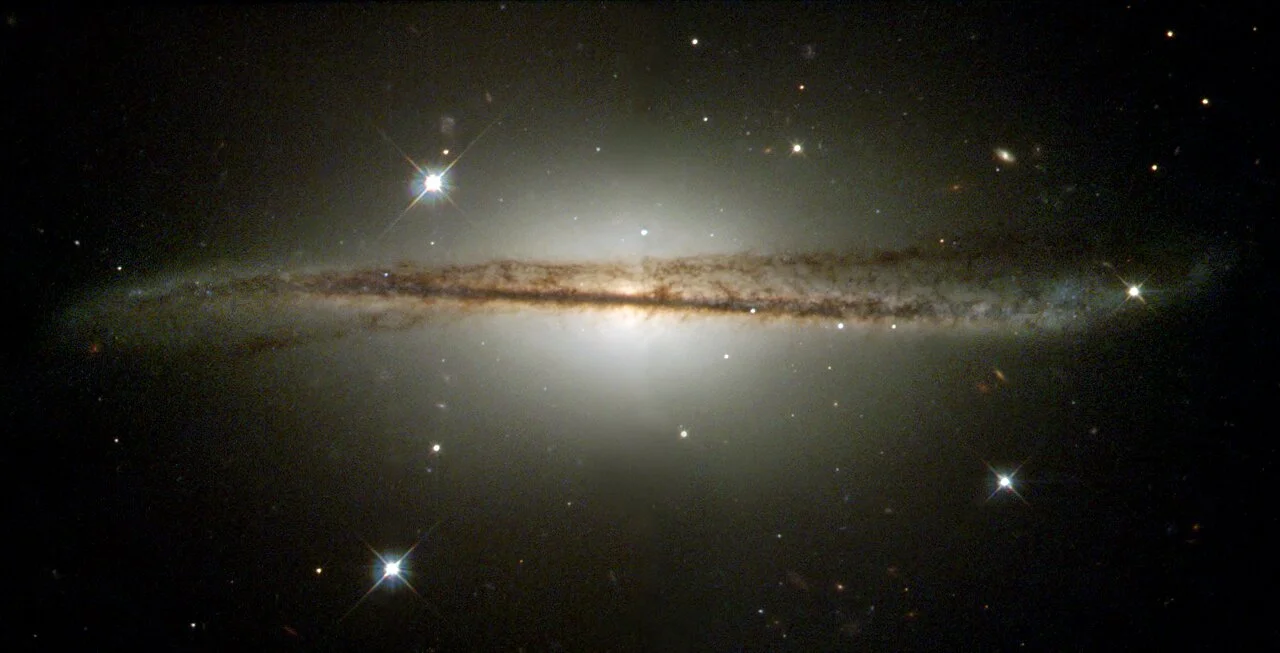 View larger ↗
65 / 100 · Where stars are born
The Warped Disk of ESO 510-G13
Hubble Space Telescope
Seen nearly edge-on, ESO 510-G13 shows a twisted dust lane, evidence of a disturbed structure rather than a simple flat disk.
A reflection on God’s handiwork
Unexpected forms remind us that beauty extends beyond perfect symmetry.
Image credit: NASA / ESA and The Hubble Heritage Team ( STScI / AURA )
Image story & original downloads ↗CC BY 4.0 · Image resized and converted for web display; caption adapted from ESA/Hubble.
Back to gallery navigation ↑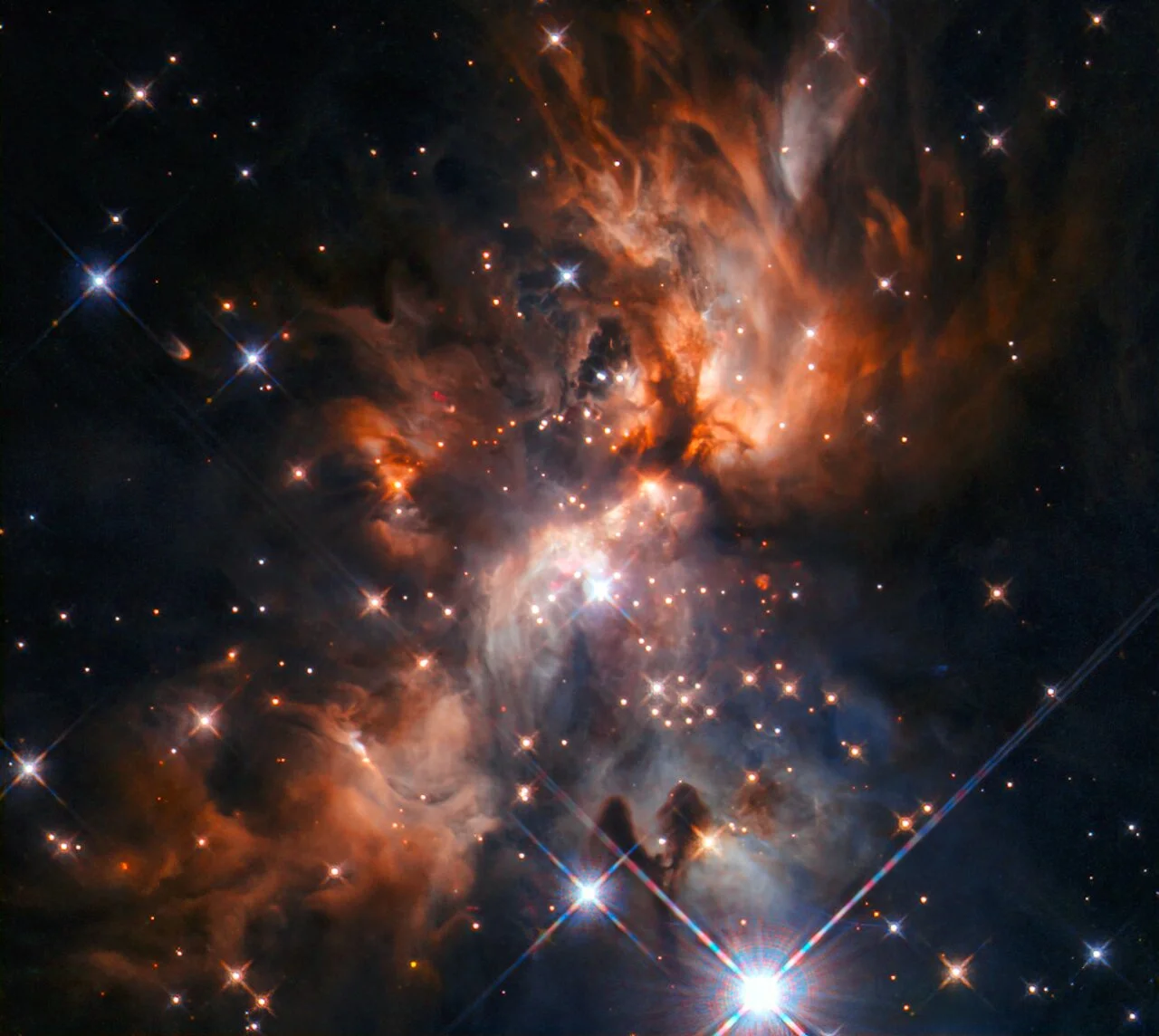 View larger ↗
66 / 100 · Where stars are born
Through the Clouds: AFGL 5180
Hubble Space Telescope
A forming star sends jets through the dusty nursery AFGL 5180, opening cavities in the surrounding material.
A reflection on God’s handiwork
Hidden beginnings become visible, inviting wonder at what is unfolding beyond our sight.
CC BY 4.0 · Image resized and converted for web display; caption adapted from ESA/Hubble.
Back to gallery navigation ↑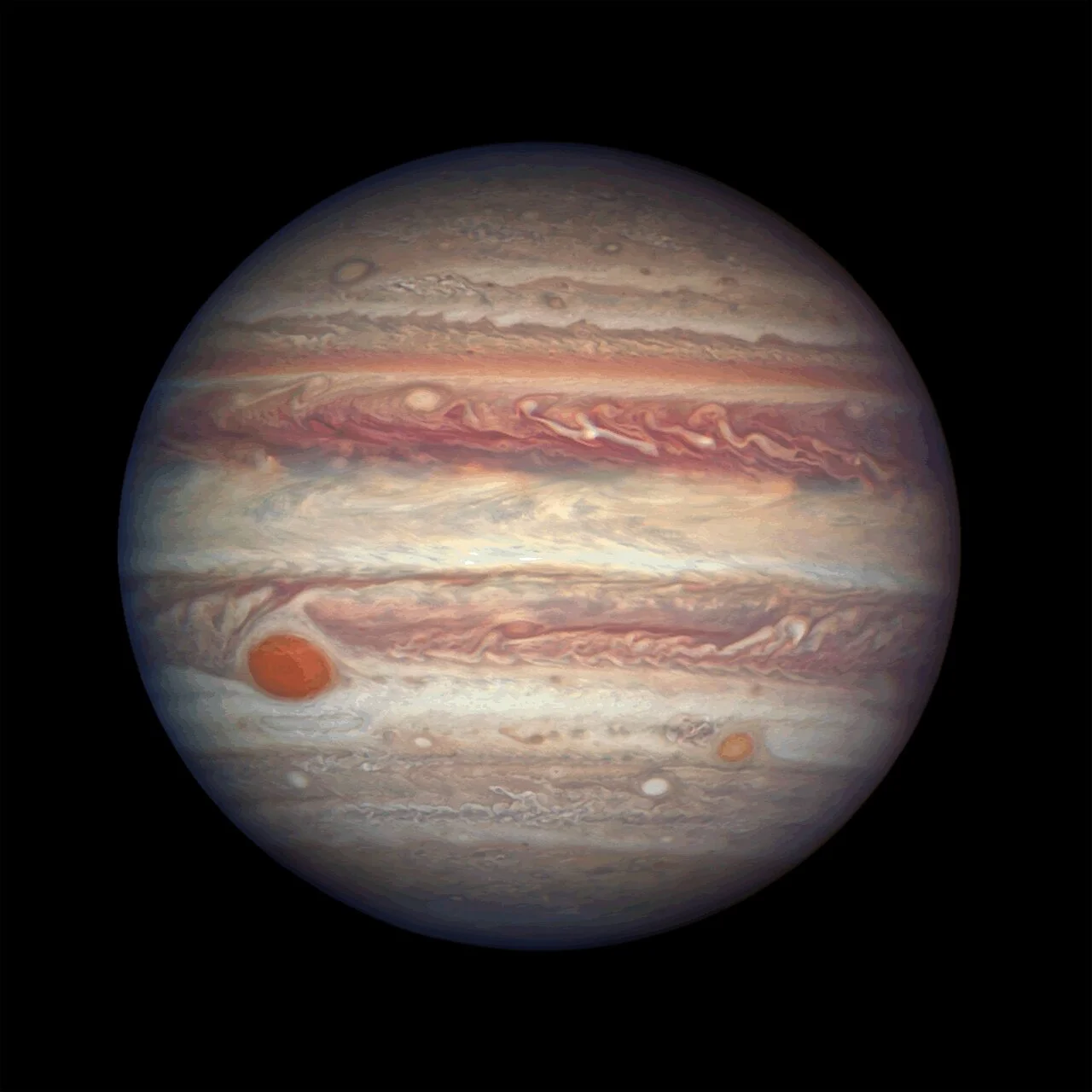 View larger ↗
67 / 100 · Our solar neighborhood
Jupiter’s Swirling Clouds
Hubble Space Telescope
Jupiter’s colorful bands reflect atmospheric circulation at different latitudes, giving Hubble a detailed view of the giant planet’s weather.
A reflection on God’s handiwork
The patterns of a neighboring world invite appreciation for creation’s restless intricacy.
Image credit: NASA, ESA, and A. Simon (GSFC)
Image story & original downloads ↗CC BY 4.0 · Image resized and converted for web display; caption adapted from ESA/Hubble.
Back to gallery navigation ↑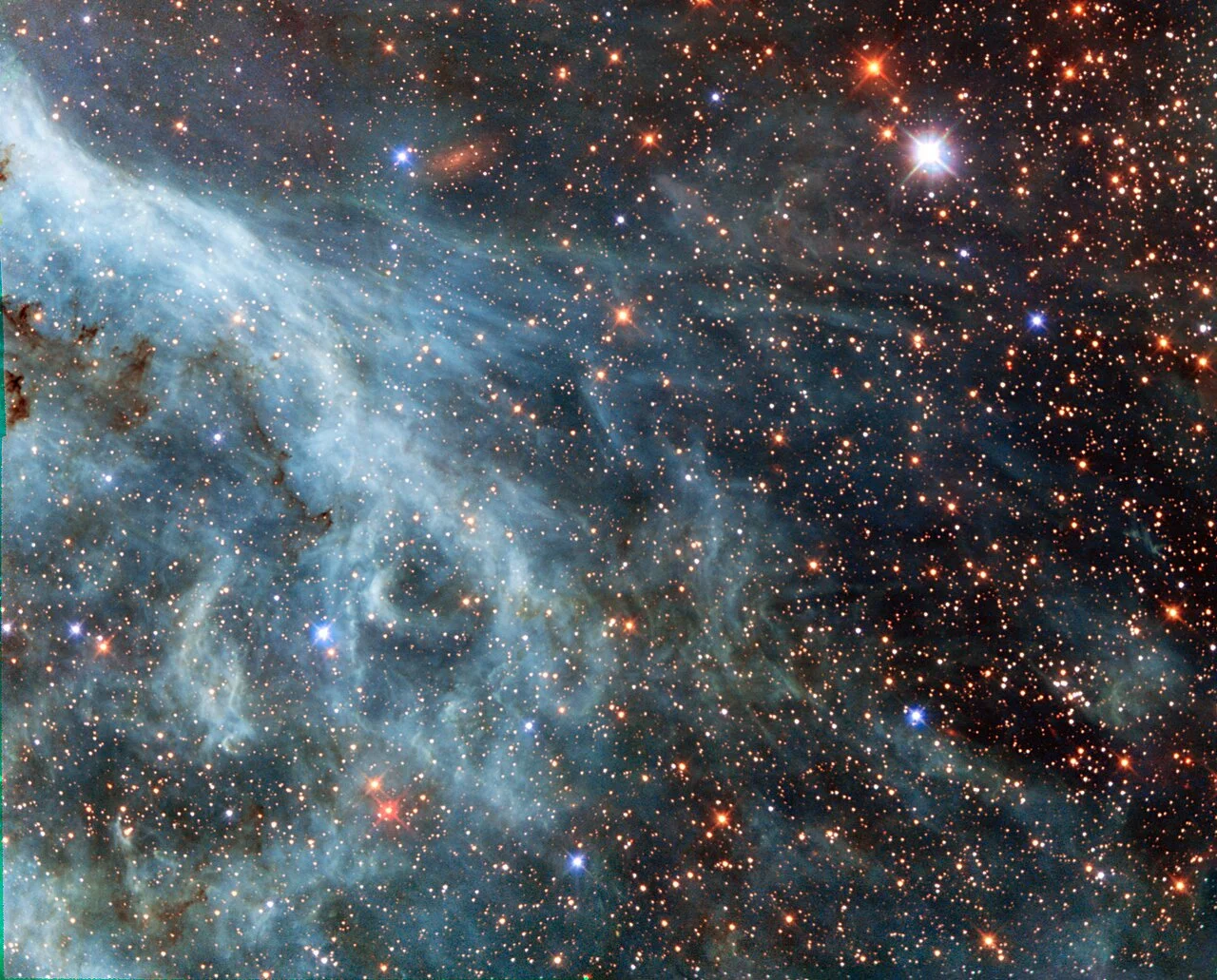 View larger ↗
68 / 100 · Where stars are born
Clouds in the Large Magellanic Cloud
Hubble Space Telescope
Turquoise-looking gas and wispy structures fill this Hubble view of a region in the nearby Large Magellanic Cloud.
A reflection on God’s handiwork
Its flowing appearance invites contemplation of beauty shared across very different natural scales.
Image credit: ESA/Hubble & NASA Acknowledgement: Josh Barrington
Image story & original downloads ↗CC BY 4.0 · Image resized and converted for web display; caption adapted from ESA/Hubble.
Back to gallery navigation ↑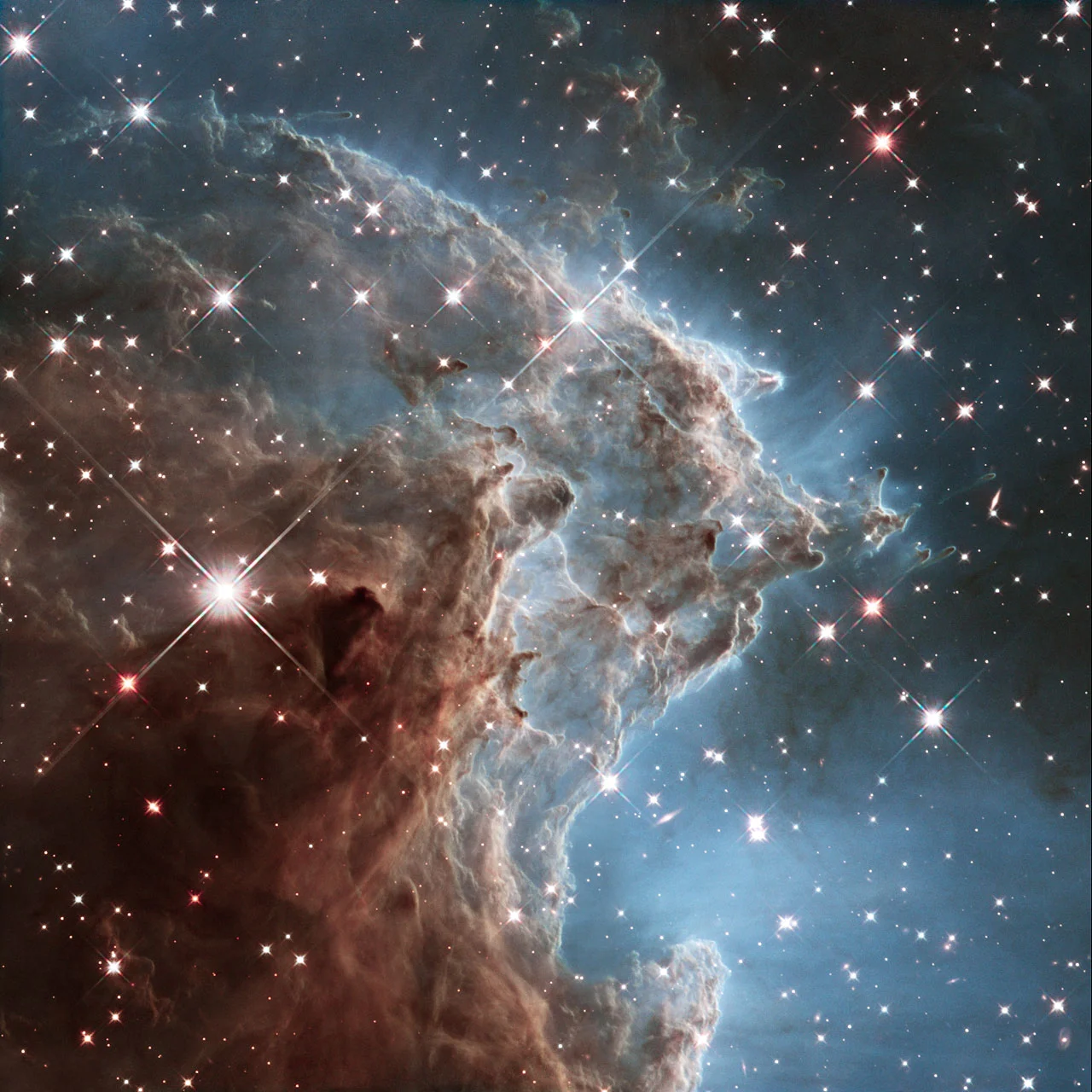 View larger ↗
69 / 100 · Where stars are born
The Monkey Head Nebula
Hubble Space Telescope
Infrared observations explore NGC 2174, revealing young stars amid the cloud structures of this star-forming region in Orion.
A reflection on God’s handiwork
A familiar shape can draw us toward a deeper encounter with the unfamiliar.
Image credit: NASA , ESA , and the Hubble Heritage Team (STScI/AURA)
Image story & original downloads ↗CC BY 4.0 · Image resized and converted for web display; caption adapted from ESA/Hubble.
Back to gallery navigation ↑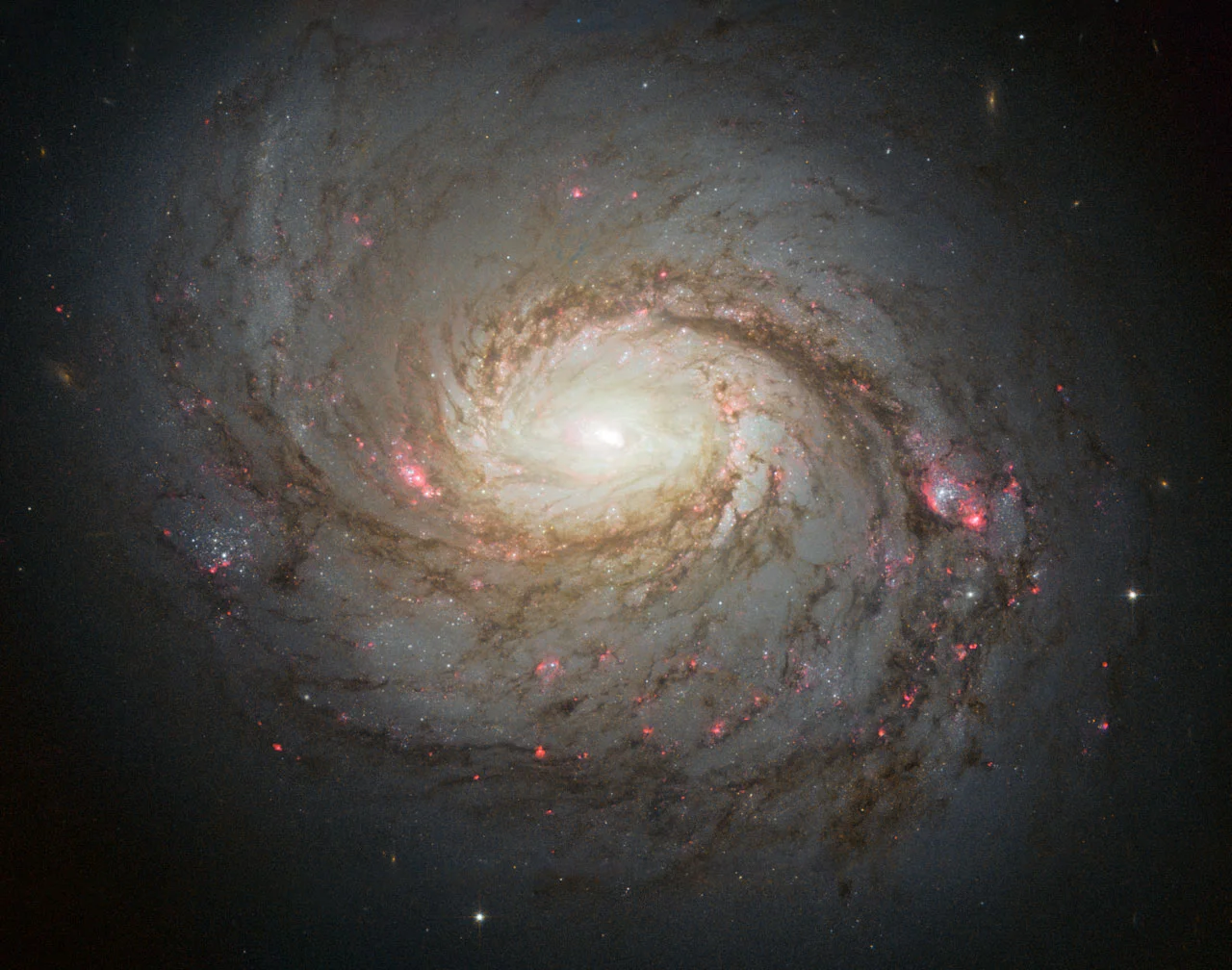 View larger ↗
70 / 100 · Galaxies beyond our own
The Active Galaxy Messier 77
Hubble Space Telescope
Dust lanes and colorful star-forming regions surround Messier 77’s luminous center; it belongs to the class of active Seyfert galaxies.
A reflection on God’s handiwork
Its layered radiance invites us to marvel at both the visible surface and hidden activity.
Image credit: NASA, ESA & A. van der Hoeven
Image story & original downloads ↗CC BY 4.0 · Image resized and converted for web display; caption adapted from ESA/Hubble.
Back to gallery navigation ↑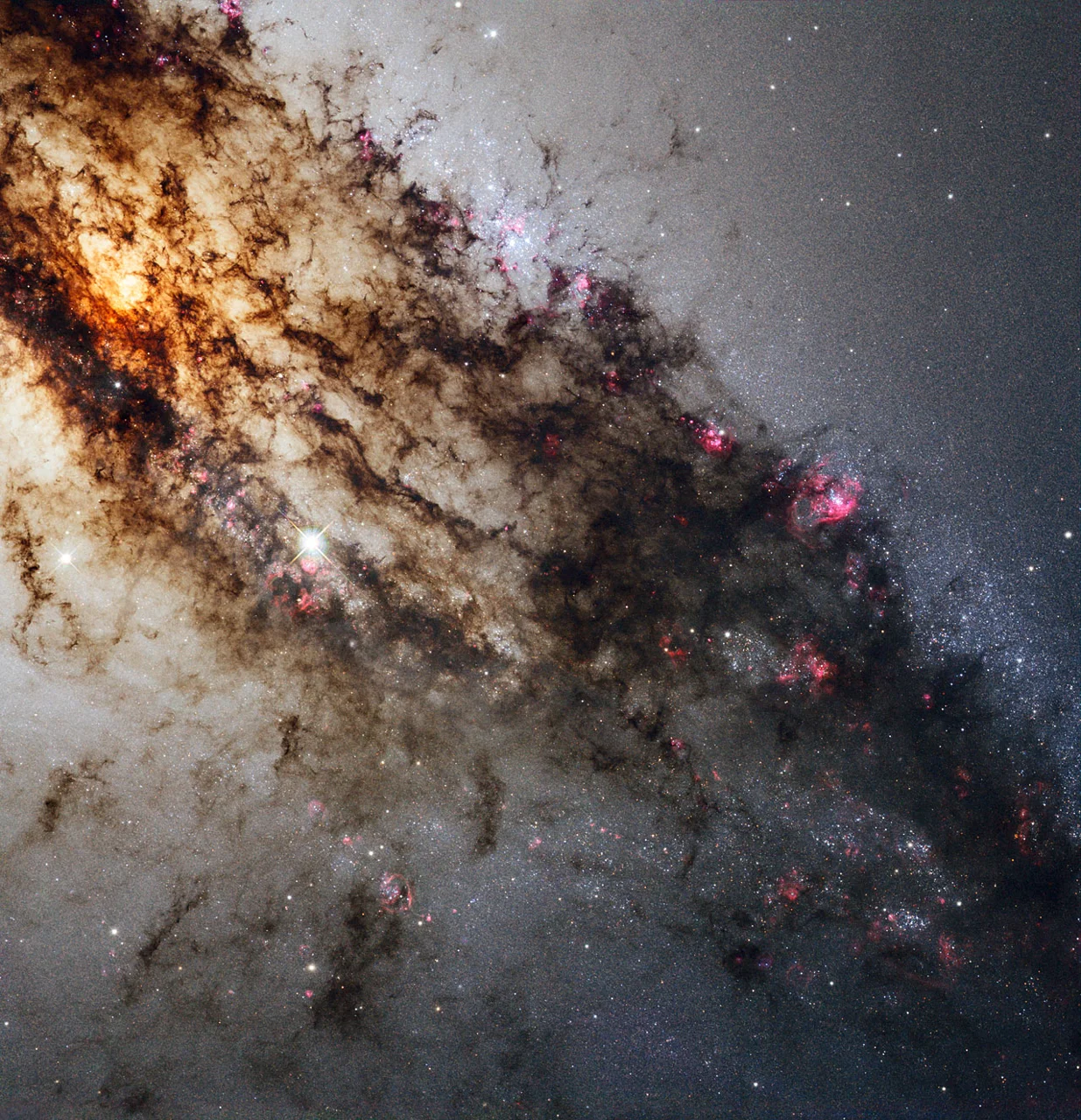 View larger ↗
71 / 100 · Where stars are born
The Dust Lanes of Centaurus A
Hubble Space Telescope
A broad, intricate dust band crosses Centaurus A. This multiwavelength image combines information about stars and material partly hidden from visible light.
A reflection on God’s handiwork
Looking through different windows encourages a fuller appreciation of God’s handiwork.
CC BY 4.0 · Image resized and converted for web display; caption adapted from ESA/Hubble.
Back to gallery navigation ↑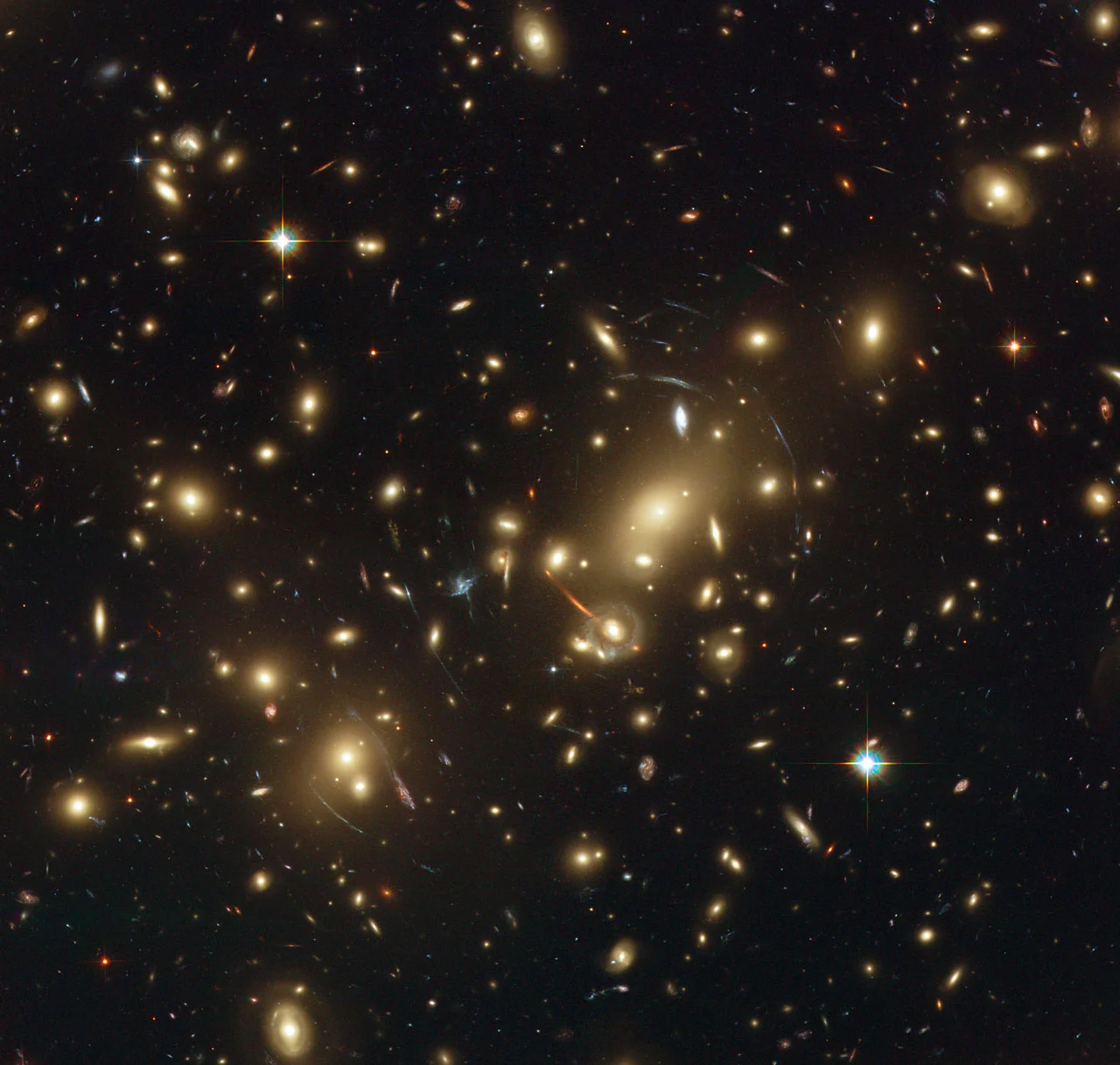 View larger ↗
72 / 100 · A window into immensity
Abell 2218: A Cosmic Lens
Hubble Space Telescope
The combined gravity of Abell 2218 bends light from more distant galaxies, stretching some of their images into slender arcs.
A reflection on God’s handiwork
Light traveling through immense distances invites contemplation of a universe richer than first appearances.
Image credit: NASA, ESA, and Johan Richard (Caltech, USA) Acknowledgement: Davide de Martin & James Long (ESA/Hubble)
Image story & original downloads ↗CC BY 4.0 · Image resized and converted for web display; caption adapted from ESA/Hubble.
Back to gallery navigation ↑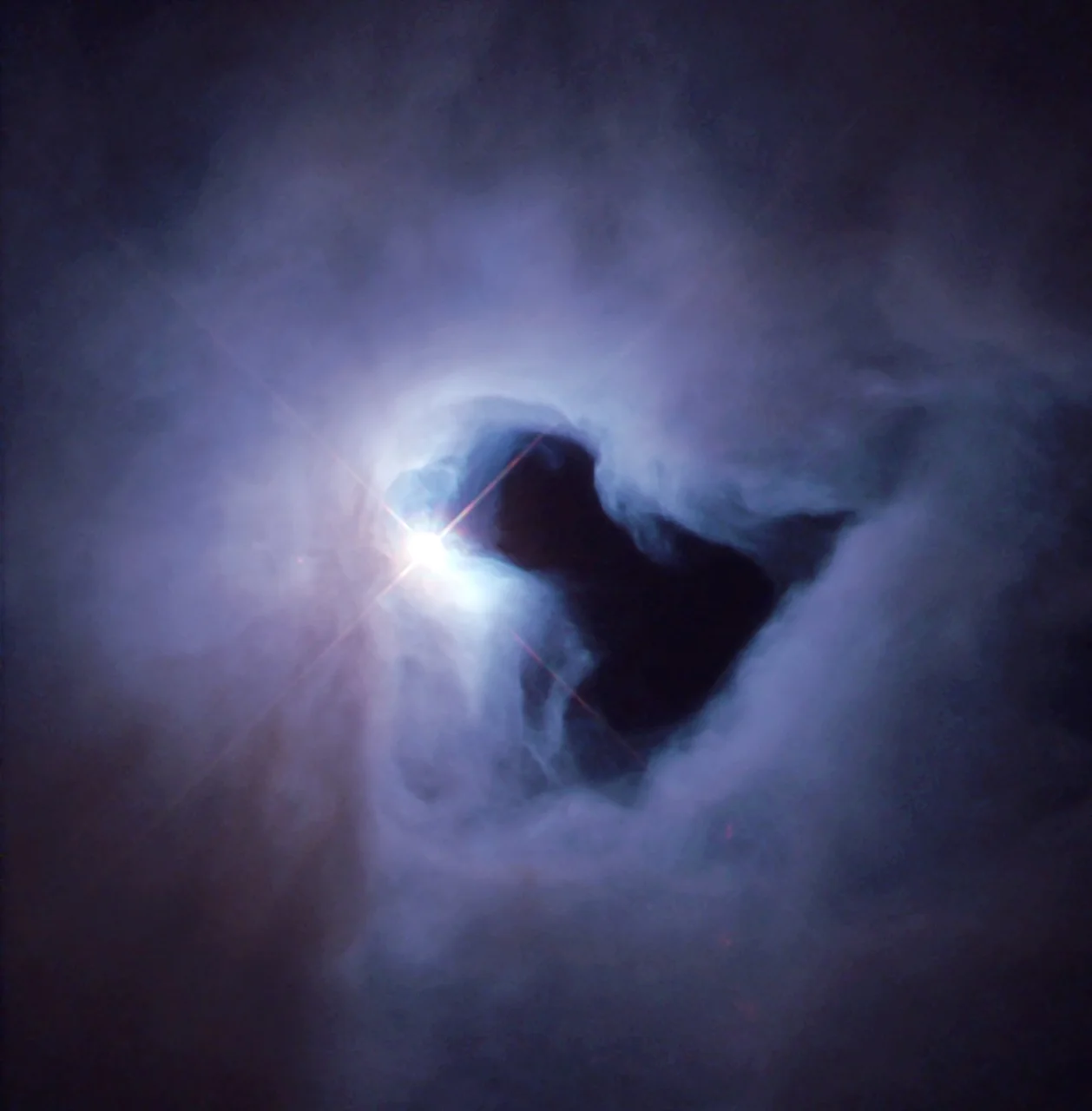 View larger ↗
73 / 100 · Where stars are born
The Reflection Nebula NGC 1999
Hubble Space Telescope
Hubble records NGC 1999 in Orion, where reflected starlight illuminates a nebular landscape surrounding a striking dark feature.
A reflection on God’s handiwork
Borrowed light can reveal remarkable beauty, inviting reflection on illumination and response.
Image credit: NASA / ESA and the Hubble Heritage Team ( STScI )
Image story & original downloads ↗CC BY 4.0 · Image resized and converted for web display; caption adapted from ESA/Hubble.
Back to gallery navigation ↑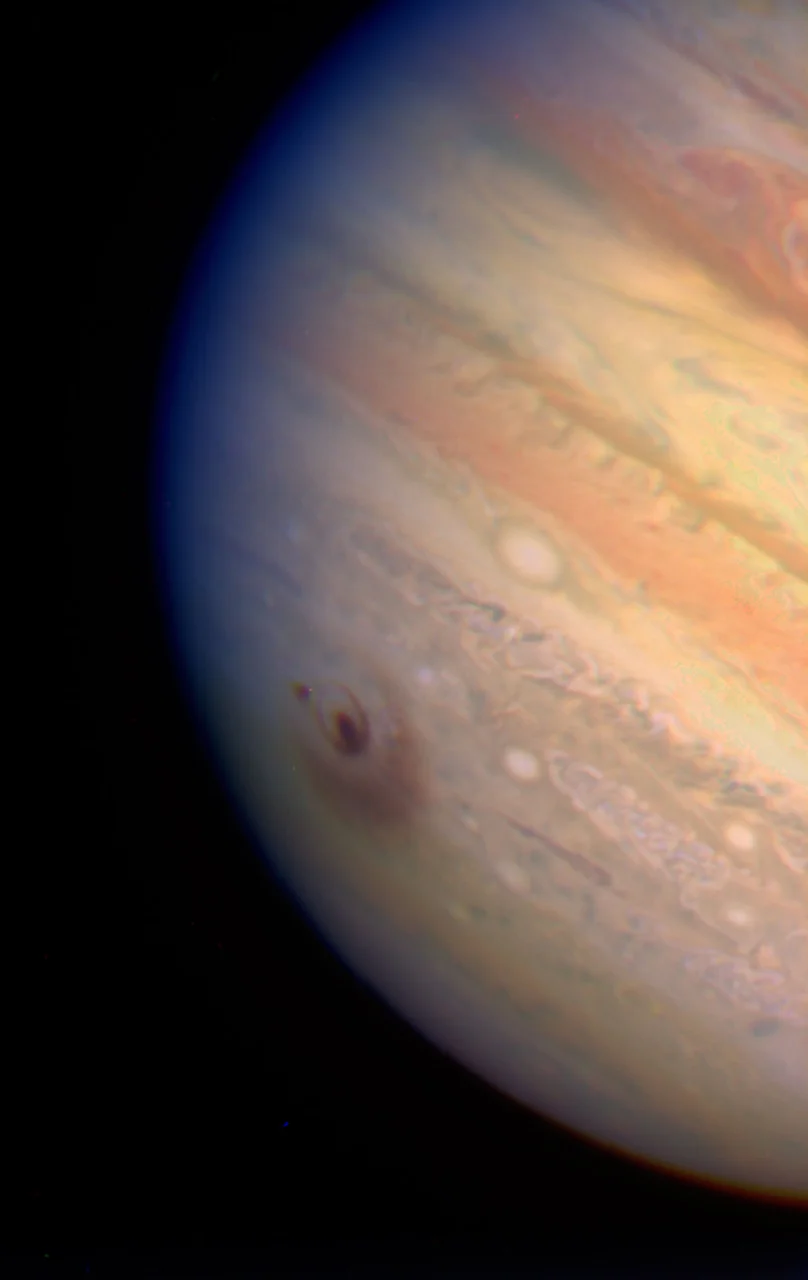 View larger ↗
74 / 100 · Our solar neighborhood
Comet Impacts on Jupiter
Hubble Space Telescope
Dark atmospheric marks show where fragments D and G of Comet Shoemaker-Levy 9 struck Jupiter in 1994.
A reflection on God’s handiwork
These traces of an encounter invite respect for the power and change within creation.
Image credit: H. Hammel, MIT and NASA / ESA
Image story & original downloads ↗CC BY 4.0 · Image resized and converted for web display; caption adapted from ESA/Hubble.
Back to gallery navigation ↑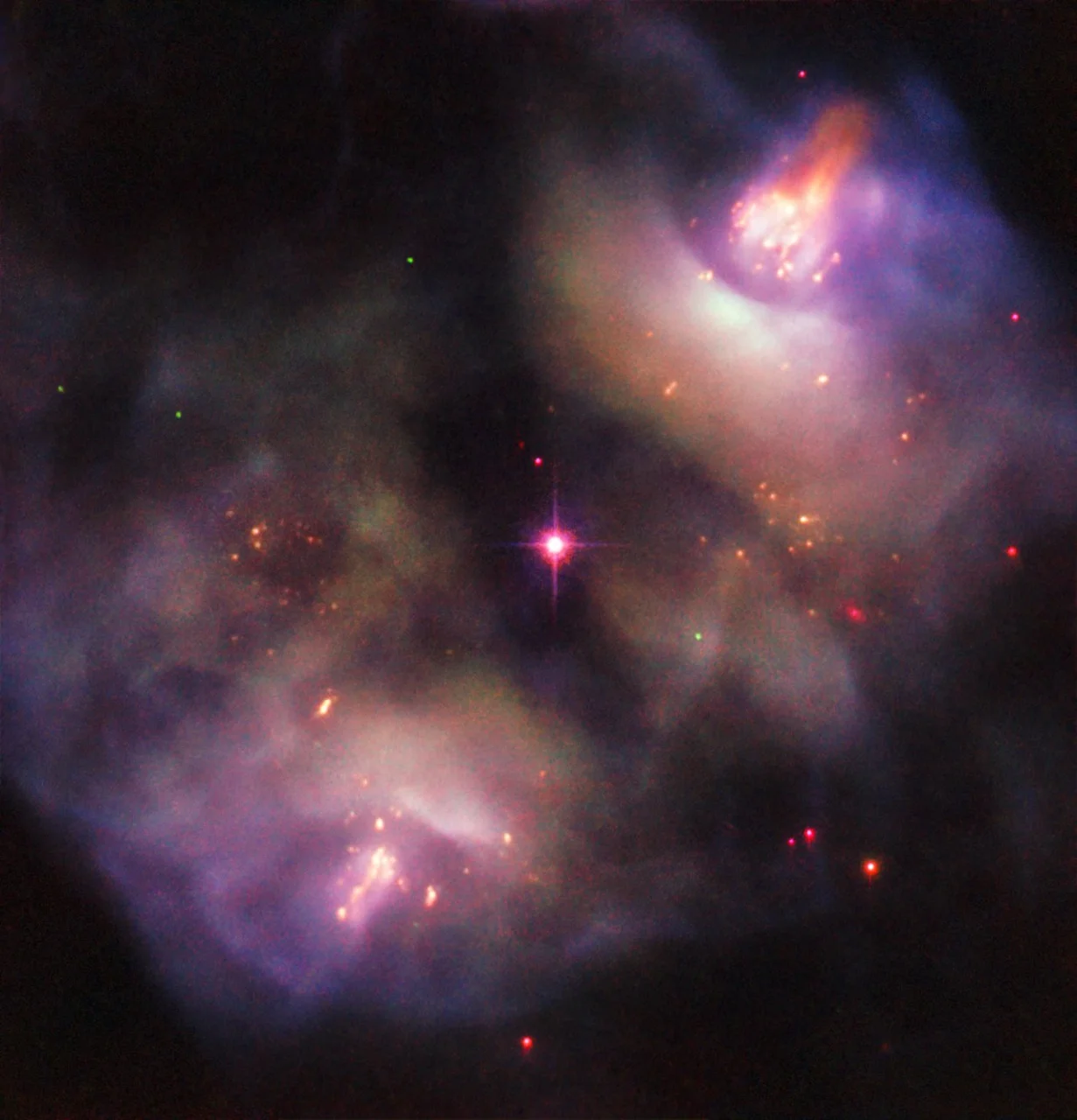 View larger ↗
75 / 100 · Where stars are born
The Twin Lobes of NGC 2371/2
Hubble Space Telescope
The nebula NGC 2371/2 has two prominent lobes, once catalogued separately, formed around a star nearing the end of its evolution.
A reflection on God’s handiwork
Two apparent forms belong to one story, inviting us to look for connections.
Image credit: ESA/Hubble & NASA, R. Wade et al.
Image story & original downloads ↗CC BY 4.0 · Image resized and converted for web display; caption adapted from ESA/Hubble.
Back to gallery navigation ↑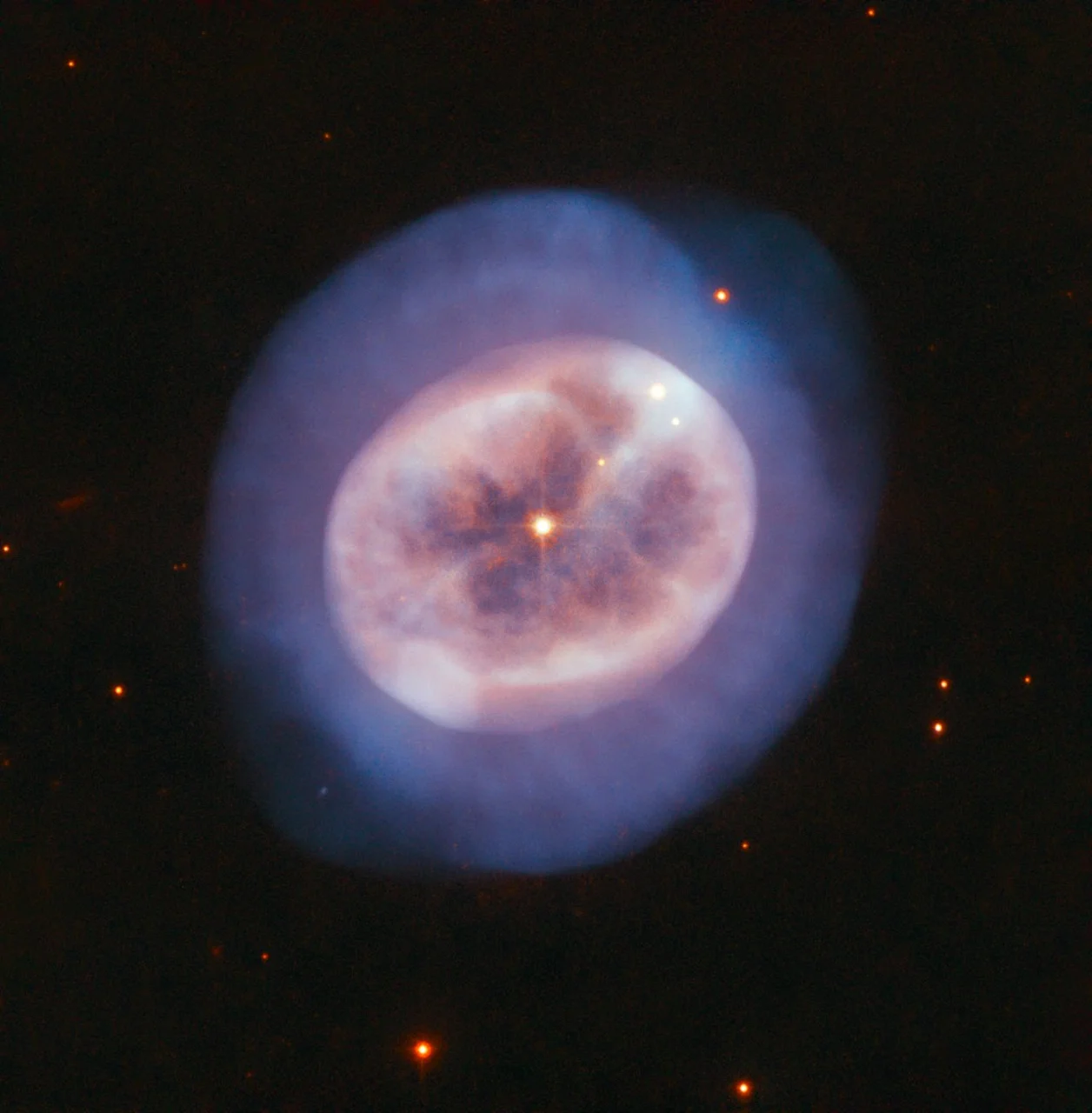 View larger ↗
76 / 100 · The changing lives of stars
The Shell of NGC 2022
Hubble Space Telescope
A faint, rounded cloud surrounds the central star of NGC 2022, preserving gas released during the star’s later life.
A reflection on God’s handiwork
Its quiet glow invites reflection on the dignity of change and the beauty of endings.
Image credit: ESA/Hubble & NASA, R. Wade
Image story & original downloads ↗CC BY 4.0 · Image resized and converted for web display; caption adapted from ESA/Hubble.
Back to gallery navigation ↑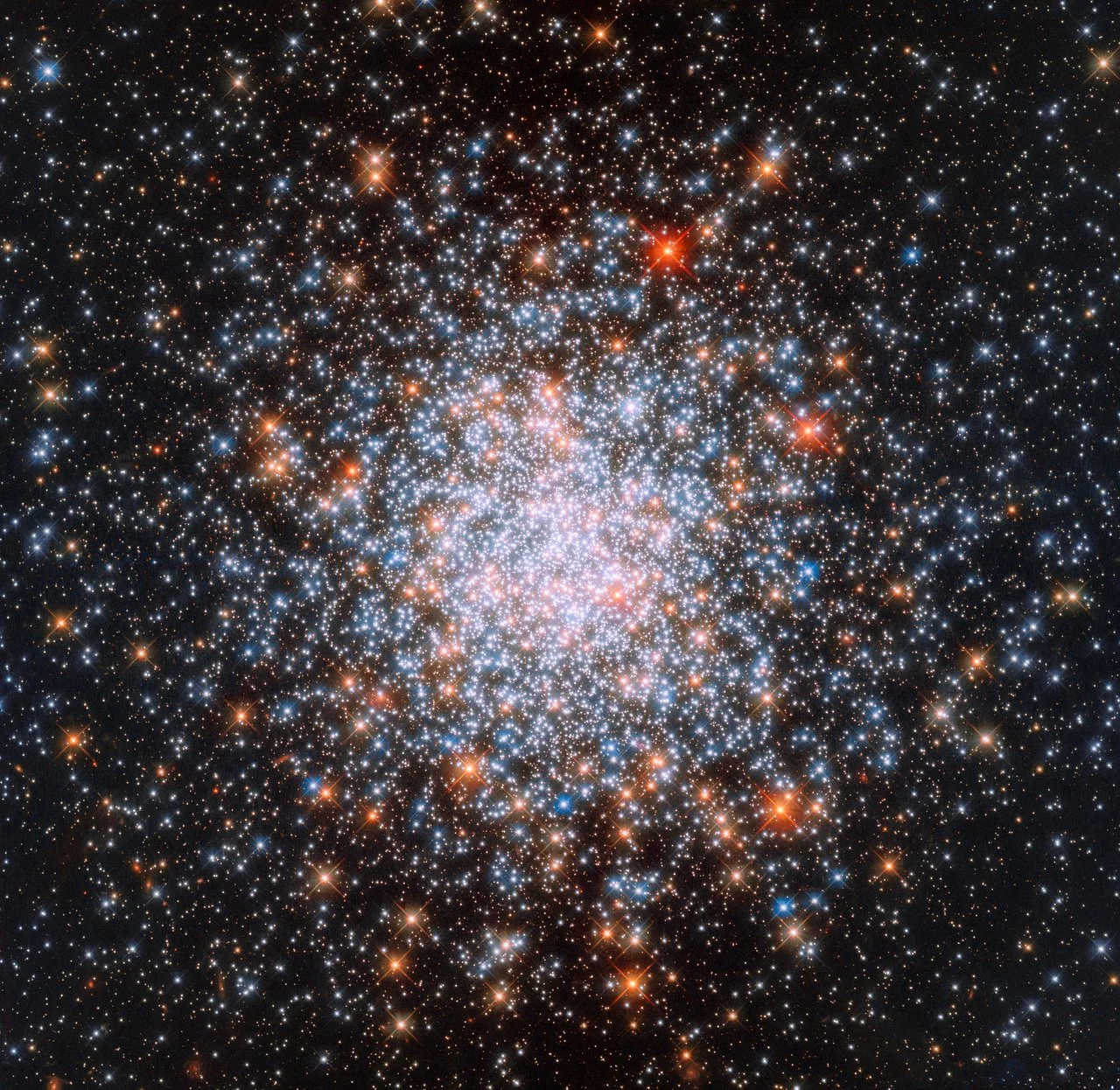 View larger ↗
77 / 100 · Gatherings of stars
Different Generations in NGC 1866
Hubble Space Telescope
The star cluster NGC 1866 lies in the Large Magellanic Cloud and presents a dense field of stellar light.
A reflection on God’s handiwork
A multitude of stars invites contemplation of generations held within a larger creation.
Image credit: ESA/Hubble & NASA
Image story & original downloads ↗CC BY 4.0 · Image resized and converted for web display; caption adapted from ESA/Hubble.
Back to gallery navigation ↑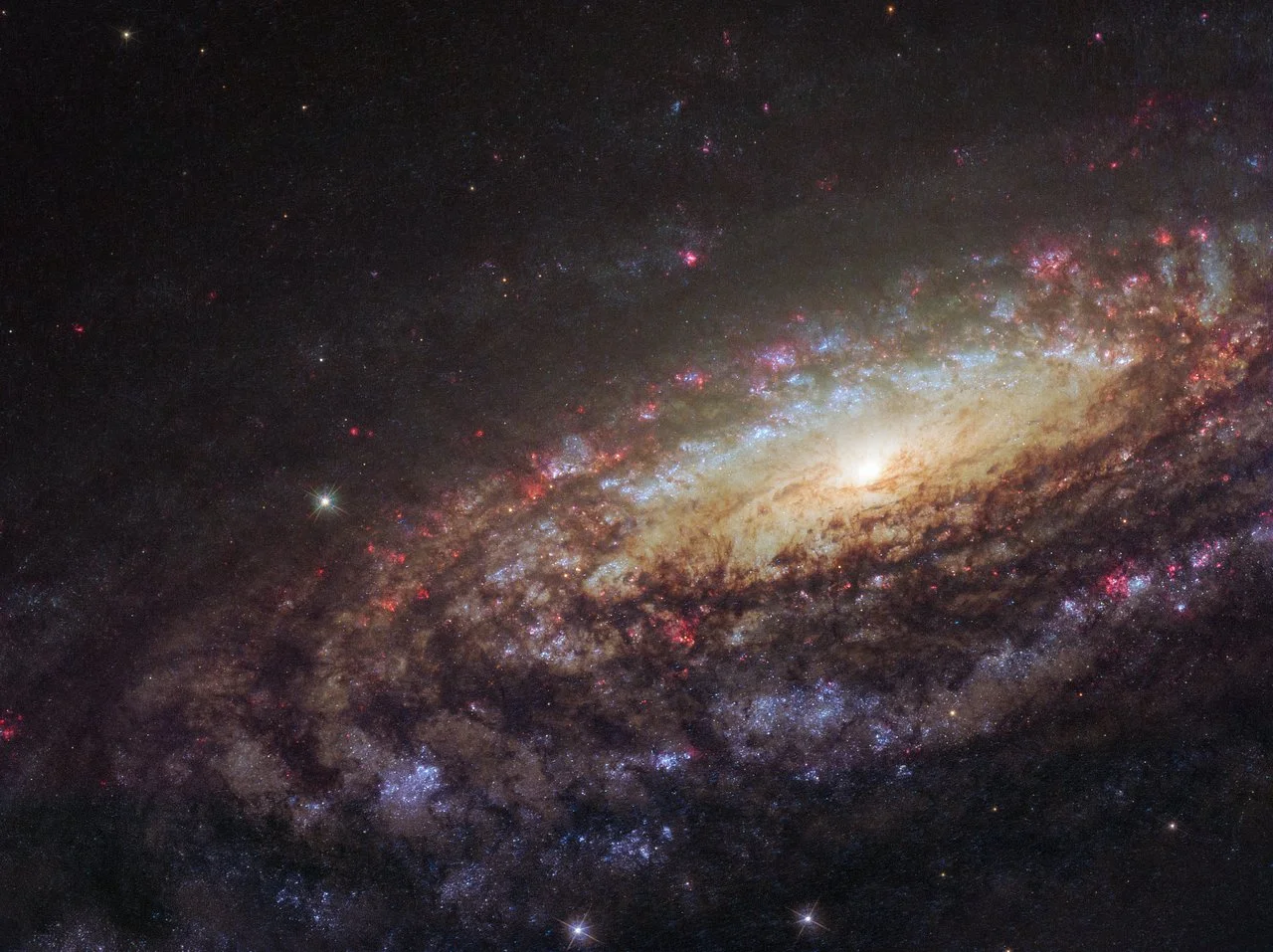 View larger ↗
78 / 100 · Where stars are born
The Inclined Spiral NGC 7331
Hubble Space Telescope
Hubble views NGC 7331 at an angle, showing sweeping arms around a bright center rather than a face-on circle.
A reflection on God’s handiwork
Its tilted perspective reminds us how much a change of position can reveal.
Image credit: ESA/Hubble & NASA/D. Milisavljevic (Purdue University)
Image story & original downloads ↗CC BY 4.0 · Image resized and converted for web display; caption adapted from ESA/Hubble.
Back to gallery navigation ↑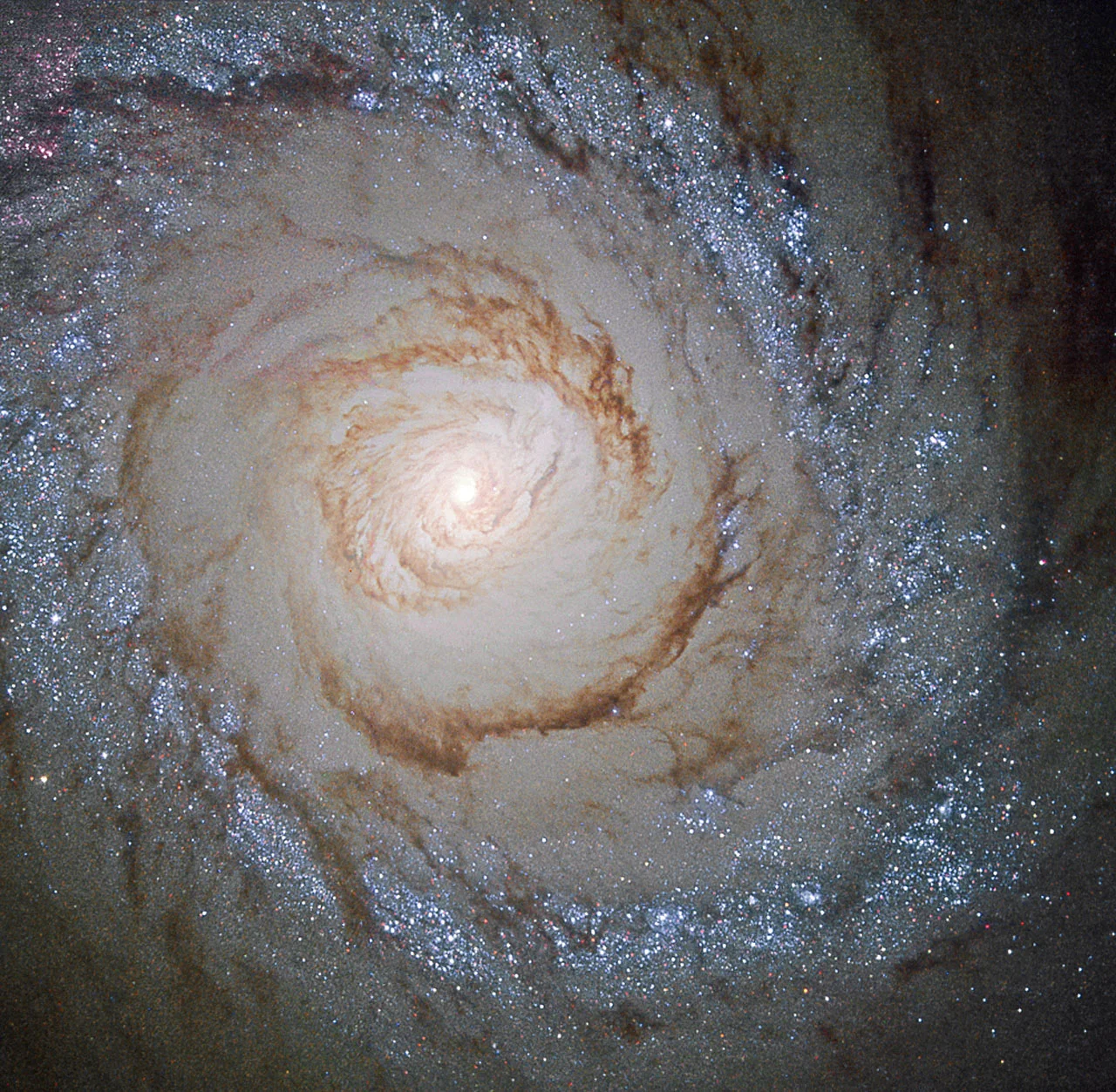 View larger ↗
79 / 100 · Where stars are born
The Starburst Ring of Messier 94
Hubble Space Telescope
A conspicuous ring of young stars encircles Messier 94’s center, marking a region where star formation is particularly active.
A reflection on God’s handiwork
A circle of new light invites reflection on renewal within the wider universe.
Image credit: ESA/Hubble & NASA
Image story & original downloads ↗CC BY 4.0 · Image resized and converted for web display; caption adapted from ESA/Hubble.
Back to gallery navigation ↑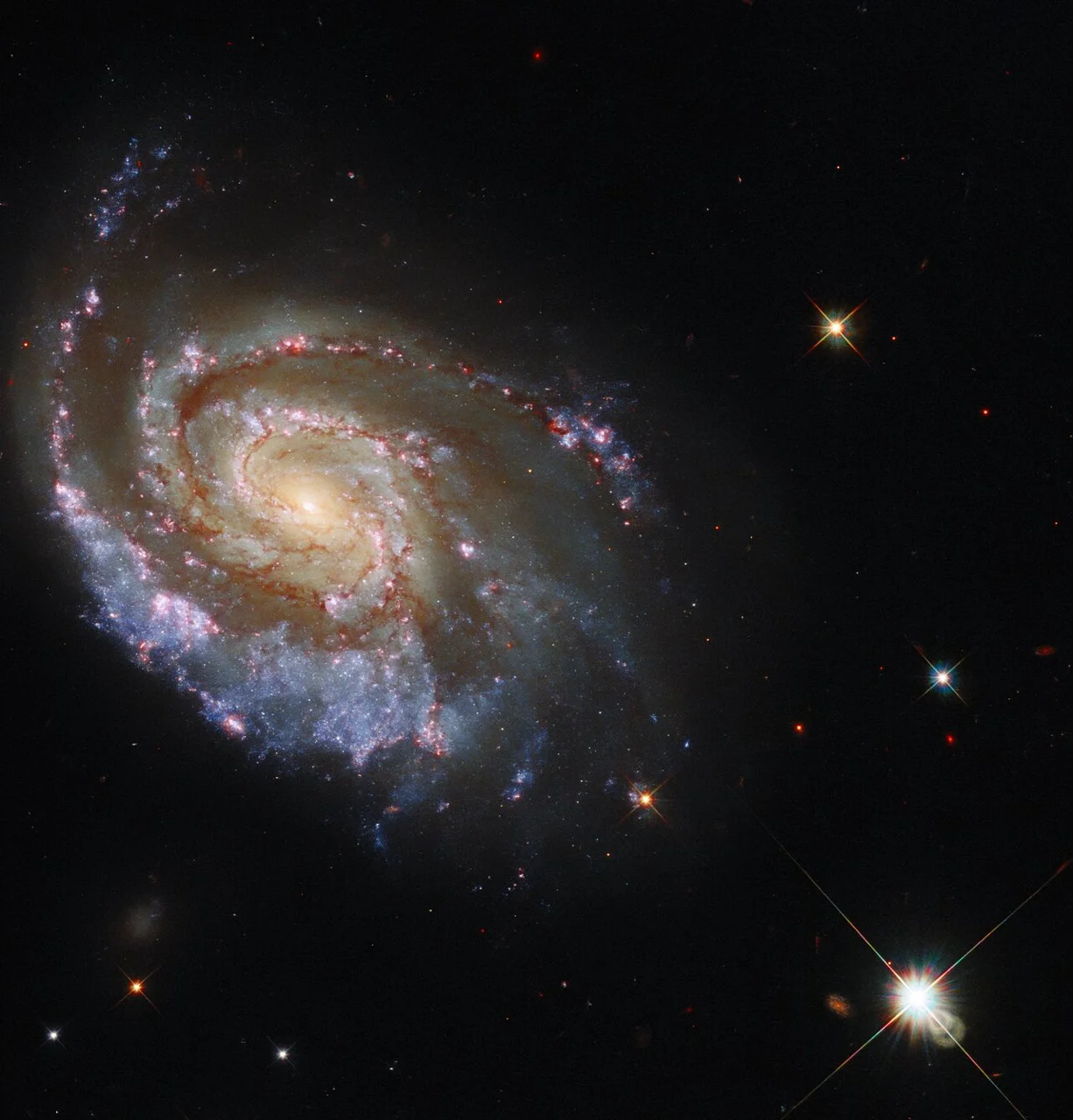 View larger ↗
80 / 100 · Galaxies beyond our own
The Spiral Galaxy NGC 6984
Hubble Space Telescope
Bright stars, star-forming regions, and dark dust lanes follow the curving arms of NGC 6984 in this detailed Hubble portrait.
A reflection on God’s handiwork
Order and richness meet here, inviting gratitude for beauty beyond our everyday horizon.
Image credit: ESA/Hubble & NASA, D. Milisavljevic
Image story & original downloads ↗CC BY 4.0 · Image resized and converted for web display; caption adapted from ESA/Hubble.
Back to gallery navigation ↑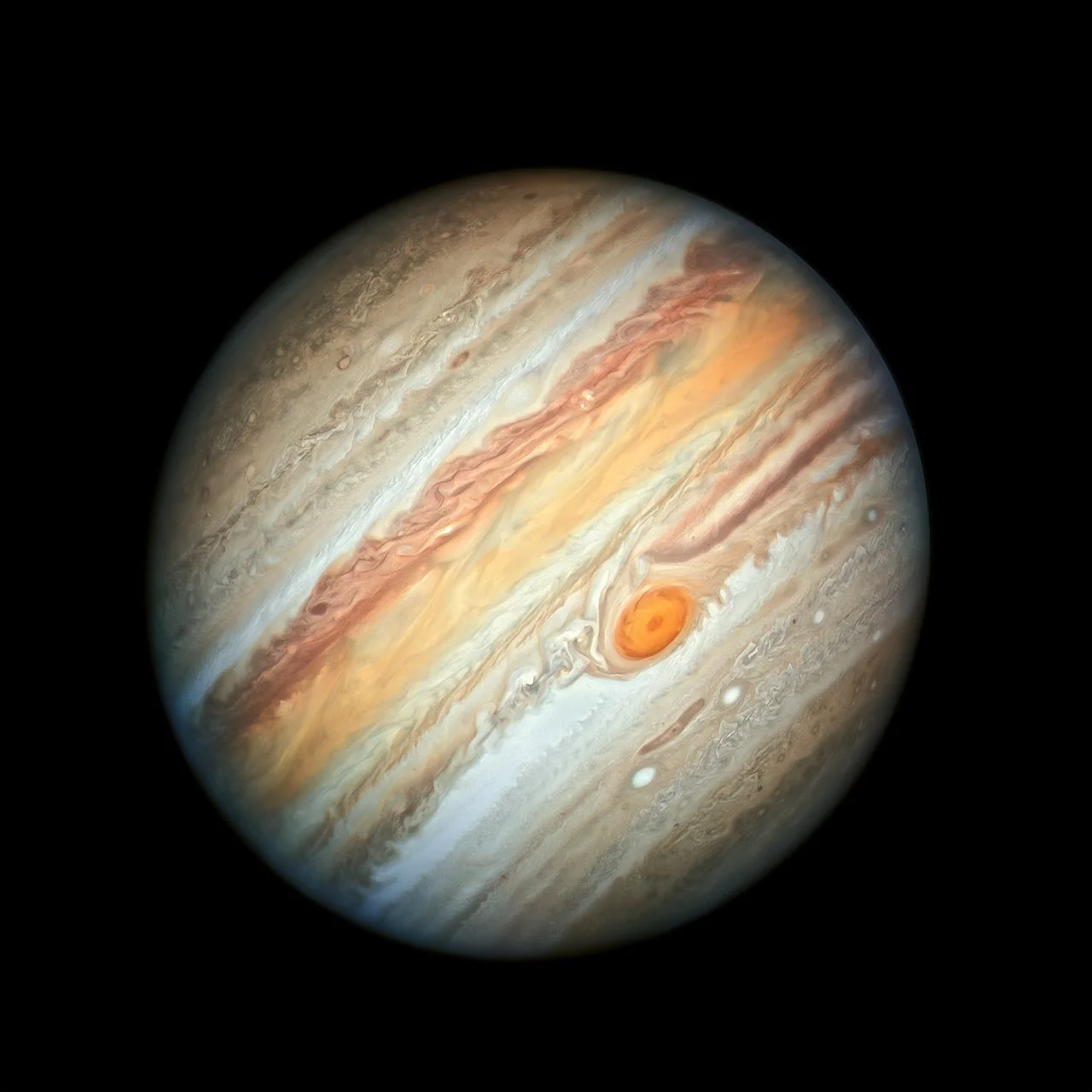 View larger ↗
81 / 100 · Our solar neighborhood
Jupiter’s Colorful Palette
Hubble Space Telescope
Jupiter’s Great Red Spot and richly colored cloud bands stand out in Hubble’s June 2019 portrait of the giant planet.
A reflection on God’s handiwork
Its changing colors invite us to rediscover wonder in a familiar part of the heavens.
Image credit: NASA, ESA, A. Simon (Goddard Space Flight Center), and M.H. Wong (University of California, Berkeley)
Image story & original downloads ↗CC BY 4.0 · Image resized and converted for web display; caption adapted from ESA/Hubble.
Back to gallery navigation ↑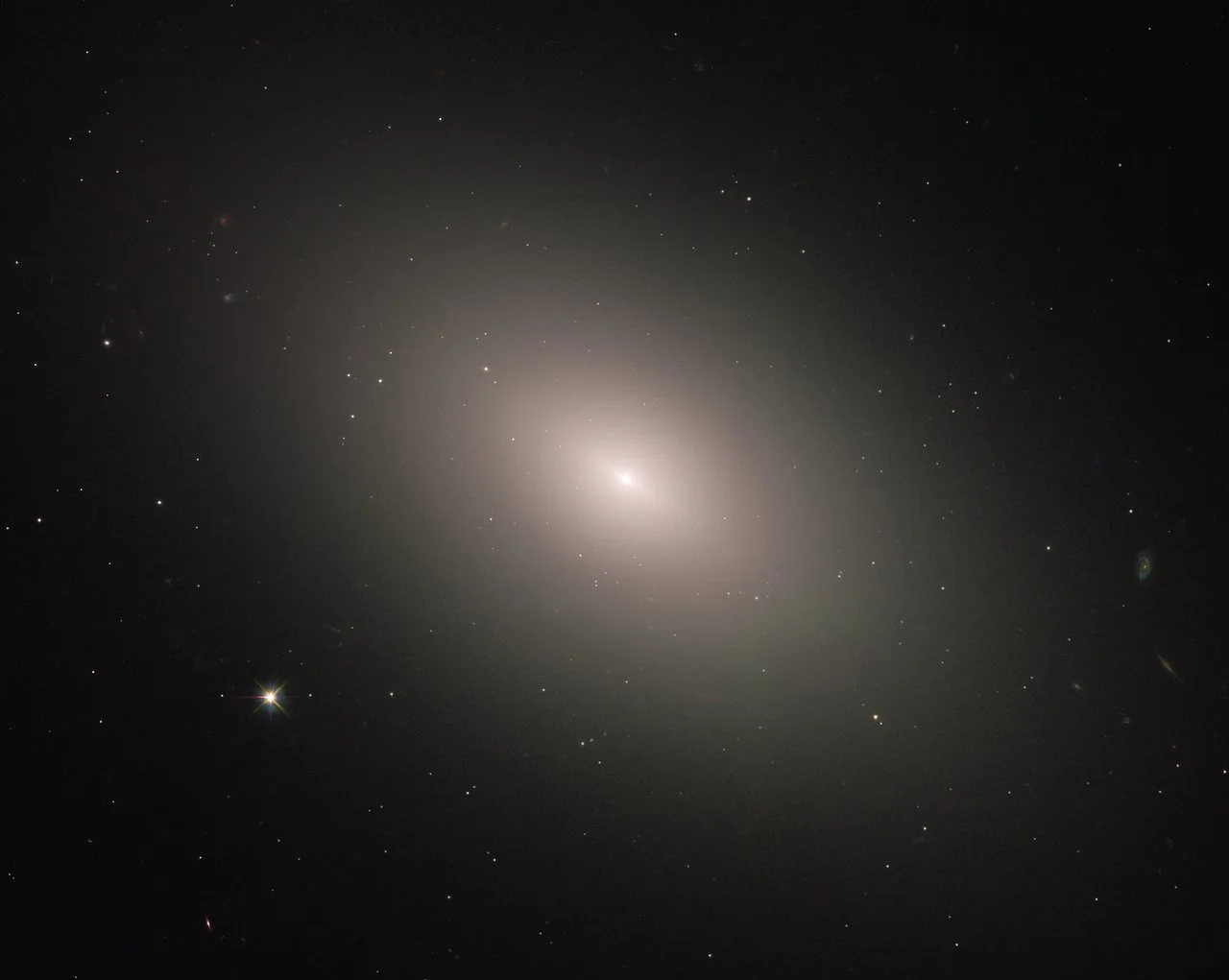 View larger ↗
82 / 100 · Galaxies beyond our own
The Luminous Galaxy Messier 59
Hubble Space Telescope
Messier 59, also called NGC 4621, appears as a glowing elliptical galaxy rather than a system with prominent spiral arms.
A reflection on God’s handiwork
A quieter shape offers its own beauty, reminding us to look beyond the spectacular.
Image credit: ESA/Hubble & NASA, P. Cote
Image story & original downloads ↗CC BY 4.0 · Image resized and converted for web display; caption adapted from ESA/Hubble.
Back to gallery navigation ↑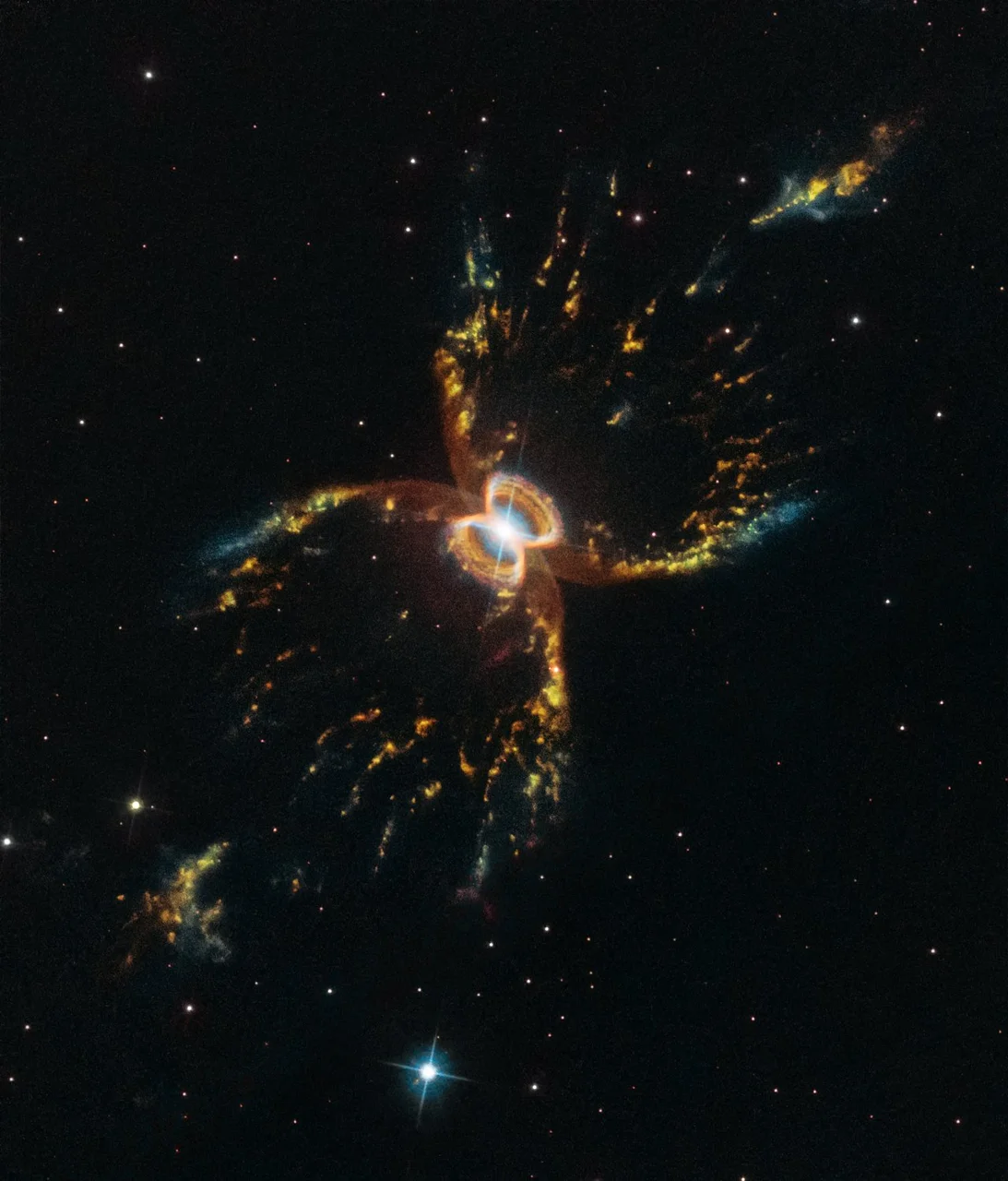 View larger ↗
83 / 100 · The changing lives of stars
The Southern Crab Nebula
Hubble Space Telescope
Hubble’s anniversary portrait presents the Southern Crab Nebula, whose symmetric-looking gas structures give the object its distinctive appearance.
A reflection on God’s handiwork
Its balanced forms invite reflection on beauty unfolding through the changing lives of stars.
Image credit: NASA, ESA, and STScI
Image story & original downloads ↗CC BY 4.0 · Image resized and converted for web display; caption adapted from ESA/Hubble.
Back to gallery navigation ↑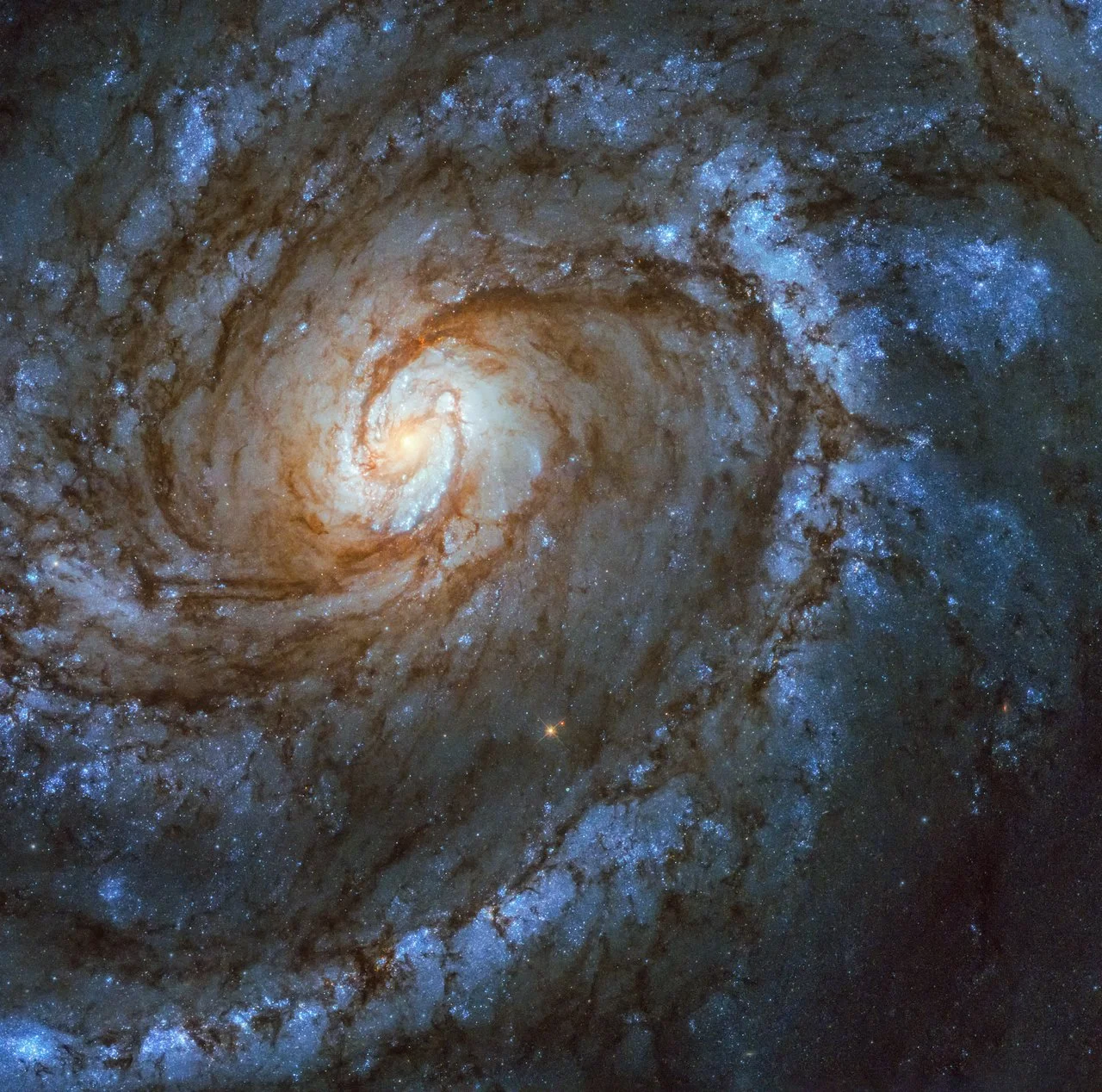 View larger ↗
84 / 100 · Galaxies beyond our own
Messier 100 in Detail
Hubble Space Telescope
This portrait of the spiral galaxy Messier 100 illustrates Hubble’s ability to resolve galactic structure after decades of observations and servicing.
A reflection on God’s handiwork
Patient exploration brings fresh appreciation of wonders that have long filled the sky.
Image credit: NASA, ESA
Image story & original downloads ↗CC BY 4.0 · Image resized and converted for web display; caption adapted from ESA/Hubble.
Back to gallery navigation ↑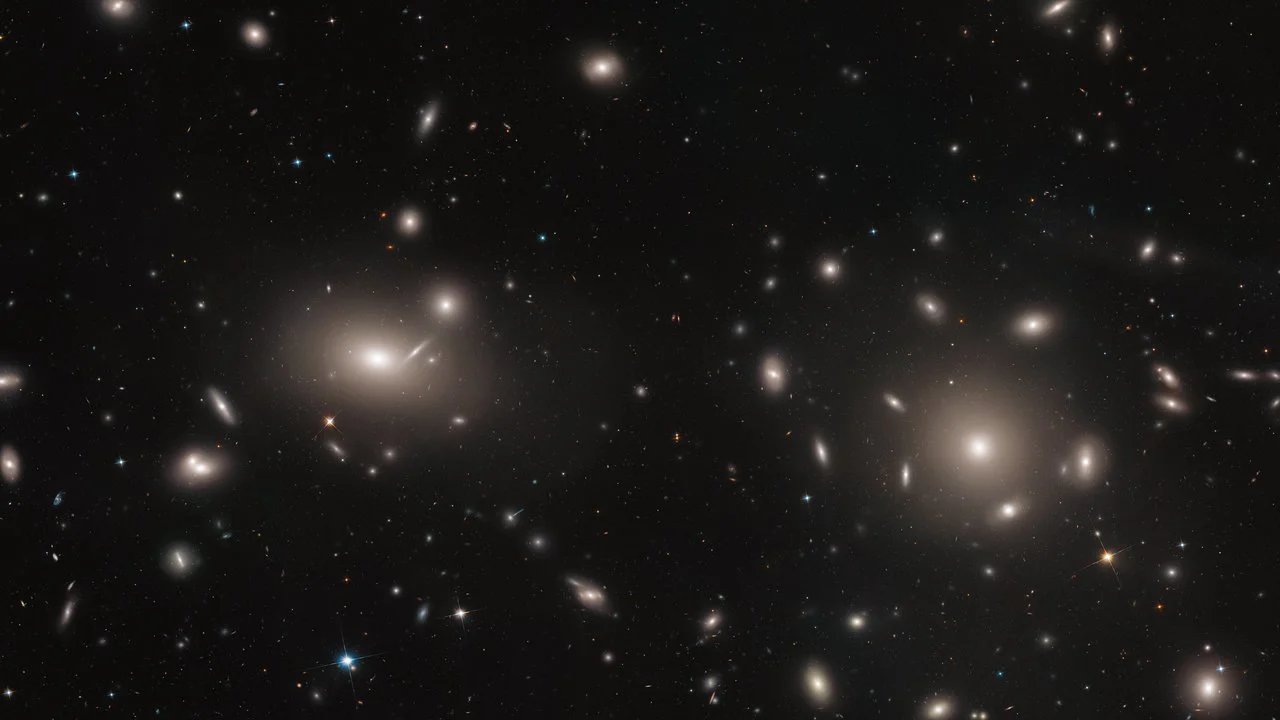 View larger ↗
85 / 100 · Galaxies beyond our own
Clusters Within the Coma Cluster
Hubble Space Telescope
Thousands of compact star clusters appear within the wider Coma galaxy cluster, revealing layers of structure on different cosmic scales.
A reflection on God’s handiwork
Belonging within belonging offers a rich image for contemplation of creation’s connectedness.
Image credit: NASA, ESA, J. Mack, and J. Madrid et al.
Image story & original downloads ↗CC BY 4.0 · Image resized and converted for web display; caption adapted from ESA/Hubble.
Back to gallery navigation ↑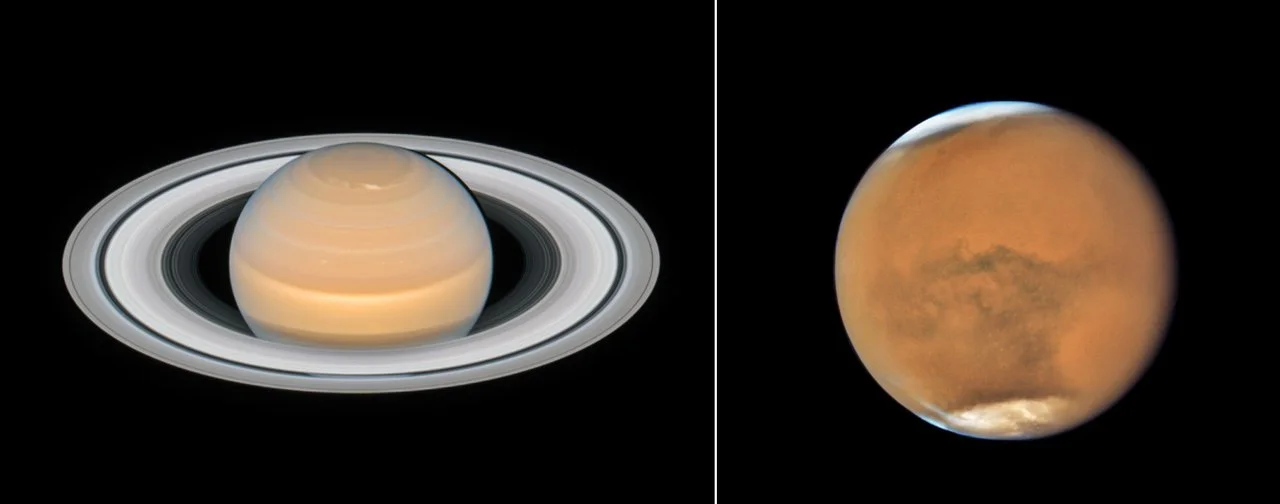 View larger ↗
86 / 100 · Our solar neighborhood
Mars and Saturn in 2018
Hubble Space Telescope
This paired portrait shows observations of Mars and Saturn made in 2018, when both planets were near opposition.
A reflection on God’s handiwork
Two neighboring worlds reveal distinct beauty within the same solar family.
Image credit: Saturn: NASA, ESA, A. Simon (GSFC) and the OPAL Team, and J. DePasquale (STScI); Mars: NASA, ESA, and STScI
Image story & original downloads ↗CC BY 4.0 · Image resized and converted for web display; caption adapted from ESA/Hubble.
Back to gallery navigation ↑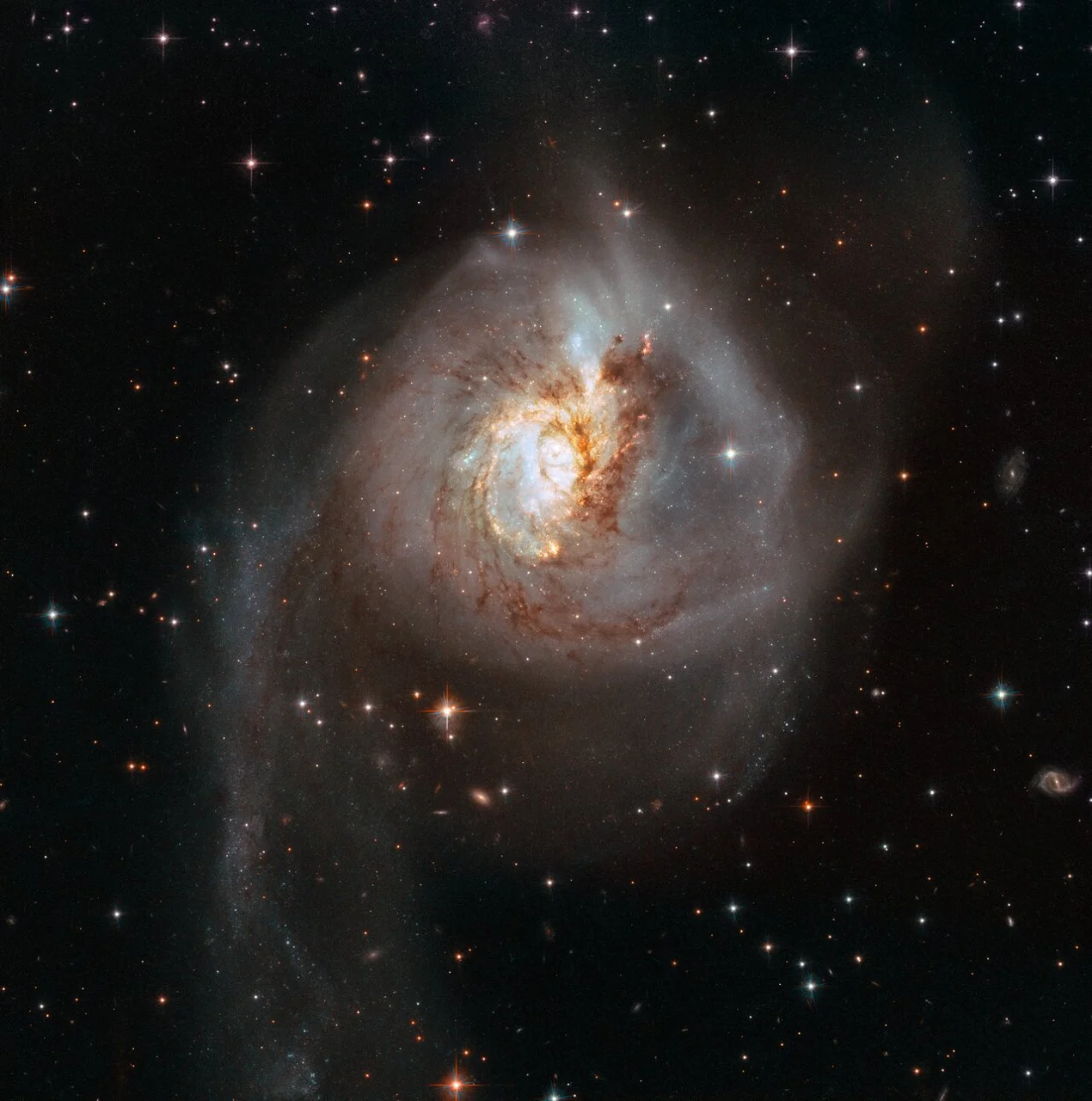 View larger ↗
87 / 100 · Galaxies beyond our own
The Merger Remnant NGC 3256
Hubble Space Telescope
NGC 3256’s disturbed shape reflects a past merger, making it a useful place to study star formation associated with galactic encounters.
A reflection on God’s handiwork
Its altered form invites reflection on the new possibilities that can follow profound change.
Image credit: ESA/Hubble, NASA
Image story & original downloads ↗CC BY 4.0 · Image resized and converted for web display; caption adapted from ESA/Hubble.
Back to gallery navigation ↑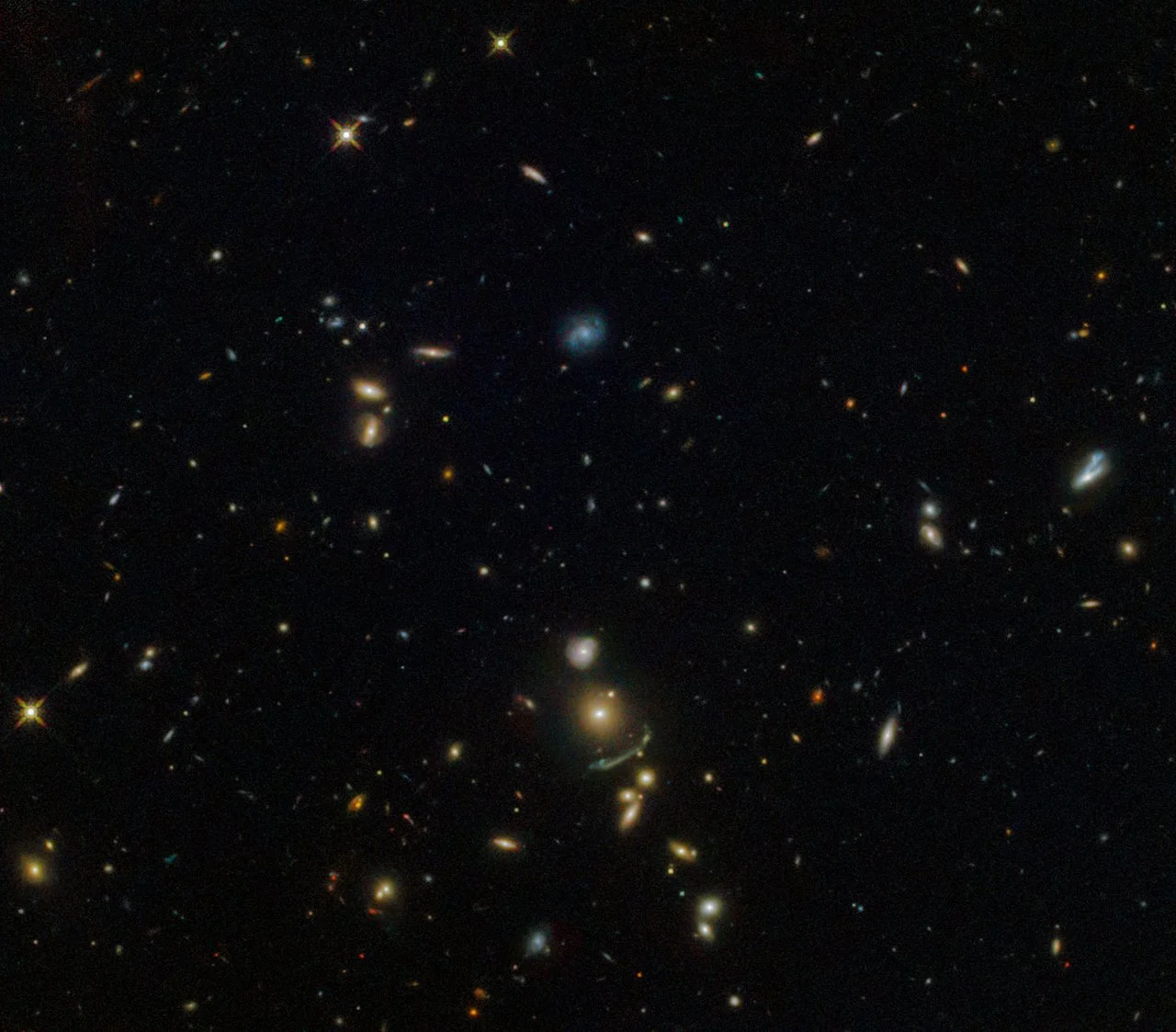 View larger ↗
88 / 100 · A window into immensity
A Green Arc in a Galaxy Cluster
Hubble Space Telescope
A curved background image appears among the foreground galaxies in this cluster field, illustrating the effects of gravitational lensing.
A reflection on God’s handiwork
An unexpected arc reminds us that discovery often begins with noticing what seems unusual.
Image credit: ESA/Hubble & NASA Acknowledgement: Judy Schmidt (Geckzilla)
Image story & original downloads ↗CC BY 4.0 · Image resized and converted for web display; caption adapted from ESA/Hubble.
Back to gallery navigation ↑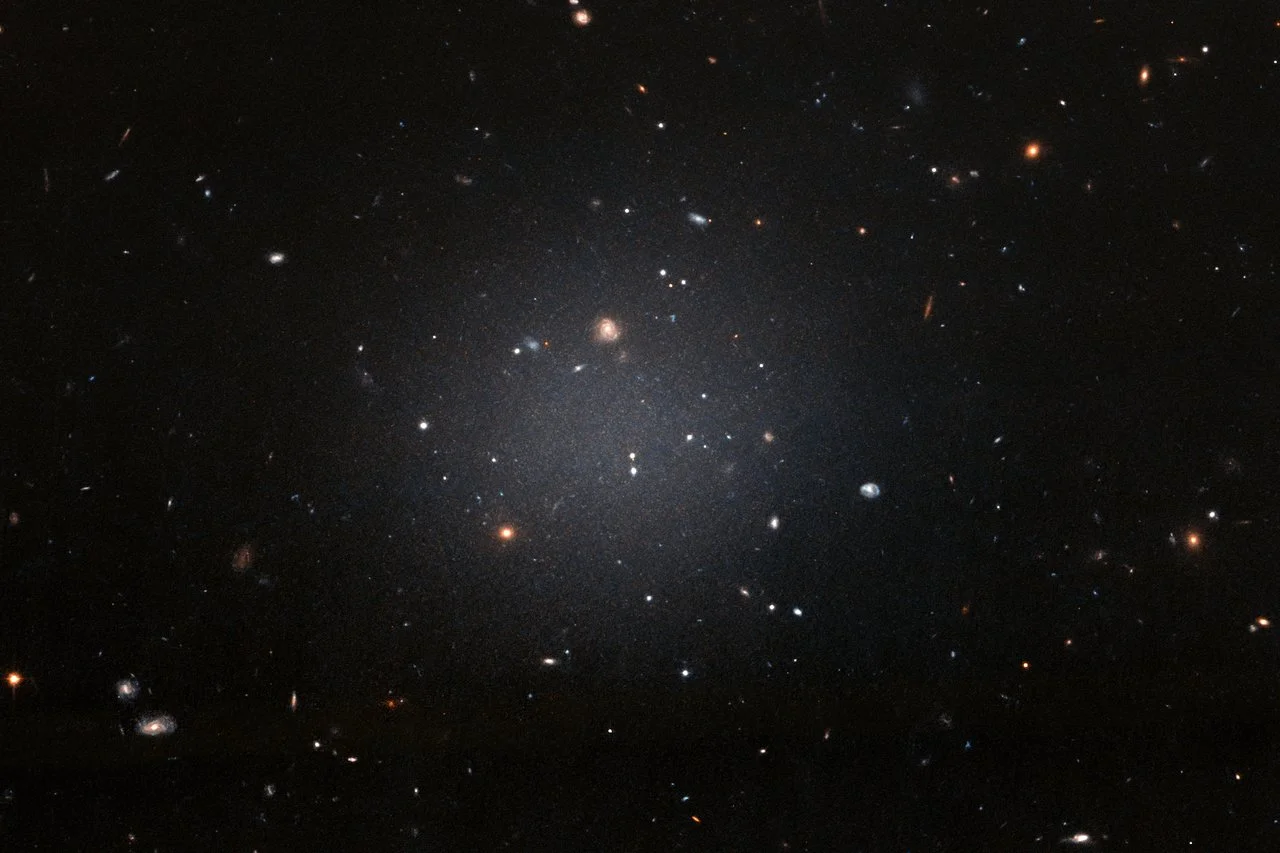 View larger ↗
89 / 100 · Galaxies beyond our own
The Diffuse Galaxy NGC 1052-DF2
Hubble Space Telescope
This faint galaxy is so sparsely filled with visible starlight that more distant galaxies can be seen through its diffuse body.
A reflection on God’s handiwork
Even an almost transparent presence has a place in creation’s extraordinary range of forms.
Image credit: NASA, ESA, and P. van Dokkum (Yale University)
Image story & original downloads ↗CC BY 4.0 · Image resized and converted for web display; caption adapted from ESA/Hubble.
Back to gallery navigation ↑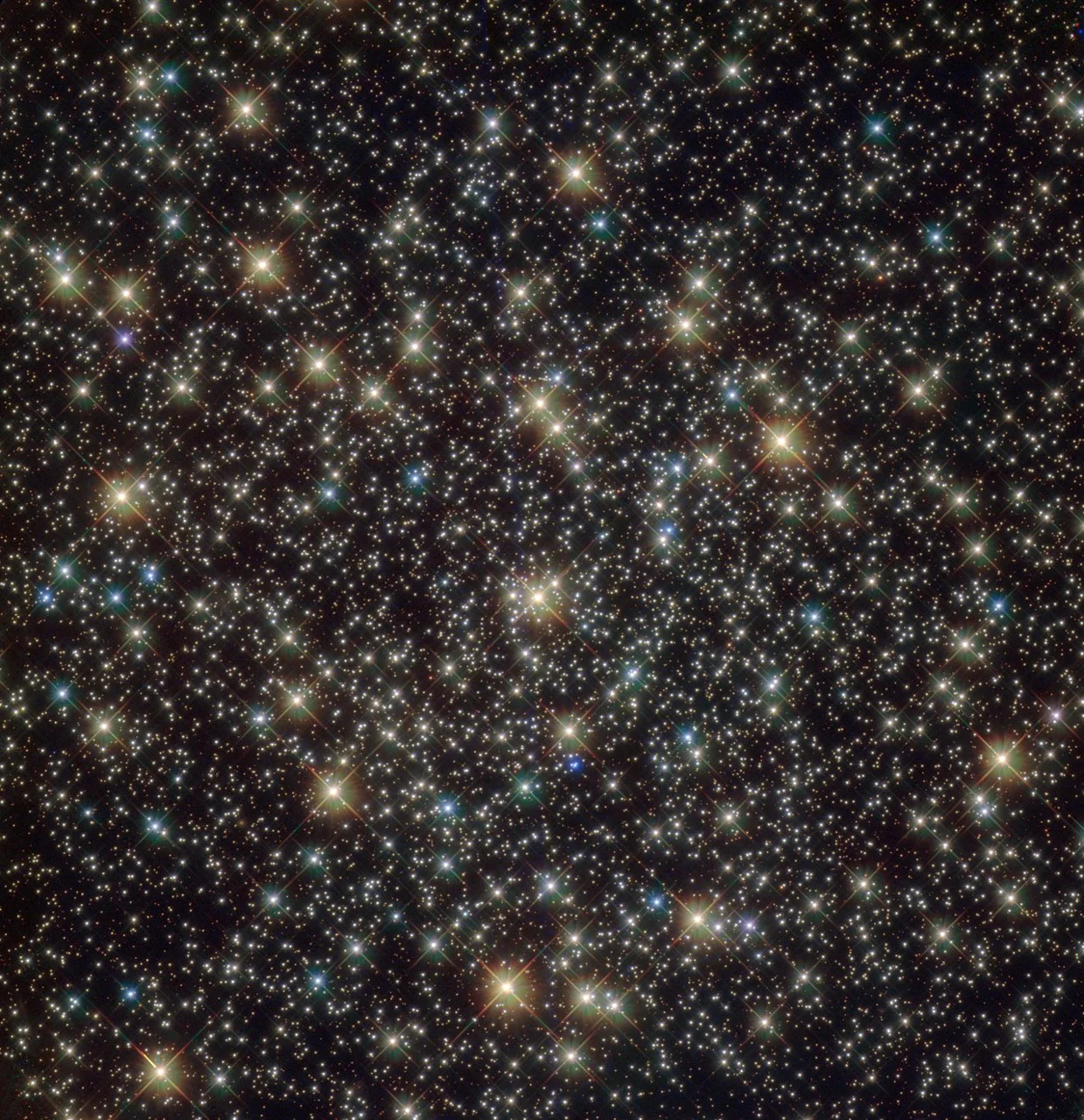 View larger ↗
90 / 100 · Gatherings of stars
The Stars of NGC 3201
Hubble Space Telescope
NGC 3201 is a globular cluster: a large, gravitationally bound gathering whose many stars fill Hubble’s field of view.
A reflection on God’s handiwork
Its gathered lights invite contemplation of abundance and the beauty of belonging.
Image credit: ESA/Hubble & NASA
Image story & original downloads ↗CC BY 4.0 · Image resized and converted for web display; caption adapted from ESA/Hubble.
Back to gallery navigation ↑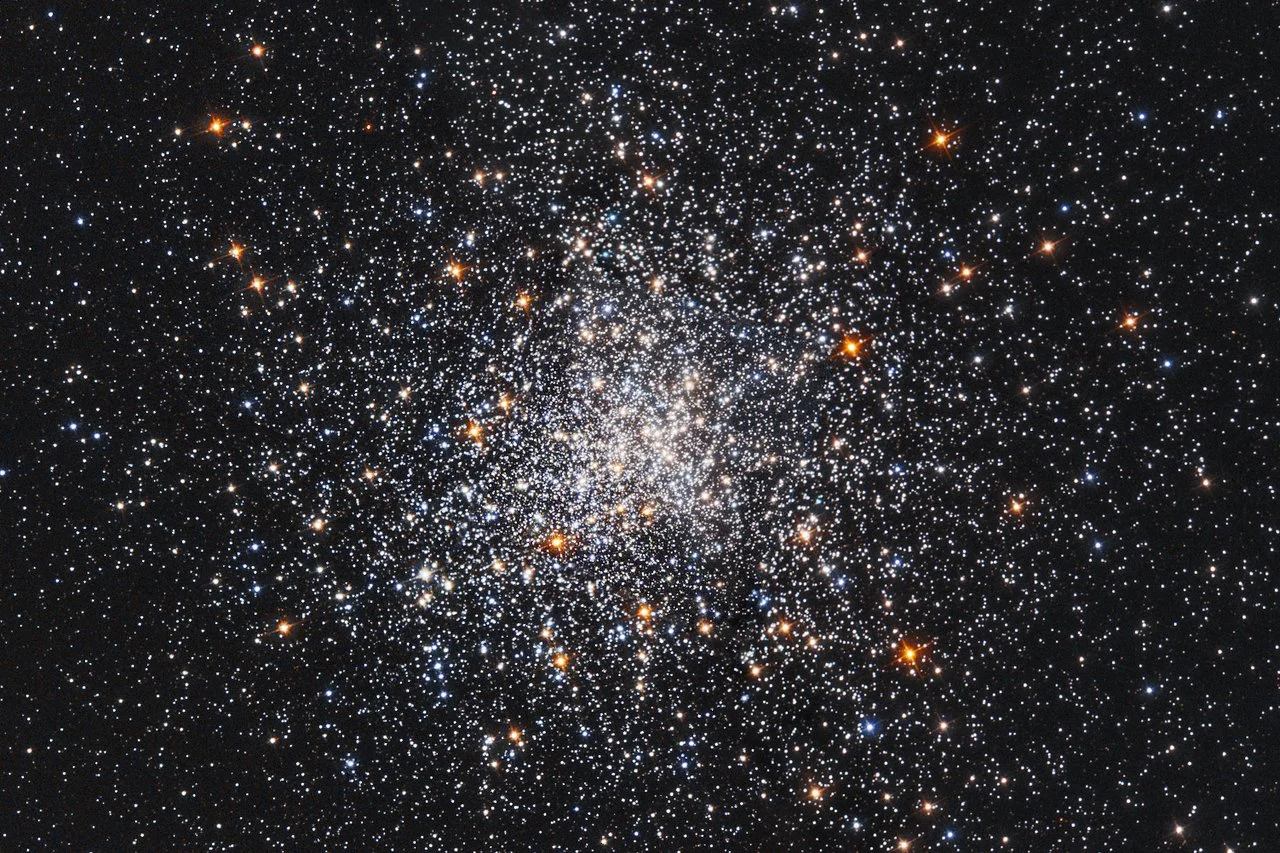 View larger ↗
91 / 100 · Gatherings of stars
A Snowstorm of Stars: Messier 79
Hubble Space Telescope
The globular cluster Messier 79 appears as a crowded field of ancient stars, bound together by their mutual gravity.
A reflection on God’s handiwork
This celestial gathering invites quiet awe at lives of light far longer than our own.
Image credit: NASA and ESA Acknowledgement: S. Djorgovski (Caltech) and F. Ferraro (University of Bologna)
Image story & original downloads ↗CC BY 4.0 · Image resized and converted for web display; caption adapted from ESA/Hubble.
Back to gallery navigation ↑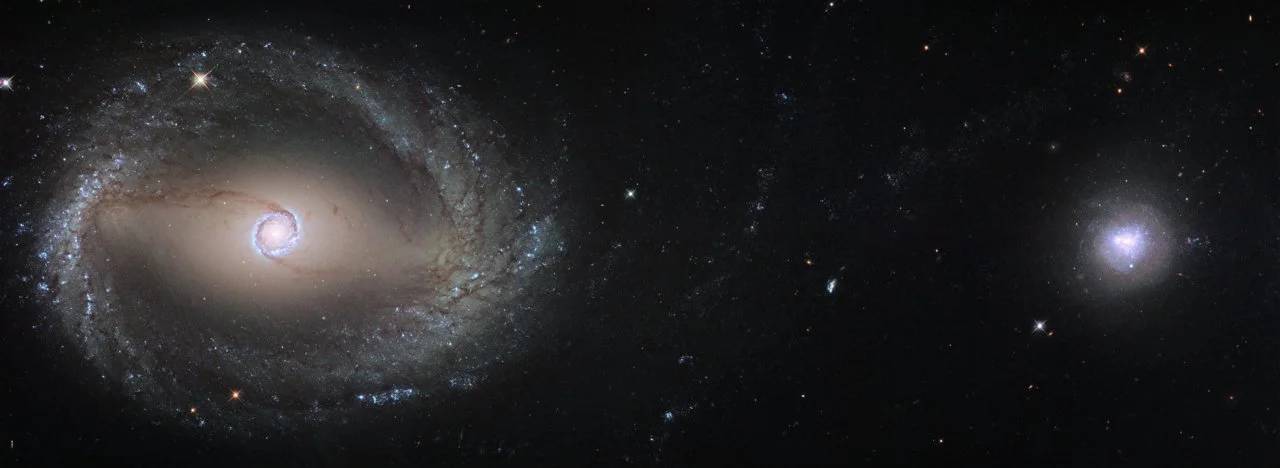 View larger ↗
92 / 100 · Where stars are born
NGC 1512 and NGC 1510
Hubble Space Telescope
A large barred spiral and its smaller companion appear together as their gravitational interaction shapes an eventual merger.
A reflection on God’s handiwork
The contrast in their sizes invites reflection on relationships across creation’s many scales.
Image credit: ESA/Hubble, NASA
Image story & original downloads ↗CC BY 4.0 · Image resized and converted for web display; caption adapted from ESA/Hubble.
Back to gallery navigation ↑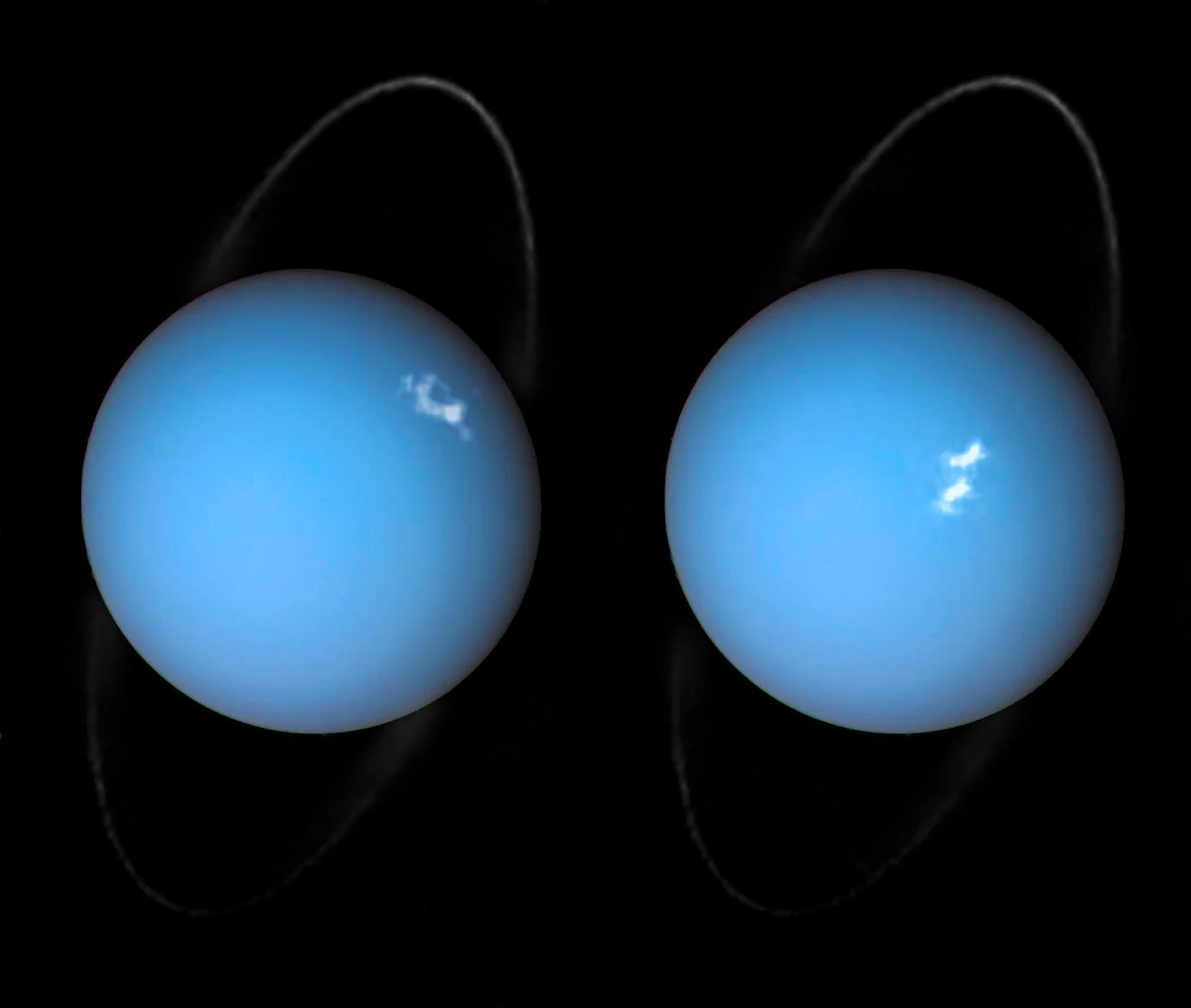 View larger ↗
93 / 100 · Our solar neighborhood
Aurorae on Uranus
Hubble + Voyager 2 composite
This composite view presents auroral activity on Uranus, where charged particles interact with the planet’s magnetic environment and upper atmosphere.
A reflection on God’s handiwork
Light can appear in unexpected places, renewing our curiosity about the worlds around us.
Image credit: ESA/Hubble & NASA, L. Lamy / Observatoire de Paris
Image story & original downloads ↗CC BY 4.0 · Image resized and converted for web display; caption adapted from ESA/Hubble.
Back to gallery navigation ↑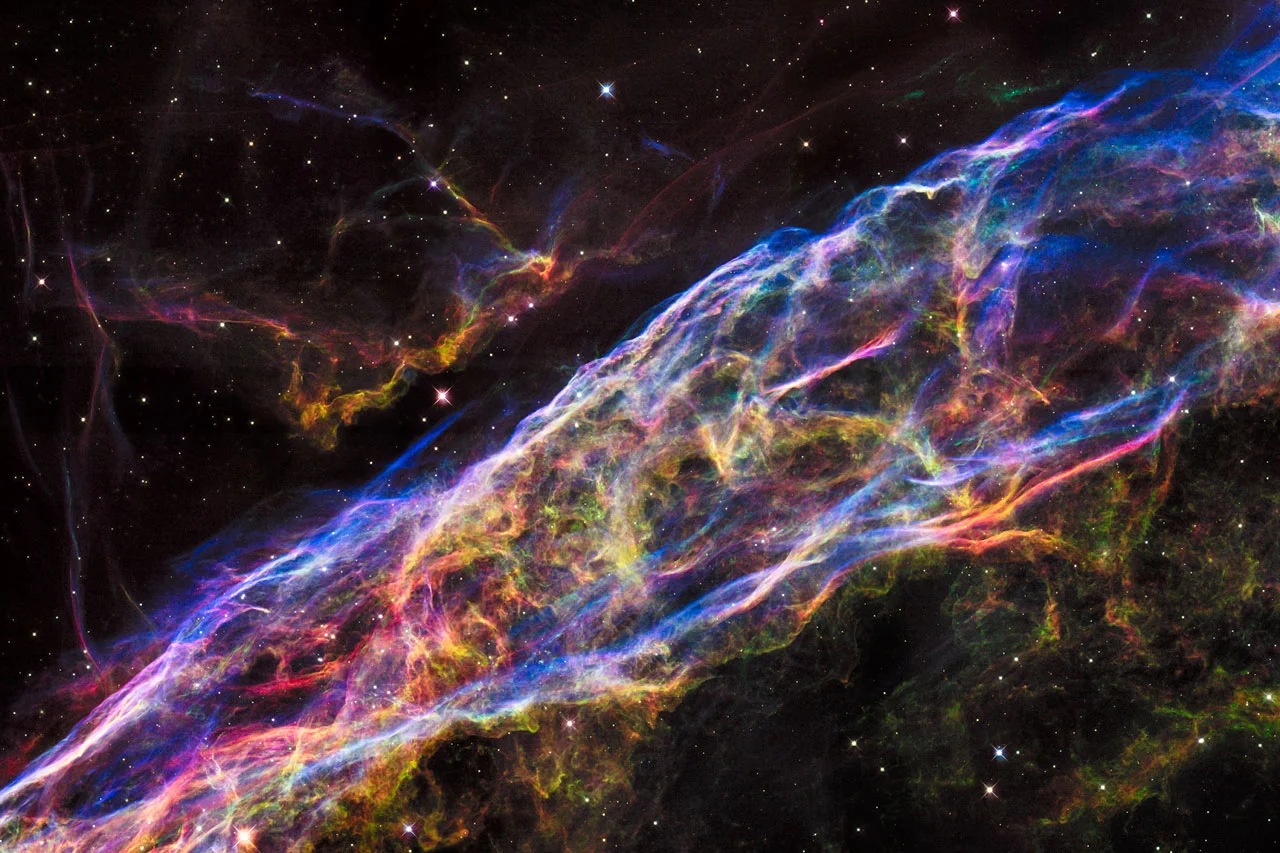 View larger ↗
94 / 100 · The changing lives of stars
The Veil Nebula Revisited
Hubble Space Telescope
This close view explores part of NGC 6960, a filamentary section of the Veil Nebula’s expanding supernova remnant.
A reflection on God’s handiwork
Fine luminous threads invite us to find beauty in both fragility of appearance and strength of history.
Image credit: NASA, ESA, Hubble Heritage Team
Image story & original downloads ↗CC BY 4.0 · Image resized and converted for web display; caption adapted from ESA/Hubble.
Back to gallery navigation ↑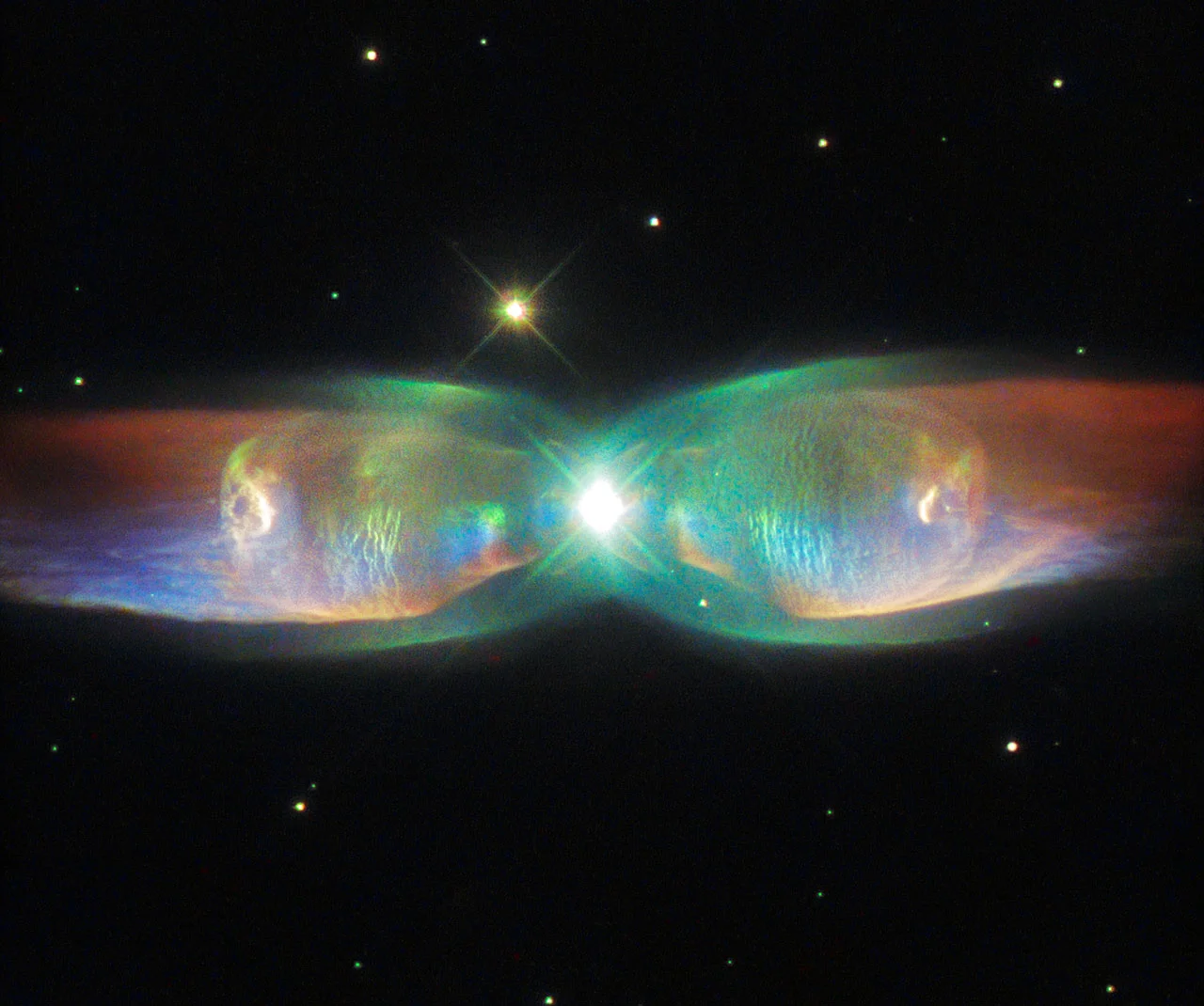 View larger ↗
95 / 100 · The changing lives of stars
The Twin Jet Nebula
Hubble Space Telescope
The two lobes of PN M2-9 expand from a central binary system, producing the nebula’s distinctive paired structure.
A reflection on God’s handiwork
Its mirrored form offers an invitation to contemplate companionship and the shapes it can inspire.
Image credit: ESA/Hubble & NASA Acknowledgement: Judy Schmidt
Image story & original downloads ↗CC BY 4.0 · Image resized and converted for web display; caption adapted from ESA/Hubble.
Back to gallery navigation ↑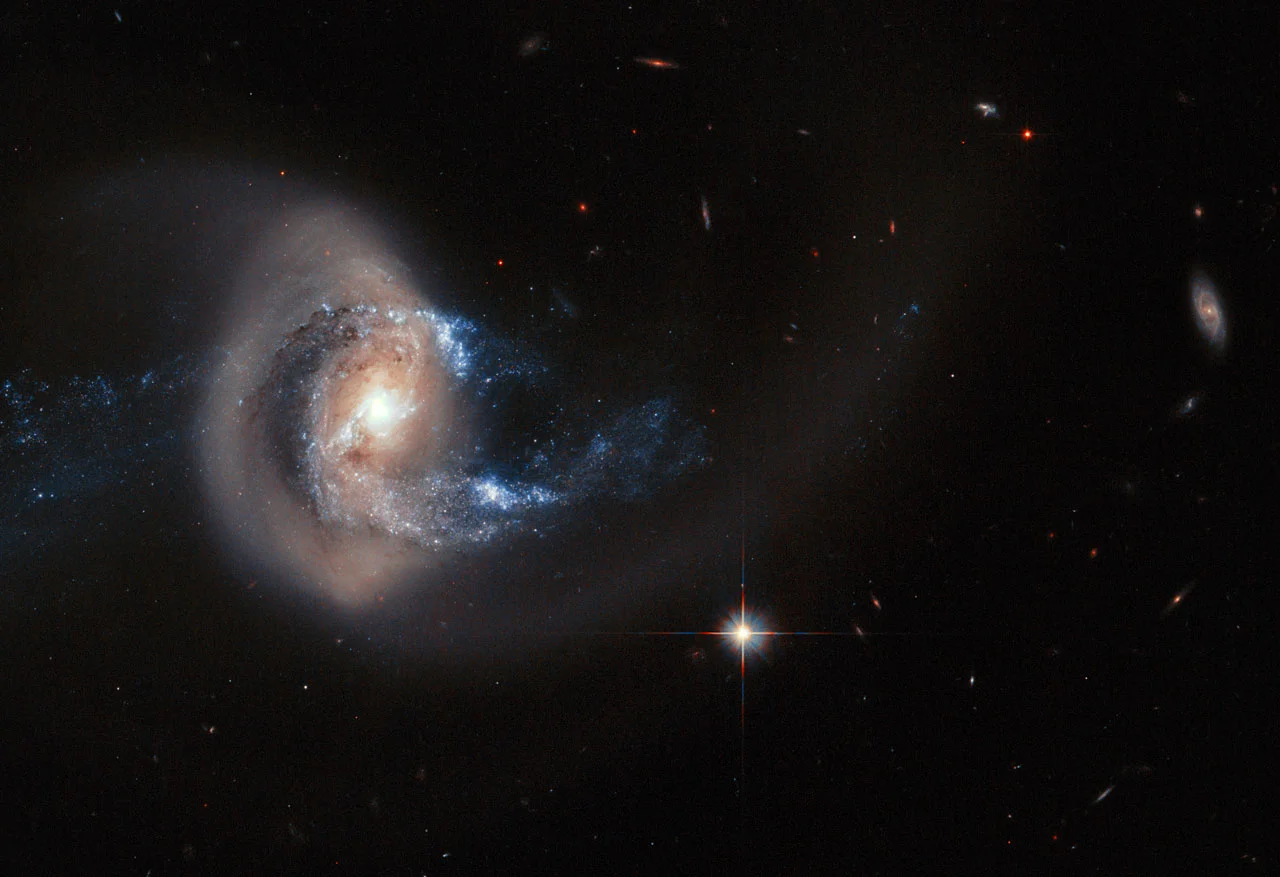 View larger ↗
96 / 100 · Galaxies beyond our own
The Disturbed Spiral NGC 7714
Hubble Space Telescope
An encounter with a smaller companion has stretched NGC 7714’s arms and produced a luminous, uneven structure around the galaxy.
A reflection on God’s handiwork
Transformation leaves visible traces, inviting thoughtful attention to the stories held by beauty.
Image credit: ESA, NASA Acknowledgement: A. Gal-Yam (Weizmann Institute of Science)
Image story & original downloads ↗CC BY 4.0 · Image resized and converted for web display; caption adapted from ESA/Hubble.
Back to gallery navigation ↑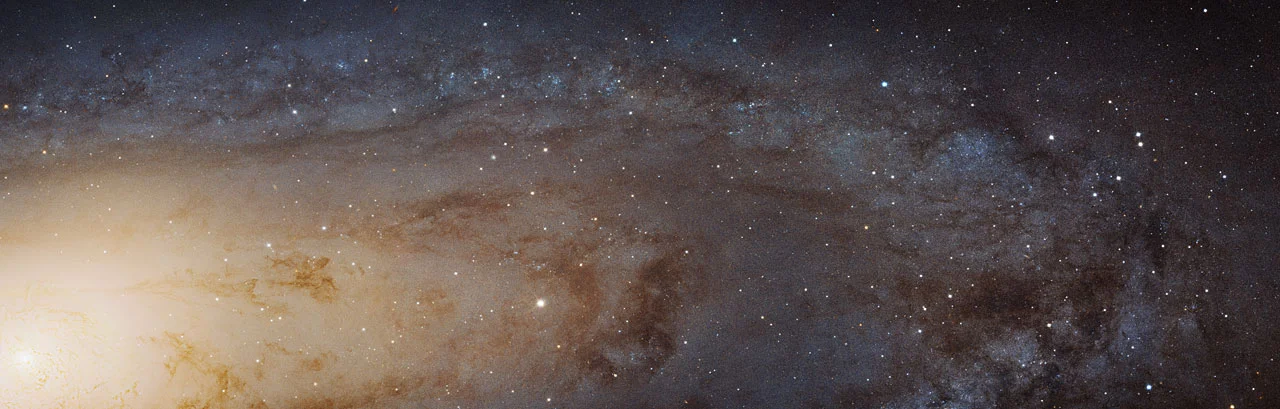 View larger ↗
97 / 100 · Galaxies beyond our own
A Panorama of Andromeda
Hubble Space Telescope
This sweeping view covers part of Andromeda’s stellar disk, resolving a vast population of stars and clusters within our neighboring galaxy.
A reflection on God’s handiwork
Countless individual lights remind us how much lies beyond what a distant glance can reveal.
CC BY 4.0 · Image resized and converted for web display; caption adapted from ESA/Hubble.
Back to gallery navigation ↑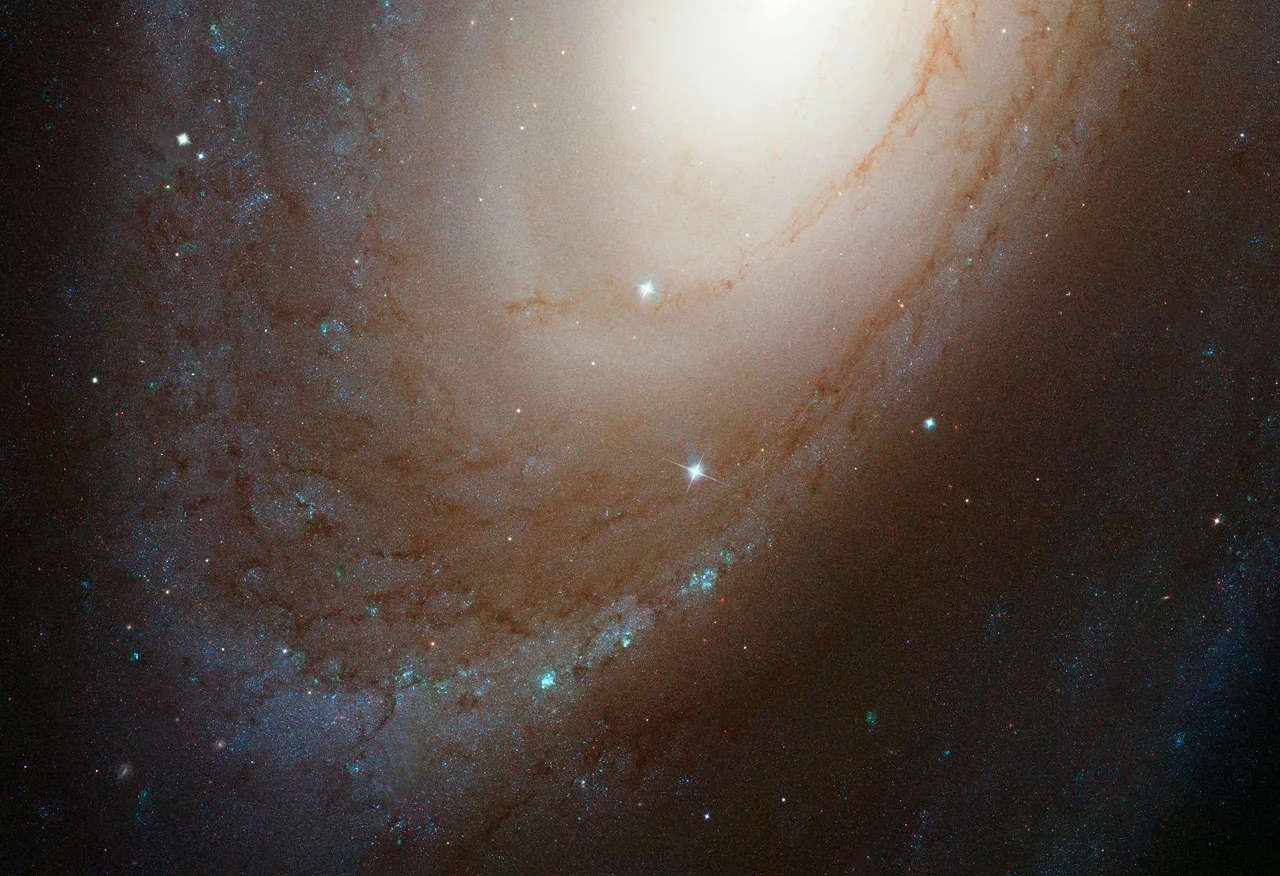 View larger ↗
98 / 100 · Galaxies beyond our own
The Spiral Galaxy Messier 81
Hubble Space Telescope
Hubble’s view of Messier 81 reveals a luminous central region and winding arms in a galaxy that hosted supernova 1993J.
A reflection on God’s handiwork
Its graceful outline invites gratitude for the richness of the heavens beyond our own galaxy.
CC BY 4.0 · Image resized and converted for web display; caption adapted from ESA/Hubble.
Back to gallery navigation ↑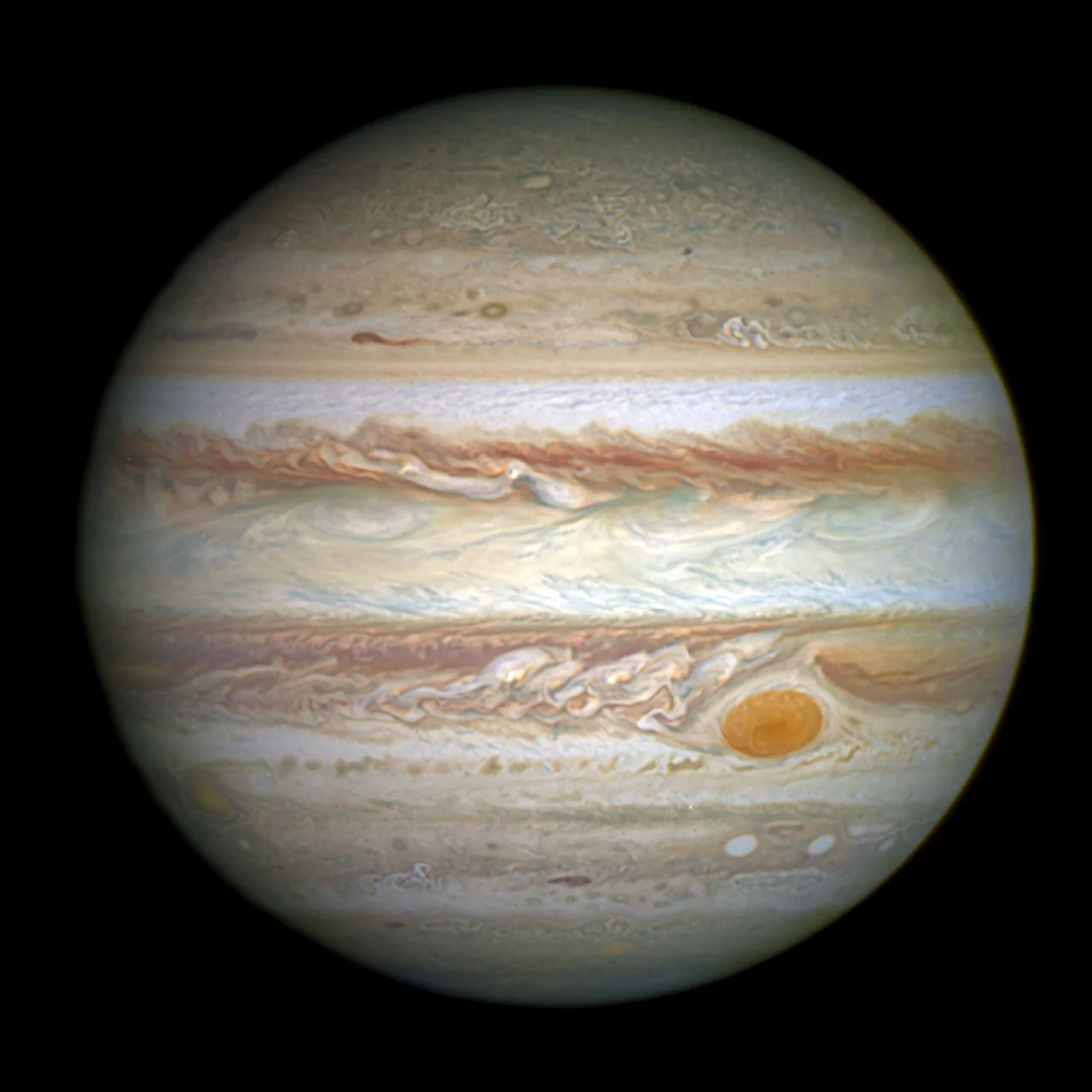 View larger ↗
99 / 100 · Our solar neighborhood
Jupiter’s Great Red Spot in 2014
Hubble Space Telescope
This full-disk Hubble observation from April 2014 records Jupiter’s atmospheric bands and the changing appearance of its Great Red Spot.
A reflection on God’s handiwork
A long-lived storm reminds us that enduring features can still be continually changing.
CC BY 4.0 · Image resized and converted for web display; caption adapted from ESA/Hubble.
Back to gallery navigation ↑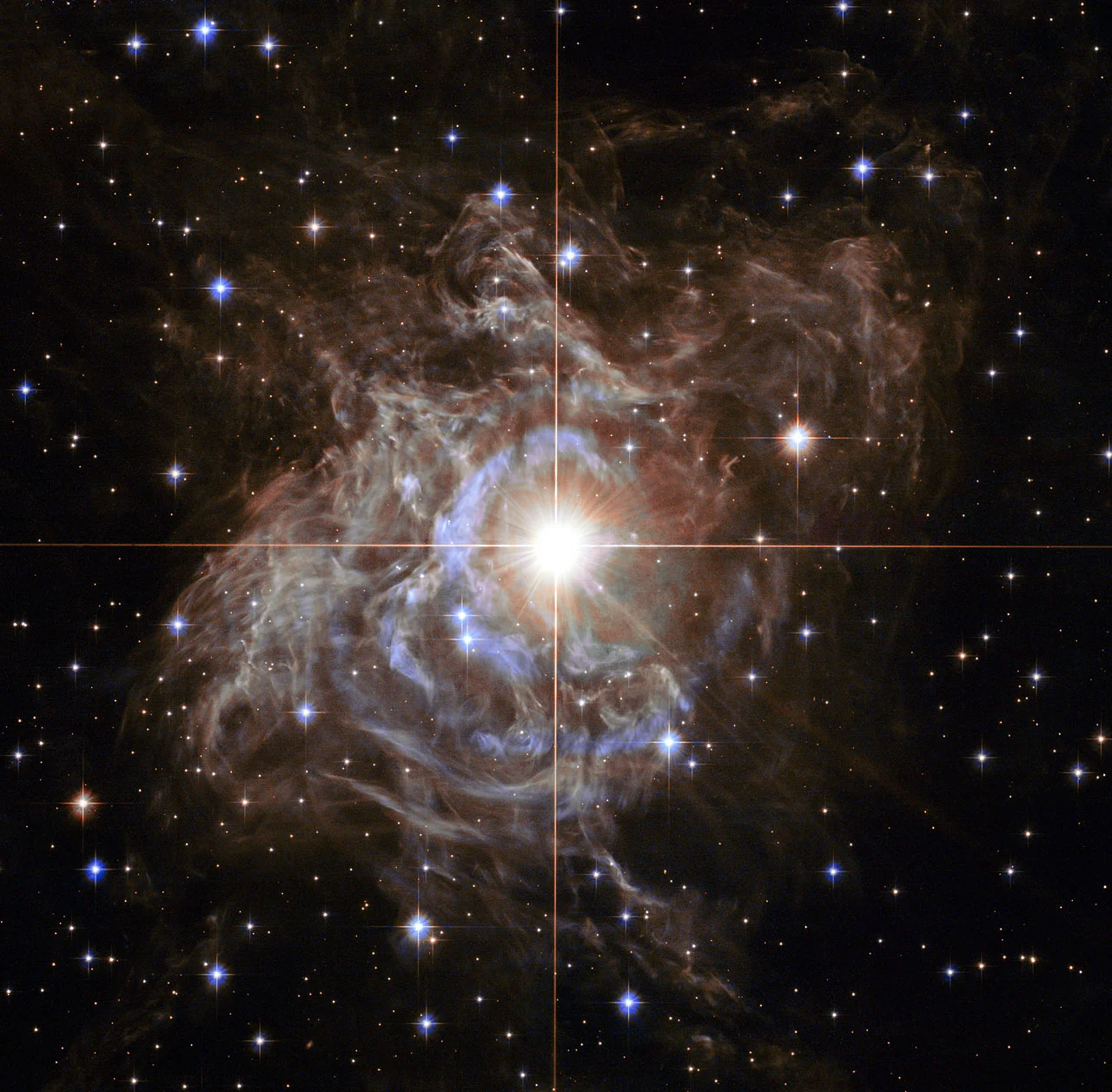 View larger ↗
100 / 100 · The changing lives of stars
The Light Echoes of RS Puppis
Hubble Space Telescope
The variable star RS Puppis changes brightness regularly, illuminating surrounding dust and producing striking light echoes in Hubble’s observations.
A reflection on God’s handiwork
Its changing radiance offers a meditation on rhythm, revelation, and the beauty of light.
CC BY 4.0 · Image resized and converted for web display; caption adapted from ESA/Hubble.
Back to gallery navigation ↑